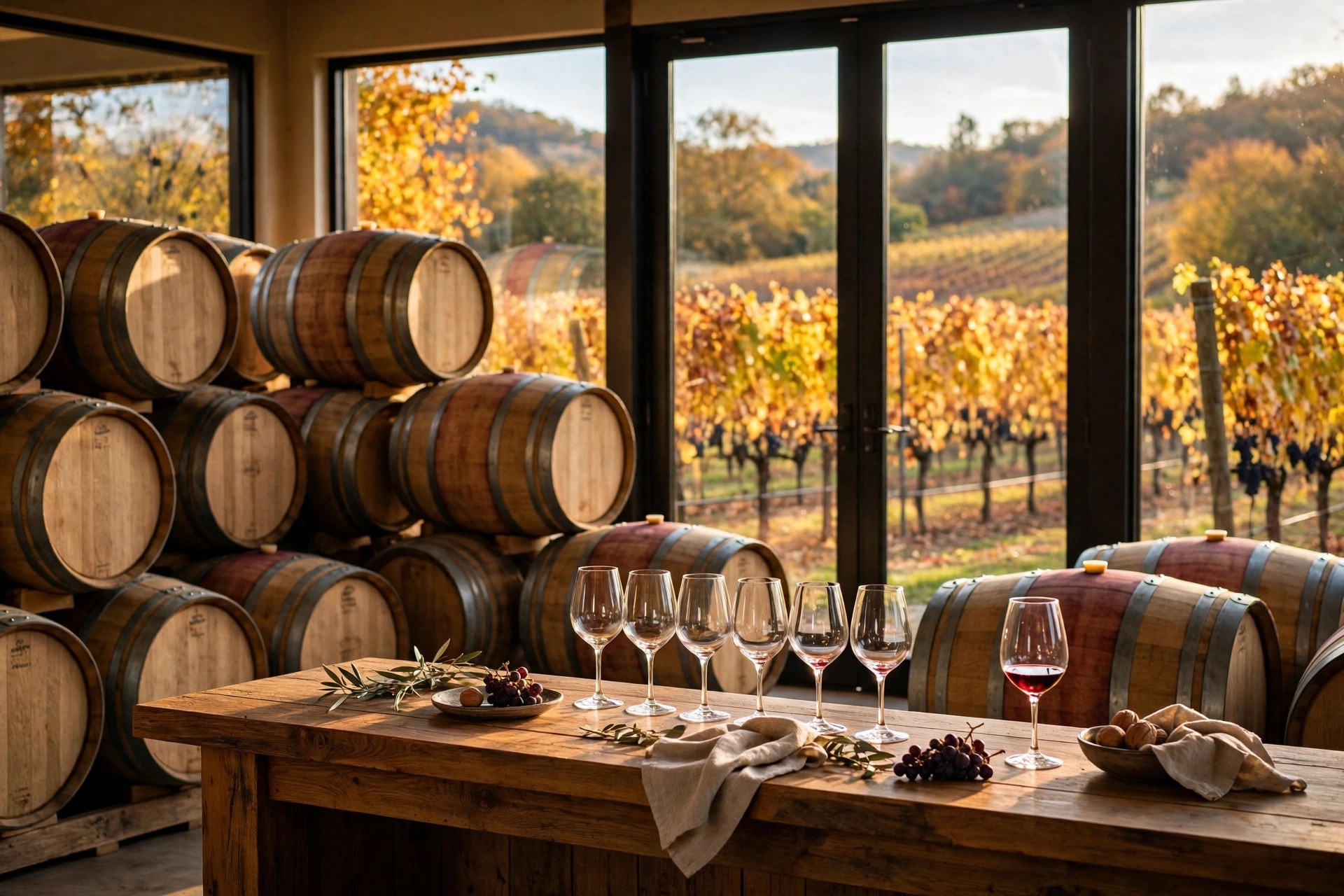
A winery is three businesses wearing one label: a farm, a factory, and a tasting room. The farm takes three to five years to produce a sellable crop. The factory needs tanks, presses, barrels, and a bottling line before the first vintage is ready. The tasting room is where the fattest direct-to-consumer margins live, but it needs a finished wine to sell. Every winery funding mistake comes from financing one of those three businesses as if it were the other two — borrowing short-term money for a vineyard that will not pay for years, or borrowing long-term money for a harvest that will be sold by Christmas.
The three doors: pick your production model first
Door one: custom crush or alternating proprietorship. You make wine under your own federal permit inside someone else's licensed facility, buying fruit and paying per-gallon processing fees. No building, no tanks, no bottling line to buy. This is how most successful small brands actually start, and it lands at 50,000 to 150,000 dollars to launch a label and bottle a first vintage of 1,000 to 2,000 cases. You prove the wine sells before you buy the factory.
Door two: your own production winery with purchased grapes. You lease or buy a modest production building, outfit it with used tanks and a press, and run a tasting room, while buying grapes each harvest. This runs 500,000 to 1,500,000 dollars for equipment, build-out, and licensing. You own the equipment and the lease and the compliance, and you skip the vineyard entirely.
Door three: the full estate. Planted vineyard, purpose-built cellar, hospitality facility. This is 2,000,000 to 5,000,000 dollars or more, and most of the money is dirt and concrete, not winemaking. Vineyard-ready land runs from about 13,750 dollars an acre in the Finger Lakes to 375,000 dollars or more an acre in prime Napa appellations, and a 20-acre vineyard alone can run 275,000 to 7,500,000 dollars for land plus 318,000 to 917,000 dollars to plant and establish, before a single building goes up. Add equipment and tasting-room build-out, and the estate path lands where it lands: two million and up, with three to five years before the vines produce a sellable crop.
The five cash demands of a winery
First, the fruit decision. The single largest swing in a winery budget is whether you grow your own fruit. Vineyard land runs 30,000 dollars an acre in an emerging region to well over 300,000 dollars an acre in a Napa AVA, and planting, trellising, and irrigating raw ground adds 25,000 to 50,000 dollars an acre before the first commercial crop, which arrives in year three or four. Buying fruit sidesteps all of that: wine grapes run 1,500 to 5,000 dollars a ton depending on variety and appellation, a ton yields roughly 60 to 70 cases of finished wine, and you buy exactly what you need this vintage with none of the multi-year capital lock-up.
Second, the cellar. One planning model's line items show the scale: fermentation tanks around 150,000 dollars, a grape press around 60,000 dollars, a bottling line around 120,000 dollars, and new oak barrels around 75,000 dollars. These are long-lived assets, and they are the classic equipment-financing fit: the asset secures the loan and the term matches its working life.
Third, the tasting room. A tasting room build-out is its own capital project — one model's tasting room construction runs around 250,000 dollars — and it is also the revenue engine that makes the rest of the business work. Direct-to-consumer sales through the tasting room carry the best margins in wine, and a tasting room that opens before the wine is ready is a room full of someone else's product.
Fourth, the compliance stack. The federal Alcohol and Tobacco Tax and Trade Bureau permit itself is free — there is no fee to apply for or maintain it, and most startups owe no wine bond either — but state licenses, label approvals, and the record-keeping around production and sales are real work, and the facility carries much of the compliance burden in a custom-crush arrangement. That compliance transfer is part of what the custom-crush fee buys.
Fifth, the working-capital valley. A winery spends all year — fruit, labor, barrels, bottles — and sells in bursts: tasting-room weekends, holiday clubs, release events. The valley between harvest spending and sales collection is where wineries borrow, and it is where the wrong product hurts most. A revenue-based advance fits a single fast gap with a defined collection event, such as a bottling run before a club release. A line of credit fits the harvest-to-sale float. Neither fits a vineyard planting, which will not repay for years.
Need working capital this week?
Apply Now →Free to apply · Soft credit check only · Funding in 24–72 hoursThe product map: what fits which need
Land and vineyard establishment belong in long-term, asset-backed financing — a term loan or SBA-backed loan, on a timeline of weeks to months, sized against the land value and the business plan, not against this year's tasting-room weekends. Cellar equipment fits equipment financing, where the tanks, press, and bottling line secure the loan. The tasting-room build-out fits a term loan, because a room that will serve for a decade should not be repaid in months. The harvest-to-sale float fits a line of credit, drawn at crush and repaid from release sales. A revenue-based advance fits only a single fast gap with a defined collection event — a bottling run, a label printing, a harvest contractor invoice due before the club shipment goes out. What does not fit is borrowing a vineyard on a short-term advance, or borrowing a tasting room on a product whose debits do not pause for the winter slow season.
What lenders check on a winery file
Underwriting starts with the production model, because the three doors are three different risk profiles. A custom-crush brand is underwritten on the owner's history, the label's sales, and the crush agreement. A production winery is underwritten on the facility, the equipment, and the tasting-room revenue. An estate is underwritten on the land, the vines, and a plan that survives three to five pre-revenue years. For fast working-capital products, three months of business bank statements are the core document, and they show the seasonality plainly: the harvest spend, the release spike, the winter trough. A photo ID and a voided check may be requested as optional verification items, but they are not upfront requirements for getting a quote. For larger term loans, expect tax returns, financial statements, and — for land — an appraisal.
Three mistakes wineries make when borrowing
Buying the estate before proving the brand. Spending two million dollars to answer a question a custom-crush vintage could answer for under 150,000 dollars is the most expensive mistake in wine. Prove the wine sells first, then buy the dirt.
Financing the vineyard on short-term money. Vines do not produce a sellable crop for three to five years. Any product that repays in months cannot be repaid by a vineyard, and the refinance conversation that follows is always worse than the original loan would have been.
Opening the tasting room with nothing to pour. A tasting room is a margin machine only when it pours your wine. Opening it on borrowed money before the first vintage is bottled means paying rent and staff to sell someone else's product at someone else's margin.
Frequently asked questions
Can a winery get a business loan?
Yes. Wineries qualify for lines of credit, revenue-based advances, equipment financing, and term loans through third-party funders, based on the production model, deposits, tasting-room revenue, and the asset file. A custom-crush brand is underwritten very differently from a full estate.
What do lenders check for winery funding?
The production model first: custom crush, purchased-grape production, or full estate are three different risk profiles. Then deposits and seasonality — the harvest spend, the release spike, the winter trough — plus the land and equipment where a term loan is involved.
How fast can a winery get funded?
Revenue-based products typically fund in 24 to 72 hours from a complete application, once bank statements are verified. Equipment financing takes days to weeks, and SBA-backed loans for acquisitions or build-outs take longer.
Is a merchant cash advance good for a winery?
It can be, for a single fast gap with a defined collection event, such as a bottling run before a club release. For a vineyard planting or a tasting-room build-out, it does not fit — vines take three to five years to fruit and a room that serves for a decade should not be repaid in months.
What documents does a winery need to apply?
Recent business bank statements, typically the last three months, are the core requirement. A photo ID and a voided check may be requested as optional verification items, but they are not upfront requirements for getting a quote. A crush agreement, grape contracts, or equipment quotes help where available.
How much funding can a winery get?
It depends on revenue, seasonality, and the product: revenue-based advances are usually sized as a multiple of monthly revenue, while lines, equipment loans, and term loans depend on the broader file. Ask for the total repayment in dollars before accepting any offer. A custom-crush label launches around 50,000 to 150,000 dollars, a production winery with purchased grapes runs 500,000 to 1,500,000 dollars, and a full estate runs 2,000,000 dollars or more.
The best offer is the one you compare
Get a no-obligation quote from our #1-ranked lender, Coast to Coast Fast Funding — $5K to $5M, MCA and revenue-based products that fund in 24–72 hours with soft-pull-only applications. We shop 75+ lenders so you can compare the true cost of every offer side by side.Apply Now →Soft credit check · 60-second pre-qualification · (352) 809-3201