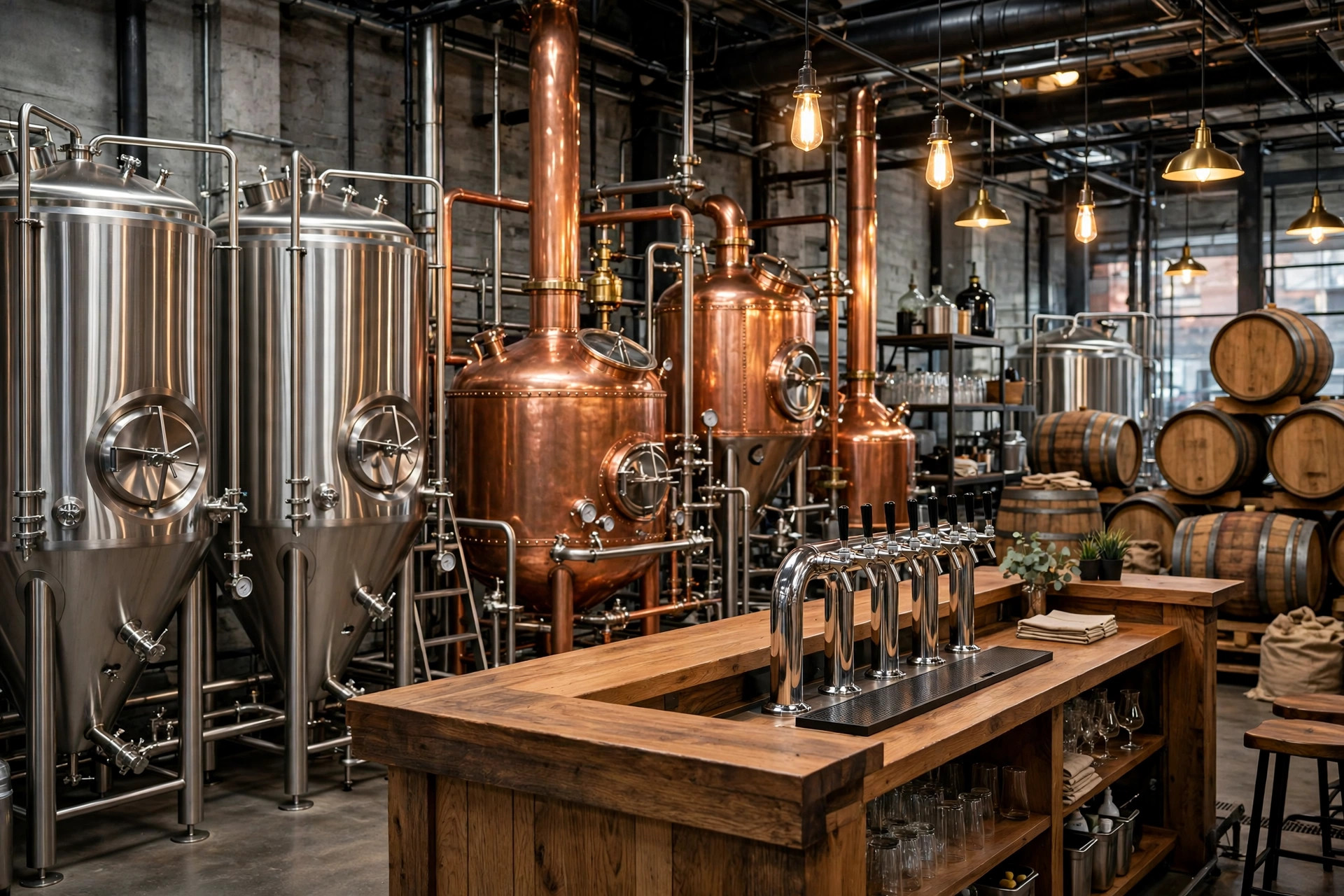
Breweries look simple from the taproom — steel tanks in the back, a bar up front, a flight on the table — but the business underneath is one of the most capital-intensive in food and beverage. The equipment eats more than half the budget, the licenses take months, and the revenue ramp is slow enough that running out of cash in month four is one of the most common reasons early breweries close. This guide covers what breweries actually borrow for, what opening, buying, or expanding one costs in 2026, and which product fits each need.
The funding map for a brewery splits into five buckets: opening a brewpub or taproom, building a production brewery, buying an existing brewery, adding packaging and distribution, and funding the working-capital ramp. Each bucket has a different best product, and the single most important underwriting fact in all five is the license timeline: federal and state permits take several months, and no funding plan should schedule a grand opening before every permit is in hand.
What breweries borrow for
Opening a brewpub or taproom. The most common first funding need. A small brewpub or taproom brewery runs $100,000 to $300,000 in published planning estimates, with the brewhouse, the taproom build-out, and the licensing timeline as the three variables that move it most. Taproom sales carry the highest margin in the business — a pint sold over your own bar keeps far more of the dollar than a can sold through a distributor — which is why the taproom is the engine of the early file.
Building a production brewery. The capital-heavy route. A small commercial microbrewery runs $200,000 to $500,000, a growing production brewery $400,000 to $1,000,000 or more, and a regional production brewery $800,000 to $2,000,000 or more. The money goes to the brewhouse, fermentation capacity, glycol and utilities, and the packaging line — and to the working capital for the 6 to 12 months before revenue stabilizes.
Buying an existing brewery. Acquisitions are common and often smarter: the brewery comes with a license in hand, a taproom with regulars, distributor relationships, and equipment already installed. Funding is usually an SBA loan or a term loan underwritten on the brewery's historical cash flow — and on the license: a brewery whose federal and state permits transfer cleanly is worth materially more than one whose buyer must restart the months-long application.
Adding packaging and distribution. The growth investment. A manual or semi-automatic canning line runs $40,000 to $80,000, an automatic line $150,000 to $400,000, and the keg fleet and delivery vehicle add more. Cans and kegs turn taproom traffic into wholesale volume — but wholesale carries thinner margins and distributor terms, so funders underwrite the distribution layer more conservatively than the taproom layer.
Funding the ramp. The working-capital need every brewery plan underestimates. Equipment and build-out get the attention, but the payroll, ingredients, packaging, and utilities for the first 6 to 12 months — before revenue stabilizes — are what keep the doors open. One published 2026 financial model puts operating break-even at month 14, which is why a working-capital buffer sized to more than a year is the difference between a brewery that survives its ramp and one that does not.
What a brewery actually costs in 2026
| Cost item | Published 2026 planning range | What drives it |
|---|---|---|
| 3-barrel nanobrewery equipment (total) | $78,000–$122,000 | Brewhouse, 4 fermenters, chiller, pumps and fittings |
| 7-barrel microbrewery equipment (total) | $203,000–$335,000 | Brewhouse, 6–8 fermenters, glycol, packaging, auxiliary |
| 15-barrel production equipment (total) | $580,000–$950,000 | Automated brewhouse, 10–12 fermenters, canning line, kegging |
| Basic 3-barrel brewhouse alone | $30,000–$100,000 | Vessel count, automation, heating method |
| 15-barrel production brewhouse alone | $200,000+ | Automation, vessel count, capacity |
| Canning line (manual / semi-automatic) | $40,000–$80,000 | Speed (10–20 cans per minute), seamer, date coding |
| Canning line (automatic) | $150,000–$400,000 | Speed (30–60 cans per minute), automation |
| Facility build-out (plumbing, drainage, electrical, HVAC) | $50,000–$300,000 | Condition of the space, taproom scope |
| Licenses and permits (federal TTB, state, local) | Several thousand dollars, several months | State liquor license cost and processing time vary widely |
| Total small microbrewery startup | $250,000–$1,000,000+ | Published guide range; scale and market drive the spread |
These are planning ranges from published 2026 guides, not lender terms or quotes. Two notes matter for funding: brewing equipment is 50 to 70 percent of the budget in most builds, so used equipment from a brewery that is upgrading or closing can cut the number substantially — budget for inspection and retrofitting — and the license timeline is a permitting risk that can delay an opening by months, so funders want to see permits in hand before they fund construction.
How a brewery actually makes money
Funders underwrite a brewery on three revenue layers, and the mix between them changes the file's risk profile.
Taproom sales. The margin layer: pints, flights, and merchandise sold over your own bar, at the highest margin per ounce in the business. A brewery with a strong, growing taproom underwrites better, because the funder is underwriting cash the brewery controls directly — no distributor, no retailer, no terms.
Packaged and wholesale sales. The volume layer: cans and kegs sold through distributors and retailers. It scales the brand beyond the taproom, but it carries thinner margins, distributor terms, and retailer concentration — a lost chain account hurts, so funders discount concentration in any single distributor or account.
Events, private parties, and taproom extras. The stability layer: trivia nights, live music, private events, food partnerships, and merchandise. These fill the taproom on off-peak nights, which is nearly pure margin once the space is already paid for — and they prove the brewery is a destination, not just a production floor.
The cost side is dominated by equipment and occupancy. The brewhouse, tanks, chiller, and packaging line are the largest capital outlay, and rent plus build-out is often the largest single line once the full occupancy cost is counted — which is why funders want the location search framed around total occupancy cost, not just square footage, and why a brewery that owns its building underwrites differently from one on a short lease.
Which product fits which brewery need
| Your need | Best first product | Why |
|---|---|---|
| Open a brewpub or taproom brewery | SBA 7(a) loan | Long term for a capital-heavy build with a slow ramp |
| Build a production brewery | SBA 7(a) or 504 loan | 504 fits owner-occupied real estate; long term matches equipment life |
| Buy an existing brewery | SBA 7(a) loan | Underwritten on the brewery's historical cash flow and license status |
| Brewhouse, tanks, or canning line | Equipment financing | The machines secure the loan; term matches equipment life |
| Taproom expansion or second location | Term loan | Defined investment, payments matched to the ramp |
| Bridge the 6–12 month revenue ramp | Line of credit | Draw only what the ramp requires, repay as taproom sales stabilize |
| Bridge a slow season or an emergency repair | Revenue-based funding or line of credit | Funds in days — sized small, for a short gap only |
Opening, buying, or expanding a brewery? See what you qualify for
From the first brewhouse to the canning line — get a no-obligation quote from our #1-ranked lender, Coast to Coast Fast Funding. One application reaches multiple funders, so you see the actual market for your file.
Apply Now →Soft credit check · 60-second pre-qualification