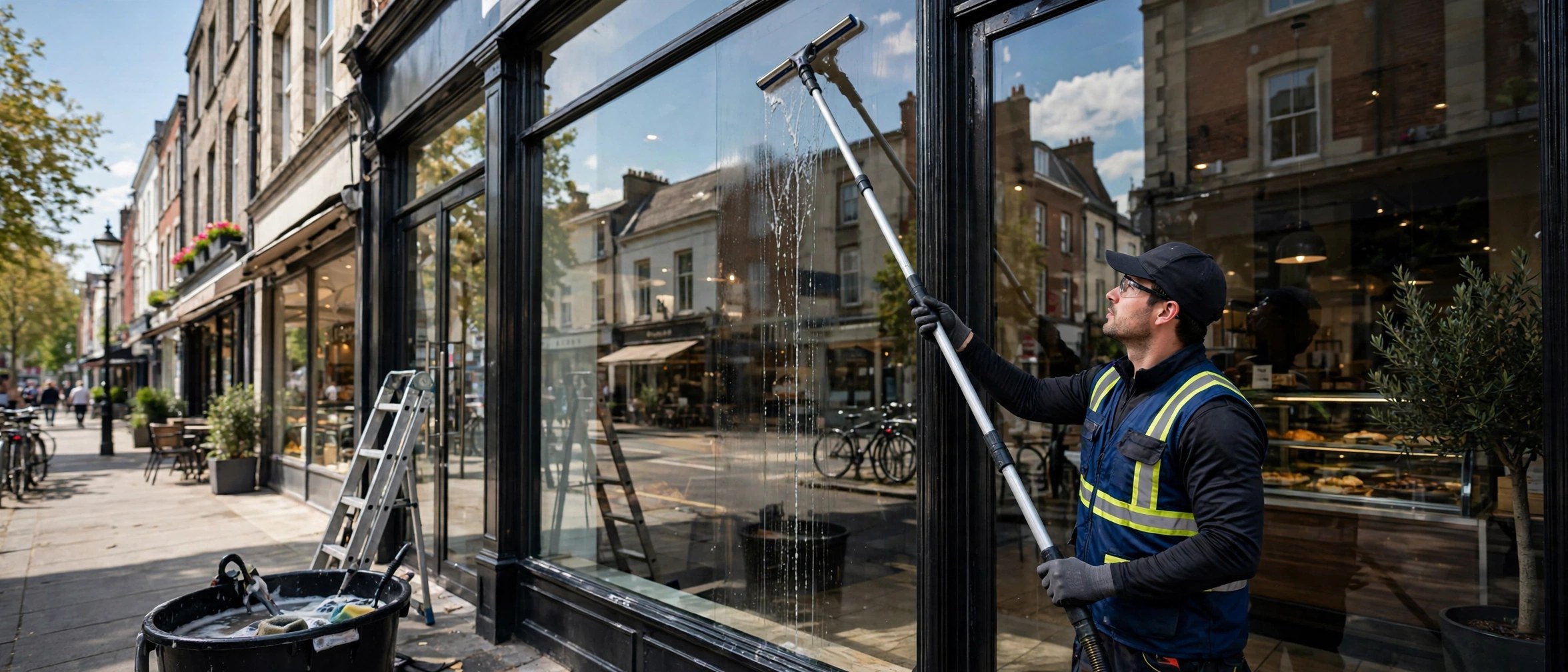
Window cleaning is the cheapest real trade to enter and one of the few where the product itself is the marketing: clean glass sells the next job. A solo operator with a vehicle can start for about 1,000 dollars in equipment, licenses, and insurance, and the whole business turns on one distinction — residential jobs pay per visit, commercial jobs pay per month. The operators who build a route of storefronts and offices on monthly contracts own a business; the operators who chase one-off houses own a job list.
The startup tiers: squeegee, pole, or franchise
The basic kit is a few hundred dollars: squeegees and scrubbers at 50 to 100 dollars for decent gear, buckets, towels, and a ladder, for 400 to 700 dollars all-in if you shop carefully. A water-fed pole system — purified water, a telescoping pole, a brush head — moves you from ground-floor storefronts to second- and third-story glass without a ladder, and it is the first real equipment step. A full setup with a van, a pole system, and a pressure washer for add-on work runs into the low thousands. The franchise path is a different business: the best-known brand lists a 40,000-dollar franchise fee and a total initial investment of roughly 136,000 to 306,000 dollars, with at least 50,000 dollars in liquid capital required.
Licensing is light — register the business, check state rules, carry liability insurance before the first job — and general liability for window cleaners runs a median of about 78 dollars a month. That lightness is the opportunity and the trap: anyone can start, so the route, the reviews, and the contract book are the moat, not the equipment.
The pricing ladder: homes, storefronts, and towers
Homes are quoted by the window or by the pane — a pane is one sheet of glass, so a two-pane window counts twice — with a minimum charge and add-ons. A typical US home window cleaning runs 150 to 302 dollars, averaging 221 dollars, or about 10 dollars per window; a single pane runs 4 to 15 dollars, and 2026 cost guides put residential rates at roughly 8 to 16 dollars per window inside and out, or 4 to 8 dollars per pane for exterior-only work. Most companies set a minimum job fee of 100 to 250 dollars, and the add-ons stack: screens at 2 to 5 dollars, tracks at 3 to 6 dollars a window, hard-water stain removal at 20 to 75 dollars or more. Third- and fourth-floor windows cost 3 to 5 dollars more per window, and the outside alone is usually about 80 percent of an inside-and-out price.
Storefronts are a different sale. A small storefront pays 40 to 75 dollars a visit on a regular route, a weekly route stop takes about 20 minutes, and commercial jobs often run 50 to 100 dollars an hour. A shop, a restaurant, or an office cleaned every two or four weeks is a small ticket that comes back every month, and twenty such stops are a route: predictable, dense, and routable in a single day. Large buildings and high-rise panes are priced by the hour — up to 85 dollars an hour, and 170 dollars an hour for the two-person crew that safety requires — and commercial properties can also be priced by the square foot at 10 to 35 cents.
The route is the business
The route math is what separates a living from a hobby. A residential operator billing 40 to 75 dollars an hour needs a full calendar to make the month; a route operator with forty storefronts at 50 dollars a visit on a two-week cycle has 4,000 dollars a month before a single house is booked. Commercial contracts also smooth the season: window cleaning slows in winter in cold climates, and a route of monthly contracts carries the operator through the months when residential calls thin out. Add-ons extend the route without extending the drive — gutters, solar panels, pressure washing, screen repair — each sold to a customer already on the calendar.
Contracts deserve the same care as the glass. A commercial agreement should state the scope — inside, outside, or both — the frequency, the price per visit, the payment terms with payment due within 30 days, and the late-payment terms. Quarterly or biannual packages for residential customers do the same job on a smaller scale: they convert a one-off clean into a calendar.
Need working capital this week?
Apply Now →Free to apply · Soft credit check only · Funding in 24–72 hoursThe product map: what fits which need
A water-fed pole system, a van, or a pressure washer is an equipment purchase, and equipment financing fits it: the asset secures the loan and the term can match its working life. A business line of credit fits the float between the work and the payment — the purified-water system, the ladder rack, the crew payroll in a month when two office contracts pay on net-30 — because the draw rises and falls with the route. A revenue-based advance fits a single fast gap with a defined collection event, such as a pole system for a new office-park contract that starts Monday, not a whole fleet. A term loan fits the full expansion budget — a second crew, a second van, a shop — because those costs pay back over years. A franchise opening, at six figures, usually needs the term-loan or SBA-backed route.
What funders check on a window cleaning file
Funders underwrite the route, not the squeegee. They want the deposit history, the contract book — how many storefronts and offices on monthly or biweekly contracts, at what per-visit price — the insurance binder, and the equipment file. A route with signed commercial contracts underwrites very differently from a list of one-off houses, because the contracts are the closest thing this business has to recurring revenue. A new operator with a pole system, a signed office contract, and a booked route reads better than a new operator with a van and a hope.
Frequently asked questions
Can a window cleaning business get a business loan?
Yes. Window cleaning businesses qualify for lines of credit, revenue-based advances, equipment financing, and term loans through third-party funders, based on deposits, time in business, the equipment file, and above all the signed contract book. A route with monthly storefront and office contracts underwrites very differently from a list of one-off houses.
What do lenders check for window cleaning funding?
The contract book first — how many storefronts and offices on monthly or biweekly contracts, at what per-visit price — then the equipment file, the insurance binder, and the deposit history. A solo start runs about 1,000 dollars with a vehicle you own, while a franchise opening runs roughly 136,000 to 306,000 dollars.
How fast can a window cleaning business get funded?
Revenue-based products typically fund in 24 to 72 hours from a complete application, once bank statements are verified. Equipment financing takes days to weeks, and SBA-backed loans for acquisitions or build-outs take longer.
Is a merchant cash advance good for a window cleaning business?
It can be, for a single fast gap with a defined collection event, such as a pole system for a new office-park contract that starts Monday while the existing route already pays monthly. For a second crew and a second van it does not fit — durable expansion should not be repaid in months.
What documents does a window cleaning business need to apply?
Recent business bank statements, typically the last three months, are the core requirement. A photo ID and a voided check may be requested as optional verification items, but they are not upfront requirements for getting a quote. Equipment quotes, the insurance binder, and any signed commercial contracts or route lists help where available.
How much funding can a window cleaning business get?
It depends on revenue, seasonality, and the product: revenue-based advances are usually sized as a multiple of monthly revenue, while lines, equipment loans, and term loans depend on the broader file. Ask for the total repayment in dollars before accepting any offer. A solo start runs about 1,000 dollars, a full setup with a van and a pole system runs into the low thousands, and a franchise opening runs roughly 136,000 to 306,000 dollars.
The best offer is the one you compare
Get a no-obligation quote from our #1-ranked lender, Coast to Coast Fast Funding — $5K to $5M, MCA and revenue-based products that fund in 24–72 hours with soft-pull-only applications. We shop 75+ lenders so you can compare the true cost of every offer side by side.Apply Now →Soft credit check · 60-second pre-qualification · (352) 809-3201