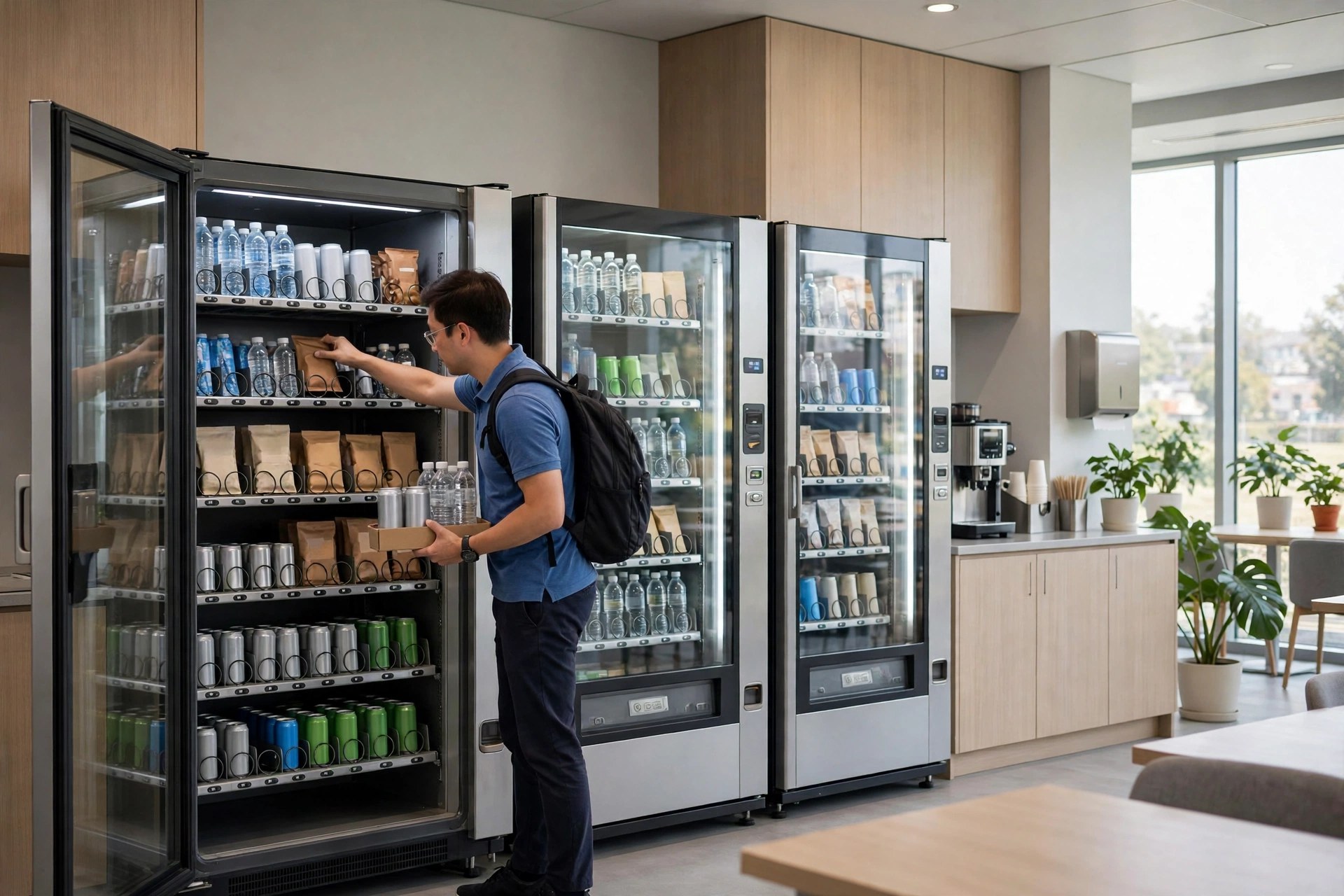
The location is the business
A vending machine business is one of the few semi-passive businesses a beginner can actually start, but only if it is treated like a route, not a single machine. The machine is not the business; the location is. The same machine that nets 40 dollars a month in a 30-person office can net 400 dollars a month in a 24-hour gym, and every number in this guide flows from that fact. A well-placed machine generates roughly 200 to 800 dollars a month in revenue, with product costs running 40 to 50 percent, leaving roughly 100 to 400 dollars a month in gross profit per machine before location commission and maintenance. A typical placement grosses roughly 150 to 700 dollars a month, a strong one 700 to 1,500 dollars, and a top-tier site such as a hospital or a 24-hour plant can pass 2,000 dollars. After product, commission, card fees, mileage, and upkeep, well-run machines keep roughly 20 to 35 percent of sales as net profit.
The startup tiers follow the same logic. A single-machine side income runs 3,000 to 8,000 dollars all-in: a new snack or combo machine at 2,000 to 5,000 dollars, or a refurbished machine at 1,000 to 3,000 dollars, plus 200 to 500 dollars of initial inventory. A realistic lean start is one or two used machines for under 4,000 dollars all-in. A serious start with one or two smart machines runs 8,000 to 15,000 dollars. A fast start of three to five machines runs 20,000 to 50,000 dollars. Average break-even runs 6 to 18 months, and a 20-machine route averaging 300 dollars a month per machine produces about 72,000 dollars a year in revenue and 20,000 to 30,000 dollars in profit, serviced in 8 to 12 hours a week. One machine is a side income; ten good ones is a real business.
Commission, cashless, and the real profit formula
Location commission is the line that surprises new operators, because it comes out of sales before profit and every point lands directly on net margin. Property owners who provide vending locations typically charge 10 to 25 percent of gross machine revenue, with prime locations such as hospitals, universities, and large offices commanding the top end, though published ranges run from 5 to 25 percent depending on the source and the site. On a machine generating 600 dollars a month, a 20 percent commission costs 120 dollars a month, or 1,440 dollars a year, and at a 40 to 50 percent gross margin before commission, the commission alone consumes 25 to 50 percent of profit per machine. The structures vary: a percentage of gross is most common and aligns incentives, a flat monthly rent of 50 to 200 dollars is better for high-performing machines and worse for underperformers, and a minimum guarantee plus percentage is the worst for operators because the minimum is owed even in slow months.
Cashless payment is no longer optional. About 84 percent of vending transactions were cashless in 2026, and a cash-only machine gives up 30 to 40 percent of potential revenue. A card reader runs 50 to 200 dollars, and telemetry software runs 40 to 100 dollars a month per machine, but the telemetry pays for itself in fewer wasted trips: it reports stock levels and sales remotely, so the operator restocks what sold instead of driving a route to look. The worked example makes the formula concrete: on a 1,200-dollar-a-month machine, product at 45 percent takes 540 dollars, commission at 12 percent takes 144 dollars, and the remaining costs leave roughly 330 dollars a month in net profit, about 27.5 percent. At 600 dollars gross the same math leaves roughly 160 dollars net; at 3,000 dollars gross it leaves roughly 825 dollars. Use the net numbers when modeling, not the gross product margins quoted online, which ignore commission, fuel, route wear, and the operator's own time.
Need working capital this week?
Apply Now →Free to apply · Soft credit check only · Funding in 24–72 hoursThe product map: what fits which need
Equipment financing fits the machines themselves: a snack machine, a beverage machine, or a combo unit is an identifiable asset with a working life measured in years, so the term can match the asset, and some new machines are even offered with 0 percent APR financing. A business line of credit fits the route-building rhythm: inventory bought ahead of a new placement, a second machine for a site that proved itself, the fuel and restocking float between collection cycles. Revenue-based advances fit a single fast gap with a defined collection event, such as landing a hospital or university placement that needs three machines installed before the contract start date while existing machines are already paying monthly. A term loan fits the full route acquisition: buying an existing route of 10 to 30 machines, a delivery vehicle, and the working capital to run it. What does not fit is funding a whole route on a daily-debit advance repaid from machines that have not been placed yet — the route pays back over years, and daily debits do not pause while locations are still being signed.
What funders check on a vending file
Three months of business bank statements are the core document for an existing operator, and a new operator's file turns on the machine quotes, the location agreements, and the route plan. Lenders weight the location agreements above almost everything else, because an unsigned route is a hope and a signed route is revenue: show the sites, the headcounts, the commission terms, and the expected restocking cadence, and the file underwrites itself. They also look at time in business, deposit consistency, existing advance positions, and — for larger term loans — broader financials. Card sales settle to the bank within days, while location commissions are usually paid monthly in arrears, so a file that shows the settlement timing honestly reads better than one that pretends every dollar arrives at once. Credit matters less for revenue-based products than deposit health does, but it still moves the price. If a funder will not put the total repayment in dollars in writing, that is the offer to walk away from, whatever the headline rate sounds like.
One practical note for new operators: start with the location, not the machine. A signed agreement with a 200-person office, a gym, or a manufacturing floor is worth more than a discounted machine with nowhere to go, and it is the document that turns a vending idea into a fundable business. Buy the machine after the site is signed, not before.
Frequently asked questions
Can a vending machine business get a business loan?
Yes. Vending businesses qualify for lines of credit, revenue-based advances, equipment financing, and term loans through third-party funders, based on deposits, time in business, the machine file, and above all the signed location agreements. A route with signed sites underwrites very differently from machines with nowhere to go.
What do lenders check for vending machine funding?
The location agreements first — the sites, the headcounts, and the commission terms — then the machine quotes, the restocking cadence, and the settlement timing. A single-machine start runs 3,000 to 8,000 dollars, while a fast start of three to five machines runs 20,000 to 50,000 dollars.
How fast can a vending machine business get funded?
Revenue-based products typically fund in 24 to 72 hours from a complete application, once bank statements are verified. Equipment financing takes days to weeks, and SBA-backed loans for acquisitions or build-outs take longer.
Is a merchant cash advance good for a vending machine business?
It can be, for a single fast gap with a defined collection event, such as installing three machines for a hospital placement before its contract start date while existing machines already pay monthly. For a whole route it does not fit — the route pays back over years.
What documents does a vending machine business need to apply?
Recent business bank statements, typically the last three months, are the core requirement. A photo ID and a voided check may be requested as optional verification items, but they are not upfront requirements for getting a quote. Machine quotes, signed location agreements, and the route plan help where available.
How much funding can a vending machine business get?
It depends on revenue, seasonality, and the product: revenue-based advances are usually sized as a multiple of monthly revenue, while lines, equipment loans, and term loans depend on the broader file. Ask for the total repayment in dollars before accepting any offer. A single machine runs 3,000 to 8,000 dollars all-in, a lean start with one or two used machines runs under 4,000 dollars, and a fast start of three to five machines runs 20,000 to 50,000 dollars.
The best offer is the one you compare
Get a no-obligation quote from our #1-ranked lender, Coast to Coast Fast Funding — $5K to $5M, MCA and revenue-based products that fund in 24–72 hours with soft-pull-only applications. We shop 75+ lenders so you can compare the true cost of every offer side by side.Apply Now →Soft credit check · 60-second pre-qualification · (352) 809-3201