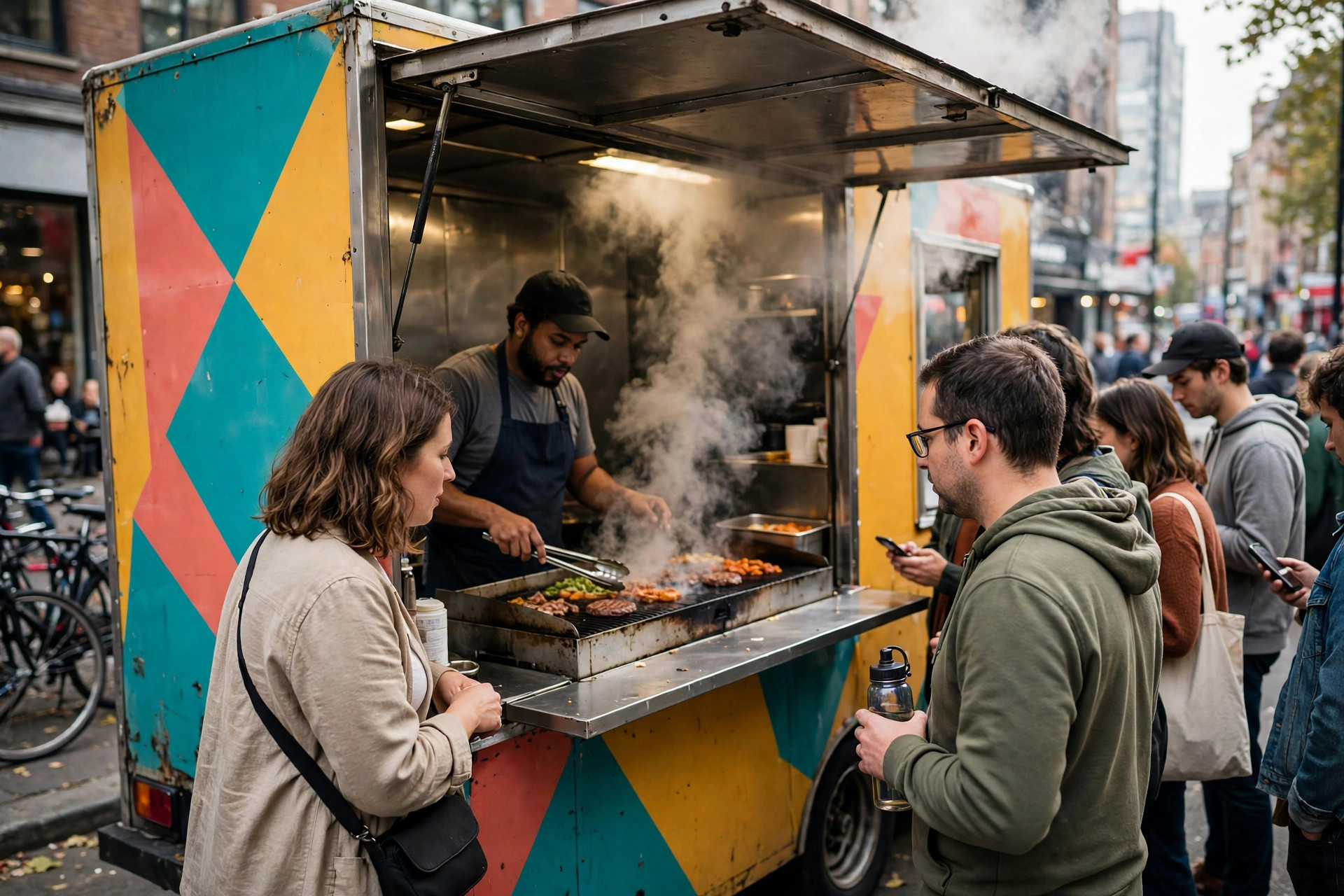
Food trucks run on a different economy than restaurants. The kitchen moves, the dining room is a sidewalk, and the biggest bill — the truck itself — arrives before the first customer orders. This guide covers what food truck owners actually borrow for, what those builds cost in 2026, which product fits each need, and what funders weigh on a food truck file.
The food truck model is equipment-heavy and permit-heavy: the vehicle, the commercial kitchen inside it, the commissary kitchen it must return to, and the stack of city permits that make it legal to park and serve. That is why food truck funding looks different from restaurant funding — the money goes into a rolling asset, the compliance around it, and the working capital to survive the first slow months.
What food truck owners borrow for
The truck or trailer. The single biggest capital outlay, and the one that sets everything else. A used truck, a new custom build, or a converted trailer — each has a different price, lead time, and financing profile.
Kitchen equipment. Fryers, griddles, refrigeration, generators, exhaust hoods, and POS hardware. Equipment-heavy menus (frying, grilling) cost far more to fit out than prepackaged or coffee concepts.
Commissary and parking. Most states require a licensed commissary kitchen for prep, storage, and waste disposal, plus a legal overnight parking spot. Both are monthly costs that funders want to see budgeted, not discovered.
Permits and licensing. Health permits, fire safety permits, vendor licenses, and mobile food permits — per city, and sometimes per event. Permit costs vary enormously by market, and multi-city routes multiply them.
Opening runway. The cost most new owners skip: 2 to 3 months of food, fuel, commissary, and labor while the customer base builds. Published 2026 operator budgets put a realistic first-year expense total near $167,000 for a single well-run truck, and most operators do not turn a profit in year one.
A second truck or a brick-and-mortar step. A second unit for events and catering, or the leap from truck to storefront. These are term-loan or SBA territory when the timeline allows, because the amounts are larger and the payoff stretches over years.
What a food truck build actually costs in 2026
Published 2026 cost breakdowns converge on the same shape, even where individual numbers differ by source. The truck is the swing factor:
| Cost item | Typical 2026 range | Notes |
|---|---|---|
| Used food truck, equipped | $20,000–$70,000 | Budget $5,000–$20,000 more for repairs and upgrades |
| New custom build | $75,000–$175,000 | 3–6 month lead time for a full commercial kitchen build-out |
| Converted food trailer | $10,000–$45,000 | Cheaper entry, but needs a tow vehicle and limits menu capacity |
| Permits and licenses, year one | $500–$5,000 typical | Some high-permit cities run far higher; multi-city routes multiply costs |
| Commissary kitchen | $400–$1,500 per month | Required in most states; pre-pay 2–3 months at startup |
| Insurance, annual | $2,000–$4,500 | Commercial auto plus general and product liability; venues often require $1M+ liability |
| Initial inventory and branding | $3,000–$8,500 | First weeks of stock plus a full vinyl wrap |
| Working capital reserve | $10,000–$20,000 | Covers slow early months before revenue stabilizes |
All-in, published 2026 guides put a typical first truck at $50,000 to $175,000, with lean used setups sometimes landing under $75,000 and new custom operations running $150,000 to $250,000 or more. Treat any single number as a band, not a quote: truck condition, city permit costs, and menu complexity move the total more than anything else.
Which product fits which food truck need
| Need | Best fit | Why |
|---|---|---|
| The truck or trailer itself | Equipment financing | The vehicle secures the loan; payments matched to its useful life |
| Kitchen equipment and generator | Equipment financing | Named assets with vendor quotes, funded against their value |
| Permits, commissary deposits, opening inventory | Working capital loan | One-time startup costs that do not fit an asset loan |
| Slow months and event gaps | Business line of credit | Draw, repay, redraw as seasons and events turn |
| Emergency repair or same-week gap | Merchant cash advance | Decision in hours, funding in 24–72 hours |
| Second truck or storefront leap | Term loan or SBA loan | Larger amounts, longer payoff, lower cost when time allows |
What funders actually weigh on a food truck file
Bank deposits, not the menu. Funders underwrite on the last 3 months of bank statements: average monthly deposits, deposit frequency, and whether balances stay positive. A truck with steady card deposits is a fundable file even with a modest credit score — and food trucks are unusually card-heavy, which makes revenue-based products fit well.
Permit status. A truck that cannot legally park and serve in its target cities is a stalled asset. Funders ask where the truck operates, whether permits are current, and whether the commissary arrangement is in place. Permits pending is a funding delay, not just a paperwork problem.
Route and event revenue. Regular lunch spots, office parks, breweries, and event bookings are the food truck version of recurring revenue. A truck with a booked calendar underwrites better than one hoping for foot traffic.
Seasonality, named and planned. Cold-weather markets slow in winter; event markets surge in summer. A truck that names its slow season and funds the gap in advance is a stronger file than one that discovers winter in January.
Repair risk. One breakdown can zero out a week of revenue, and an older used truck carries that risk every day. Funders notice when the maintenance budget is real and when it is wishful thinking.
The documents: short list, no surprises
- Last 3 months of business bank statements — the one document every funder requires
- Vendor quotes for the truck, trailer, or equipment being financed
- Commissary agreement and current permits, to show the truck can legally operate
- Event bookings or route schedule, to show recurring revenue
- Photo ID and a voided check available if a specific product's verification asks — neither is required upfront to see offers
Mistakes that cost food truck owners real money
Buying the truck before the permits are lined up. A $60,000 truck that cannot legally serve in your city is an expensive parking problem. Confirm permits and commissary before the purchase, not after.
Funding a 10-year asset with a 6-month advance. Daily-debit products are for short gaps, not long-lived trucks. Match the payoff to the purchase, or the payments eat the margin the truck was supposed to create.
Opening with no runway. The most common food truck failure is not a bad concept — it is running out of cash in month three, before the regular spots build. Fund the cushion before you need it, not after.
Underpricing to fill the window. Discounting fills orders and empties margins. Food costs run roughly 28 to 35 percent of menu price for a healthy truck — price below that and no amount of volume saves the file.
Ignoring the generator and refrigeration budget. Power and cold storage are the two systems that end service days when they fail. Budget for both, and keep a repair reserve, or one breakdown becomes a funding emergency.
Frequently asked questions
How much does it cost to start a food truck in 2026?
Published 2026 breakdowns put a typical first truck at $50,000 to $175,000 all-in. A used equipped truck runs $20,000 to $70,000, a new custom build $75,000 to $175,000, and a converted trailer $10,000 to $45,000 — before permits, commissary, insurance, and a working capital reserve.
Can you finance a food truck with bad credit?
Yes. Revenue-based funders weight bank deposits far more heavily than credit score, and scores in the 500s routinely get funded on food truck files. Equipment financing is also realistic, because the truck itself secures the loan.
Do I need a commissary kitchen to get funded?
Most states require one, and funders treat a signed commissary agreement as part of a complete file. It is not usually the funding decision itself, but a missing commissary can stall underwriting until it is in place.
Is an MCA a good fit for a food truck?
Often yes for short gaps, because food trucks take most revenue by card and repayment flexes with sales. It is a poor fit for buying the truck itself — a long-lived asset should be financed over years, not repaid in months.
Do I need a voided check or photo ID to apply?
No — not to see offers. Bank statements and an application are the standard ask. A voided check or photo ID is sometimes requested for verification on specific products before funding, but neither is a universal upfront requirement.
How fast can a food truck get funded?
Revenue-based products decide in hours and fund in 24–72 hours once statements are in. Equipment financing takes days to a couple of weeks; SBA products take a month or more.
Truck to buy, permits to pay, or a second unit to build? See what you qualify for
From the first truck to the second location — get a no-obligation quote from our #1-ranked lender, Coast to Coast Fast Funding. One application reaches multiple funders, so you see the actual market for your file.
Apply Now →Soft credit check · 60-second pre-qualification