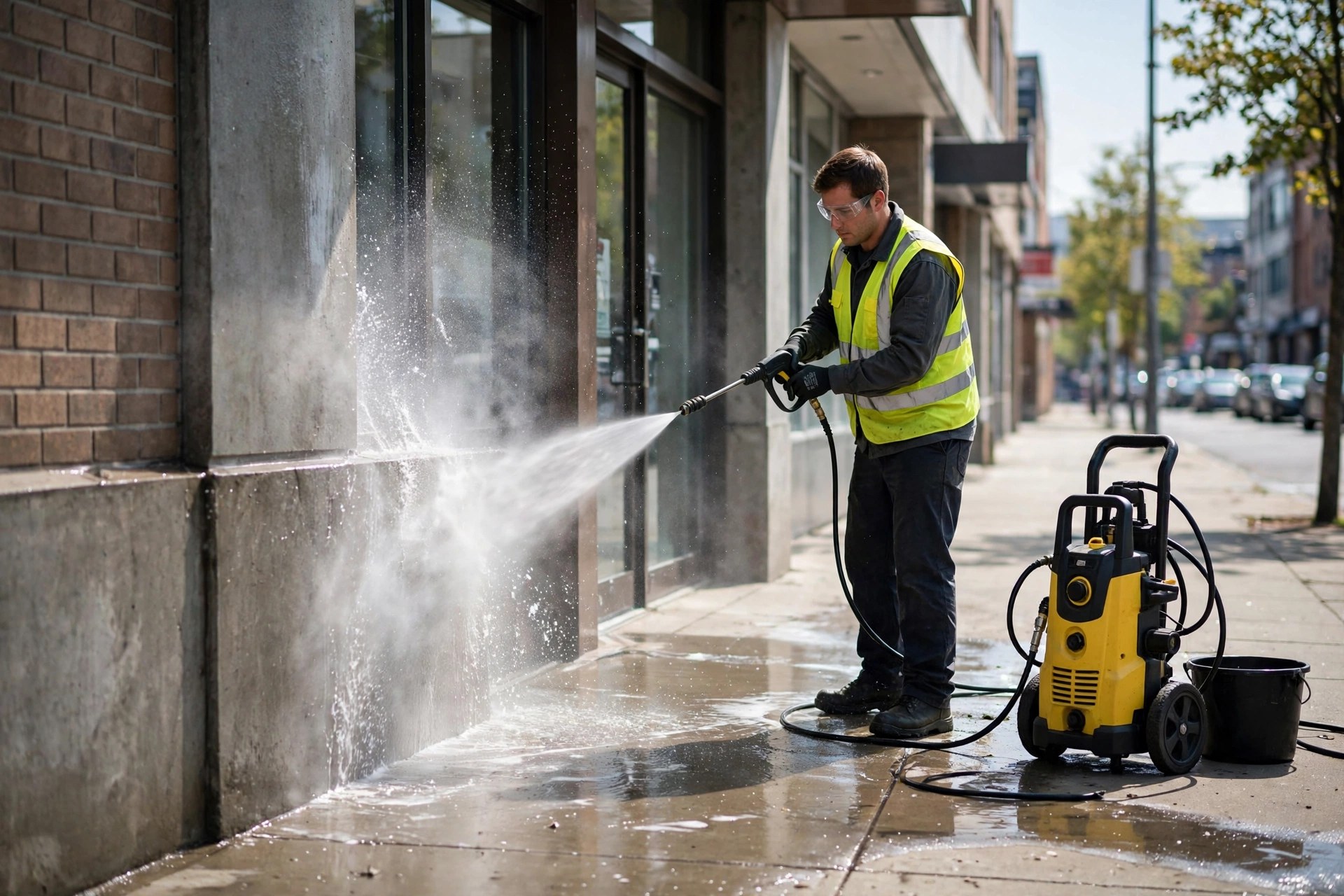
Pressure washing looks like a simple business from the outside: a rig, a hose, and a route. The cash flow underneath is not simple at all. Crews and chemicals are paid weekly, commercial contracts pay monthly or on net-30 terms, and the work itself is brutally seasonal — a spring rush, a summer grind, and a winter where residential demand can fall off a cliff in colder markets. Funding exists for exactly that shape of business.
This guide covers how pressure washing companies actually borrow: the five cash demands that recur every year, which product fits each one, what lenders check on a washing file, and the five mistakes that turn a good season into a scramble.
Why pressure washers borrow on a different calendar
Unlike a shop with a till, a pressure washing company sells a route, not a day. Residential jobs pay quickly — often on the day — but they cluster in spring and summer, when homeowners notice siding, driveways, and decks. Commercial work is the opposite: property managers, HOAs, restaurants, and fleet operators sign recurring contracts that pay monthly or on net-30 terms, which means the crew is paid four times before the first invoice clears.
That mismatch is the whole business model, and it is also the whole funding problem. A company adding a second rig and a second crew in April is spending on equipment, insurance, and wages weeks before the new route produces a full month of collections. A company that waits until the route is full to buy the rig has already lost the season.
Weather adds a second calendar. Rain weeks, freeze weeks, and the winter slowdown all cut billable days without cutting fixed costs. The washers that survive those stretches are the ones that banked the spring surplus — or funded the gap — instead of spending it as if every month were May.
The five cash demands of a pressure washing company
1. Rigs, trailers, and surface cleaners. A commercial-grade rig, a trailer, a surface cleaner, and a water tank are the price of entry, and a second rig is the price of growth. These are lumpy purchases that do not fit weekly cash flow.
2. Payroll ahead of collections. Technicians are paid weekly. Commercial clients pay monthly or net-30. Every new contract widens that gap before it narrows it.
3. Chemicals, fuel, and maintenance. Detergents, fuel, hoses, pumps, and seals are recurring costs that scale with volume — which means they peak exactly when the crew is busiest and cash is tightest.
4. Insurance, licensing, and vehicle costs. Liability coverage, commercial auto, and equipment coverage renew annually and land in a single quarter. A company that has not reserved for renewal month learns about it the hard way.
5. Marketing and route building. Door hangers, local ads, a second crew's route, or a push into commercial accounts costs money months before it produces a full book. Route building is an investment, and investments need funding, not hope.
Need working capital this week?
Apply Now →Free to apply · Soft credit check only · Funding in 24–72 hoursThe product map: what fits which need
A business line of credit fits the payroll-ahead-of-collections gap and the seasonal swing. Draw during the spring ramp and the winter trough, repay as commercial invoices clear, and the line is there again for the next cycle. For washers with recurring commercial contracts, this is usually the core facility — and it is worth opening during a strong month, not during a dry one.
Equipment financing fits rigs, trailers, and trucks — assets with a serial number and a resale market. The equipment secures the loan, which usually means better terms than an unsecured advance, and the payment schedule can match the seasons the equipment will actually work.
Revenue-based advances fit a single fast gap with a defined collection event: a commercial contract that starts Monday and pays in thirty days, a fleet account that needs three crews this week, a rig replacement that cannot wait for the slow season. They fund in 24 to 72 hours from a complete application. They are a poor fit for permanent costs, because daily debits do not pause for a rain week.
Term loans fit the big moves: buying out a competitor's route, opening a second territory, or financing a fleet of rigs at once. They take days to weeks and belong in planning, not in emergencies.
The rule of thumb: match the repayment schedule to the cash event that repays it. Float gets a line. An asset gets equipment financing. A single gap gets an advance. An expansion gets a term loan.
What lenders check on a pressure washing file
Washing files are judged on route quality as much as on history. Lenders will look at bank statements — typically the last three months — for deposit consistency, average balances, and overdrafts. But they will also weigh what a generic application never captures: the share of revenue under recurring contract versus one-off residential jobs, the average days from job to payment, and how the full year looks, not just the spring peak.
Three things strengthen a washing file more than anything else. First, a contract summary: recurring clients, monthly values, and contract lengths. Second, a full-year revenue picture that shows the winter honestly — lenders underwrite the trough, and a file that hides it loses trust. Third, a clean story on equipment: owned rigs, their age, and what the next purchase actually adds in capacity.
What weakens a file: a route that is really one big client, residential revenue presented as recurring when it is seasonal and one-off, and bank statements that show the owner sweeping the account to zero every week. None of these is fatal alone. Together they tell a lender the route is thinner than the pitch.
Five funding mistakes pressure washers keep making
1. Funding payroll with a daily-debit advance. Crews are a permanent cost. An advance is for a gap. Using one for the other means the debit continues through rain weeks and the winter slowdown.
2. Buying the second rig from operating cash in April. The rig is needed because the season is starting, which is exactly when cash is tightest. Equipment financing exists so the rig pays for itself over the seasons it works.
3. Spending the spring surplus as if it were the average month. May revenue is not monthly revenue. Reserve the surplus — or hold an open line — for the winter, or the winter will hold the company.
4. Presenting one-off residential jobs as recurring revenue. Lenders verify. A route book padded with last spring's driveways does more damage than an honest, smaller contract base.
5. Taking the first offer when a rig breaks. A down rig is real pressure, but a rushed advance signed at a high factor rate costs more than a week of rental. Get the quote, compare the total repayment in dollars, and then sign.
How fast pressure washing funding moves
Revenue-based products typically fund in 24 to 72 hours from a complete application, once bank statements are verified. A line of credit takes longer to open — days to a couple of weeks — but once open, draws are immediate. Equipment financing usually closes in days to weeks depending on the asset and the file. The practical move is to open the line during a strong month, keep it mostly undrawn, and use advances only for defined gaps.
The bottom line for pressure washers
Pressure washing is a route business with a seasonal calendar: cash out for crews, chemicals, and rigs, cash in weeks later on commercial terms and months later after the winter. Funders understand that calendar when the file shows it honestly — recurring contracts, full-year seasonality, and equipment that earns its payment. Match each need to the product built for it, compare every offer by total repayment in dollars, and open the line before the dry spell. The work is not the constraint. The calendar is.
Frequently asked questions
Can a pressure washing company get a business loan?
Yes. Pressure washing companies qualify for lines of credit, revenue-based advances, equipment financing, and term loans through third-party funders, based on recurring contracts, route revenue, bank statements, and full-year seasonality. A contract book with monthly values is often the strongest part of the file.
What do lenders check for pressure washing funding?
Recurring contract revenue versus one-off residential jobs, average days from job to payment, customer concentration, full-year seasonality including the winter trough, and bank statement health. A contract summary showing clients, monthly values, and contract lengths strengthens any application.
How fast can a pressure washing company get funded?
Revenue-based products typically fund in 24 to 72 hours from a complete application, once bank statements are verified. Equipment financing for rigs and trucks takes days to weeks, and term loans for route acquisitions or a second territory take longer.
Is a merchant cash advance good for a pressure washing company?
It can be, for a single fast gap with a defined collection event, such as a commercial contract that starts this week and pays in thirty days, or a rig replacement that cannot wait. For permanent crew payroll, a line of credit usually fits better, because daily debits do not pause for rain weeks or the winter slowdown.
What documents does a pressure washing company need to apply?
Recent business bank statements, typically the last three months, are the core requirement, plus a contract summary showing recurring clients and monthly values where available. A photo ID and a voided check may be requested as optional verification items, but they are not upfront requirements for getting a quote.
How much funding can a pressure washing company get?
It depends on route revenue, recurring contract value, seasonality, and the product: revenue-based advances are usually sized as a multiple of monthly revenue, while lines, equipment loans, and term loans depend on the broader file. Ask for the total repayment in dollars before accepting any offer.
The best offer is the one you compare
Get a no-obligation quote from our #1-ranked lender, Coast to Coast Fast Funding — $5K to $5M, MCA and revenue-based products that fund in 24–72 hours with soft-pull-only applications. We shop 75+ lenders so you can compare the true cost of every offer side by side.Apply Now →Soft credit check · 60-second pre-qualification · (352) 809-3201