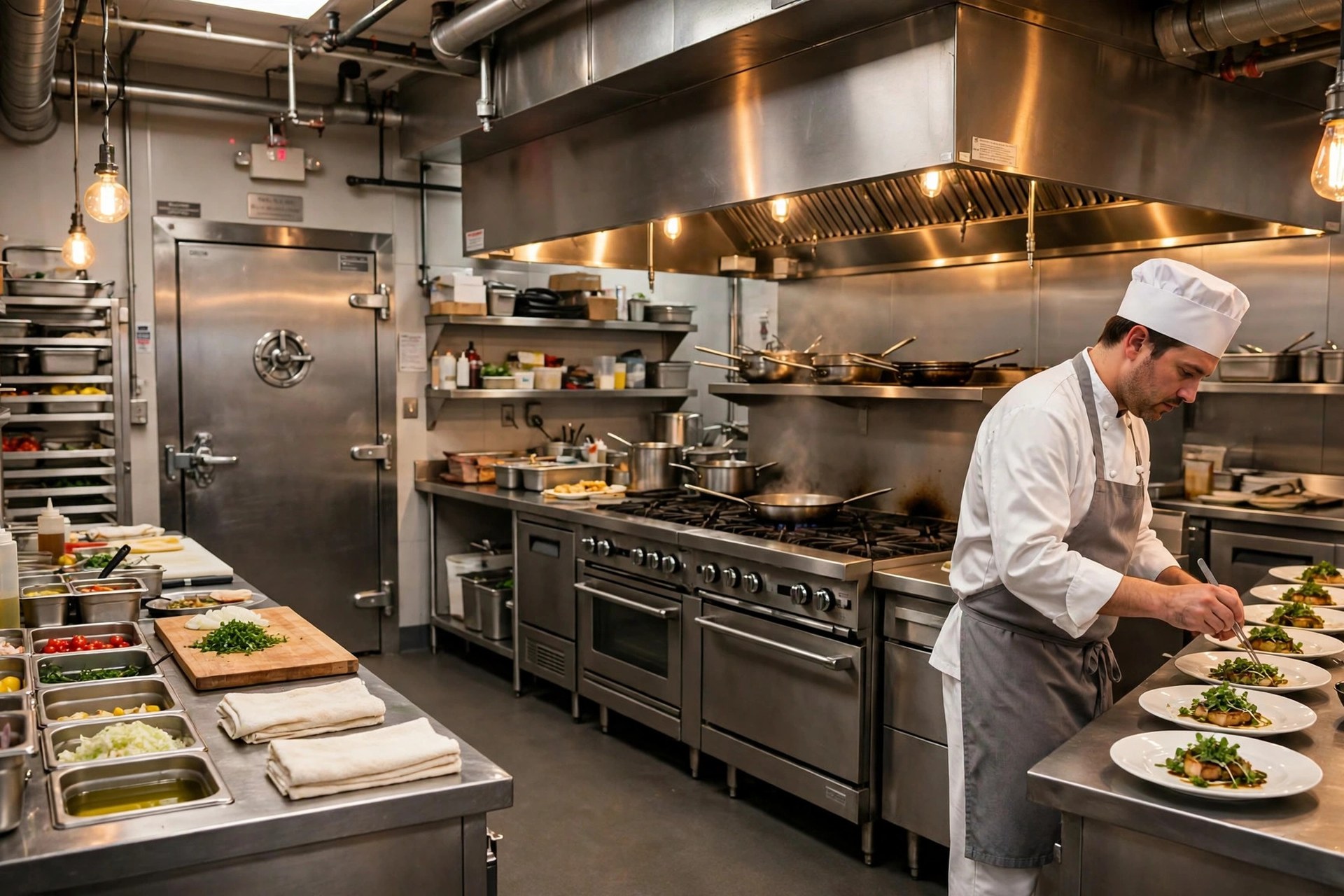
Restaurant equipment is the most expensive thing in the room that customers never see. A full commercial kitchen build-out for a new restaurant typically runs $75,000 to $175,000 for equipment alone, before installation — and the choices made in that budget follow the restaurant for a decade. This guide covers what restaurant equipment actually costs in 2026, whether to buy new or used, which product fits each purchase, and what funders weigh on an equipment file.
The core mistake in restaurant equipment financing is a mismatch: buying a ten-year asset with a ten-month payback. Equipment financing exists precisely to prevent that — the equipment secures the loan, the term matches its useful life, and the monthly payment stays sized to what the kitchen actually earns.
What restaurant equipment actually costs in 2026
Published 2026 price indexes converge on the same shape. The cookline and refrigeration dominate the budget, and ventilation — the line item most new owners forget — is one of the largest single costs:
| Equipment | Typical 2026 range, new | Notes |
|---|---|---|
| Full commercial kitchen build-out, equipment only | $75,000–$175,000 | Before installation, hookups, and ventilation labor |
| Commercial ranges | $2,500–$12,000 | Higher end for large suites with ovens and griddles |
| Combi ovens | $10,000–$40,000 | The most versatile — and most expensive — single cooking unit |
| Walk-in coolers and freezers | $6,000–$18,000 | Larger units and low-temp freezers run higher; $100–$150 per square foot is a common planning figure |
| Ventilation hood systems, installed | $8,000–$25,000 | Includes fire suppression in most jurisdictions; the most commonly underestimated line item |
| Reach-in refrigerators | $1,500–$6,000 | Two-door stainless units anchor most small kitchens |
| Commercial dishwashers | $3,000–$10,000 | High-temp and conveyor models run higher; water heating and drainage add to install cost |
| Ice machines with bin | $1,500–$6,500 | Size for peak demand, not average — an undersized machine caps service on the busiest nights |
Installation is not a rounding error. Freight delivery, liftgate service, placement, gas and electrical hookups, water lines, drainage, ventilation ductwork, and removal of old units all sit outside the equipment price. Request itemized estimates for any project involving fixed installation — a quote that shows only the unit price understates the real cost by thousands.
New versus used: where the savings actually are
The used market is where restaurant equipment financing gets interesting. Well-maintained, brand-name items typically sell for 20–40% of their original price, and the gap is widest exactly where new prices are highest:
| Equipment | New, typical | Used, typical |
|---|---|---|
| Commercial ranges and cooking suites | $8,000–$25,000 | $2,500–$9,000 |
| Commercial refrigeration (reach-ins, prep tables) | $1,500–$6,000 | $400–$2,500 |
| Walk-in coolers and freezers | $5,000–$20,000 installed | $1,500–$7,000 plus install and transport |
| Commercial dishwashers | $3,000–$10,000 | $1,000–$4,000 |
| Mixers (e.g., 20-quart Hobart) | $3,500–$4,500 | $800–$1,800 |
Three rules for buying used. First, buy refrigeration and ice machines carefully: compressors and evaporators hold the value, and a failing compressor erases the savings. Second, prefer refurbished units from dealers over auction purchases when the unit matters — dealer units are cleaned, tested, and often carry a limited warranty. Third, check age, brand, and maintenance proof: True, Hobart, Vulcan, and Blodgett hold value for a reason, and a documented service history is worth paying for.
Which product fits which equipment purchase
| Purchase | Best fit | Why |
|---|---|---|
| Full kitchen build-out for a new restaurant | Equipment financing or term loan | Largest amounts, longest terms, matched to a decade of use |
| Single major unit (combi oven, walk-in) | Equipment financing | The unit secures the loan; terms of 3–7 years match its life |
| Replacing a failed unit this week | Revenue-based advance or line of credit | Speed matters more than term when the kitchen is down |
| Outfitting a second location | Term loan | Fixed payments over years, sized to the expanded revenue |
| Seasonal or event-driven equipment needs | Equipment leasing | Lower monthly cost and a return path if the need is temporary |
| Refinancing expensive existing equipment debt | Debt refinance / consolidation loan | Replaces daily debits with a monthly payment the restaurant can carry |
What funders actually weigh on an equipment file
Resale value of the equipment. Equipment financing underwriting leans on what the unit is worth on the secondary market. Standard, brand-name units with deep used markets finance easily; custom or single-purpose builds do not.
New versus existing restaurant. An existing restaurant with 6–12 months of deposits finances equipment far more easily than a pre-revenue startup, where the funder is underwriting a plan rather than a track record. Startups lean on SBA loans, owner credit, and vendor terms.
Installation and total project cost. Funders want the whole project in the file — equipment, freight, hookups, ventilation, and permits — not just the unit price. A file that hides installation costs underwrites as a surprise later.
Existing debt and daily debits. A restaurant already carrying two daily-debit advances will struggle to finance a new kitchen line; a refinance conversation is usually the better route before adding equipment debt.
Cash flow coverage. The monthly equipment payment has to fit inside the restaurant's actual operating margin after food, labor, and rent. Funders test this from bank statements, not from projections — which is why clean, unedited statements matter more than a polished pro forma.
The documents: short list, no surprises
- 3–6 months of business bank statements (clean PDFs, unedited)
- A completed application (about 5 minutes for revenue-based products)
- Government-issued photo ID (sometimes requested before funding, not to see offers)
- A voided business check or bank letter (sometimes requested for the funding deposit — not a universal upfront requirement)
- For equipment financing: vendor quotes, itemized to include freight, installation, hookups, and ventilation
- For a new restaurant: the lease, the build-out plan, and any contractor bids
- For SBA products: tax returns, a business plan, and personal financial statements — the longer list is the price of the longer term and lower cost
Mistakes that cost restaurant owners real money
Financing a ten-year asset with a ten-month advance. A walk-in cooler lasts a decade; a daily-debit advance is repaid in months. Match the payoff to the purchase, or the payments eat the margin the equipment was supposed to create.
Forgetting ventilation in the budget. A hood system at $8,000–$25,000 installed, with fire suppression, is routinely the largest surprise in a kitchen build. Budget it first, not last.
Oversizing refrigeration and ice. Capacity drives both purchase price and utility cost. Size for peak demand — but not far beyond it, or the restaurant pays for cold air it never uses.
Buying the cheapest unit instead of the serviceable one. A no-name range with no parts network costs more in downtime than a brand-name unit costs up front. Brand, parts availability, and a local service tech are part of the price.
Taking the first offer. Getting two or three offers and comparing total repayment dollars typically saves thousands on the same financing. The first offer is rarely the best one.
Frequently asked questions
How much does it cost to equip a new restaurant kitchen in 2026?
A full commercial kitchen build-out typically runs $75,000–$175,000 for equipment alone, before installation. The range depends on concept and size: a small cafe with a limited menu sits at the low end, a full-service kitchen with a combi oven, walk-in, and full ventilation sits at the high end — and installation adds thousands more.
Can I finance used restaurant equipment?
Yes, and it is often the smarter deal. Used ranges that cost $8,000–$25,000 new typically sell for $2,500–$9,000, and used walk-ins run $1,500–$7,000 against $5,000–$20,000 new. Funders finance used equipment readily when it is a standard brand-name unit; dealer-refurbished units with a limited warranty underwrite cleanest.
Is equipment financing better than a merchant cash advance for kitchen equipment?
For equipment, almost always. Equipment financing uses the unit as collateral, runs 3–7 years, and charges a monthly payment sized to the asset's life. An advance repays in months through daily debits — the right tool for a short cash gap, the wrong tool for a ten-year asset.
What credit score do I need to finance restaurant equipment?
Revenue-based funders weight bank deposits far more heavily than credit score, and scores in the 500s routinely get funded. Equipment financing is also accessible at lower scores because the equipment secures the loan. SBA and bank products are stricter, typically 650-plus.
Do I need a voided check or photo ID to apply?
No — not to see offers. Bank statements and an application are the standard ask. A voided check or photo ID is sometimes requested for verification on specific products before funding, but neither is a universal upfront requirement.
How fast can restaurant equipment be financed?
Equipment financing typically takes days to a couple of weeks once the vendor quote and statements are in. Revenue-based products decide in hours and fund in 24–72 hours — the right choice when a failed unit has the kitchen down. SBA products take a month or more.
Kitchen to build, a unit to replace, or a second location to outfit? See what you qualify for
From the first range to the full build-out — get a no-obligation quote from our #1-ranked lender, Coast to Coast Fast Funding. One application reaches multiple funders, so you see the actual market for your file.
Apply Now →Soft credit check · 60-second pre-qualification