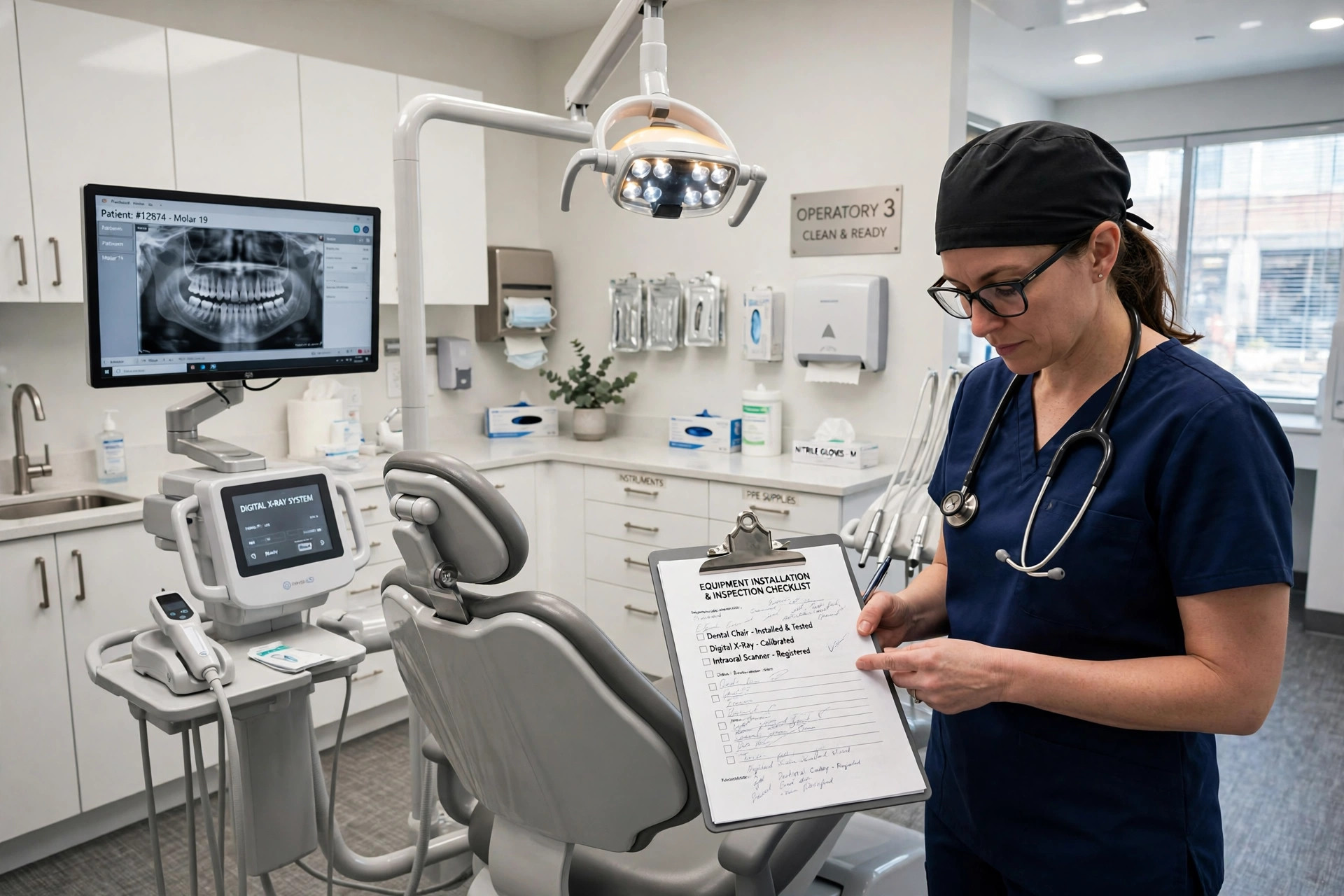
A single dental operatory — chair, delivery system, light, cabinetry — can cost more than a luxury car. Add a CBCT 3D imaging unit or a chairside CAD/CAM mill and one equipment decision can run deep into six figures. Almost no practice pays cash for that. The question is not whether to finance dental equipment; it is which structure leaves the practice with the lowest true cost after taxes.
This guide covers the four ways dentists actually pay for equipment — equipment loans, equipment leases, lines of credit, and merchant cash advances — and the 2026 tax rules that can make the timing of your purchase worth as much as the financing itself. Dental equipment is Section 179 property, and for 2026 the first-year write-off ceiling is $2,560,000 with 100% bonus depreciation now permanent. Buy it right and the tax code effectively co-signs your loan.
What dental equipment actually costs
Dental equipment pricing is opaque by design — most dealers quote rather than publish — but typical market ranges are well established. A complete new operatory (chair, delivery unit, light, cabinetry, vacuum and compressor share) often runs $50,000–$100,000 all-in. A CBCT 3D imaging unit commonly lands between $90,000 and $250,000 depending on field of view and software. Chairside CAD/CAM milling systems typically run $100,000–$150,000. Intraoral scanners — the gateway drug of digital dentistry — generally fall in the $20,000–$40,000 range. A three-operatory buildout with digital imaging can clear $300,000 before you see your first patient in the new chairs.
Two things follow from those numbers. First, equipment decisions are capital-structure decisions: the financing term should roughly match the equipment's useful life, or you end up paying for a chair long after it is obsolete. Second, at these price points the tax treatment is not a footnote — it can swing the first-year economics by tens of thousands of dollars.
The four ways dentists pay for equipment
The equipment term loan. The workhorse. You borrow against the equipment itself — the chair, the CBCT, the mill serves as collateral — which is why lenders offer longer terms (often 5–7 years) and lower rates than unsecured products. You own the asset from day one, you claim the depreciation, and at the end of the term it is yours free and clear. Best for: core equipment you will run for 7–10 years.
The $1-buyout lease. Economically a loan wearing a lease costume. You make fixed payments for the term, then buy the equipment for $1. Payments are often slightly higher than a comparable loan, but approval can be easier and the structure keeps the debt off certain balance-sheet presentations. You still claim Section 179 on $1-buyout leases in most cases — confirm with your CPA. Best for: practices that want ownership with lease-style paperwork.
The fair-market-value (FMV) lease. A true lease: lower payments, and at the end you return the equipment, renew, or buy it at its then-fair-market value. The tradeoff is total cost — if you end up buying the equipment at FMV after years of payments, you usually pay more than a loan would have cost. And leased equipment under an FMV structure generally does not qualify for Section 179 the way owned equipment does. Best for: technology with a short useful life — scanners and software-driven systems you expect to replace in 3–4 years.
The merchant cash advance or line of credit. The speed options. An MCA funds in 24 hours against practice revenue — useful when a compressor dies on a Monday and patients are booked Tuesday. A business line of credit covers the same emergencies more cheaply if you already have one open. Neither is priced for a 7-year asset: financing a $150,000 CBCT with daily-debit products is how practices end up in our dental MCA guide for the wrong reasons. Best for: emergencies and bridge needs, not planned capital purchases.
Loan vs. lease vs. cash advance, side by side
| Equipment loan | $1-buyout lease | FMV lease | MCA / line of credit | |
|---|---|---|---|---|
| You own it | Day one | At term end ($1) | Only if you buy at FMV | Yes (MCA/LOC) / n/a |
| Typical term | 5–7 years | 3–5 years | 3–5 years | 6–18 months (MCA) |
| Section 179 eligible | Yes | Usually yes | Generally no | Yes, if you buy the equipment |
| Speed | Days to weeks | Days | Days | 24 hours (MCA) |
| Best for | Core 7–10 year assets | Ownership via lease paperwork | Fast-turnover tech | Emergencies, bridge gaps |
The 2026 tax playbook: Section 179 and bonus depreciation
Here is where dental equipment financing gets interesting. Two federal provisions let you deduct the full cost of qualifying equipment in the year it is placed in service, instead of depreciating it over its 5-year MACRS class life:
Section 179. For 2026, the maximum deduction is $2,560,000 (set by IRS Rev. Proc. 2025-32, up from $2,500,000 in 2025 after the One Big Beautiful Bill Act doubled the old $1,250,000 cap). The deduction phases out dollar-for-dollar once your total qualifying purchases for the year pass $4,090,000, and disappears entirely at $6,650,000. For all but the largest DSO-scale buyers, the cap is not the binding constraint — a solo practice equipping three operatories is nowhere near $2.56 million.
What binds instead is the taxable income limitation: Section 179 cannot exceed your business's taxable income for the year. Buy $200,000 of equipment with $120,000 of taxable income and you deduct $120,000 now; the remaining $80,000 carries forward. Bonus depreciation then covers what Section 179 cannot.
100% bonus depreciation — now permanent. For property acquired and placed in service after January 19, 2025, bonus depreciation is 100% and permanent — the old step-down schedule is gone. Unlike Section 179, it has no dollar cap, no phase-out, and no taxable-income limit: it can create or increase a loss. It applies by asset class rather than asset by asset, and it is taken after any Section 179 election. Most practices use both: Section 179 first, bonus depreciation on the rest.
Three timing rules that decide everything:
1. Financed equipment still qualifies. The deduction follows the purchase price and the placed-in-service date — not your down payment. The IRS treats a financed purchase as a purchase: you own the equipment, you owe the debt, and the full basis is deductible in year one if you elect it. Finance $150,000 of equipment in November, make two payments before year end, and you may still deduct the full $150,000.
2. "Placed in service" means installed and ready — by December 31. A signed quote or a delivery sitting in crates does not count. If the CBCT is not installed, calibrated, and ready for patients by December 31, 2026, the deduction waits until 2027. Order lead times on imaging equipment can run 8–12 weeks; a November decision can easily become a January installation.
3. Check your state. Many states follow the federal rules, but not all — California, for example, caps Section 179 at $25,000 and does not follow federal bonus depreciation. And none of this is tax advice: the income limitation, related-party rules, and business-use tests all have teeth. Run your specific purchase past your CPA before you sign.
Financing new equipment before year end? Get terms in writing first
Apply Now →Free to apply · Soft credit check only · Funding in 24–72 hoursThe $150,000 CBCT, financed — worked math
Put it together. A practice finances a $150,000 CBCT unit over 60 months at an illustrative 9% APR. The monthly payment works out to roughly $3,114 — about $186,800 in total repayment, or roughly $36,800 in interest over five years. (Illustrative; your rate depends on credit, time in business, and the lender.)
Now the tax side. If the unit is installed and seeing patients by December 31, 2026, the practice can elect Section 179 on the full $150,000 (assuming sufficient taxable income), or take 100% bonus depreciation. At an illustrative 32% marginal tax rate, that first-year deduction is worth roughly $48,000 in reduced taxes — more than the entire first year of loan payments. The equipment effectively pays for a third of itself in year one, before it produces a dollar of scan revenue.
That is the real argument for financing rather than waiting: every month you delay past the placed-in-service deadline is a month of scan revenue lost and a year of tax benefit deferred. The practices that win on equipment are the ones that line up financing, delivery, and installation as one project — not three.
What funders weigh on a dental equipment file
Practice revenue and collection history. Funders want to see consistent production and collections — not just gross billings. Insurance-heavy practices with slow receivables get more scrutiny than fee-for-service practices with same-week collections.
The equipment is the collateral. This is the structural advantage of equipment financing: the lender's risk is lower because the asset secures the loan. That is why equipment loans price below unsecured products and approve practices that would struggle for a general working-capital loan.
Time in business and credit. Startups can finance equipment — the collateral helps — but expect larger down payments (often 10–20%) and shorter terms. Established practices with clean bank statements get the best structures.
Why MCA funders love dental. Dental practices are prized MCA borrowers: steady card revenue, high margins, low closure rates. That means when a practice does need speed — a dead compressor, a sudden expansion opportunity — MCA money is available fast. It also means practices get marketed aggressively; the discipline is using MCA money for what it is (a bridge) and never for what it is not (a 7-year asset). Our MCA for dental practices guide covers that line in detail.
Mistakes that cost dentists real money
Signing an FMV lease on equipment you will keep for a decade. The low payment is seductive. Then year five arrives, you cannot imagine practicing without the unit, and you buy it at fair market value — paying twice. If the useful life is 7–10 years, buy it (loan or $1 buyout) from the start.
Financing a 7-year asset with a 9-month product. Daily-debit MCA money against a CBCT is a cash-flow mismatch that compounds monthly. Match term to asset life or refinance the MCA into an equipment loan within months — our MCA refinance guide covers the exit.
Missing the placed-in-service deadline. The December order that installs in January costs you a full year of the deduction. Work backward from December 31: order date, delivery window, installation, calibration, staff training. If any link slips past New Year's, the tax benefit slips a year with it.
Counting Section 179 savings you cannot use. The deduction is limited to taxable income. A practice having a thin year cannot deduct $200,000 against $120,000 of income — the excess carries forward, and bonus depreciation may do the heavier lifting instead. This is a CPA conversation, not a sales-rep conversation.
Frequently asked questions
Does financed dental equipment qualify for Section 179?
Yes. The IRS treats a financed purchase as a purchase — the deduction follows the equipment's purchase price and its placed-in-service date, not how much cash you have paid so far. Finance $150,000 of equipment in November and, if it is installed and ready by December 31, you may deduct the full $150,000 for that tax year (subject to the taxable-income limit), even though you have made only a payment or two.
Should I take a loan or a lease for dental equipment?
For equipment you will keep 7–10 years (chairs, compressors, cabinetry), a loan or $1-buyout lease usually wins on total cost — and both generally preserve Section 179 eligibility. For technology you expect to replace in 3–4 years (scanners, software-driven systems), a fair-market-value lease's lower payments can make sense, but confirm the tax treatment first since FMV leases generally do not qualify for Section 179 the way owned equipment does.
Can a startup dental practice finance equipment?
Yes — equipment financing is one of the more accessible products for a new practice because the equipment itself serves as collateral. Expect larger down payments (often 10–20%), shorter terms, and closer scrutiny of your business plan and projections than an established practice would face.
How fast can dental equipment financing fund?
Equipment loans typically take days to a few weeks — the lender verifies the equipment quote and your financials. Leases can move in days. If a critical unit fails mid-week, a merchant cash advance or existing line of credit funds in 24 hours as a bridge; refinance it into proper equipment financing once the emergency passes.
Can I finance used or refurbished dental equipment?
Usually yes — and used equipment that is new to you generally qualifies for Section 179 and bonus depreciation the same as new equipment. Lenders may offer shorter terms on used assets, and you should verify service history and remaining useful life before committing.
What is the Section 179 limit for dental equipment in 2026?
The 2026 Section 179 maximum is $2,560,000, phasing out once total qualifying purchases for the year exceed $4,090,000. Separately, 100% bonus depreciation is permanent for property acquired and placed in service after January 19, 2025, with no dollar cap. Both require the equipment to be installed and ready for use by December 31, 2026 to count for the 2026 tax year. Confirm your specific situation with your CPA.
New chairs, new imaging, new revenue — get the financing structured right
Tell us about your practice and send your last 3 months of statements — we will compare equipment lenders and put total repayment dollars in writing, so you can weigh the financing against the tax benefit with real numbers. No obligation, no upfront fees.
Apply Now →Soft credit check · 60-second pre-qualification