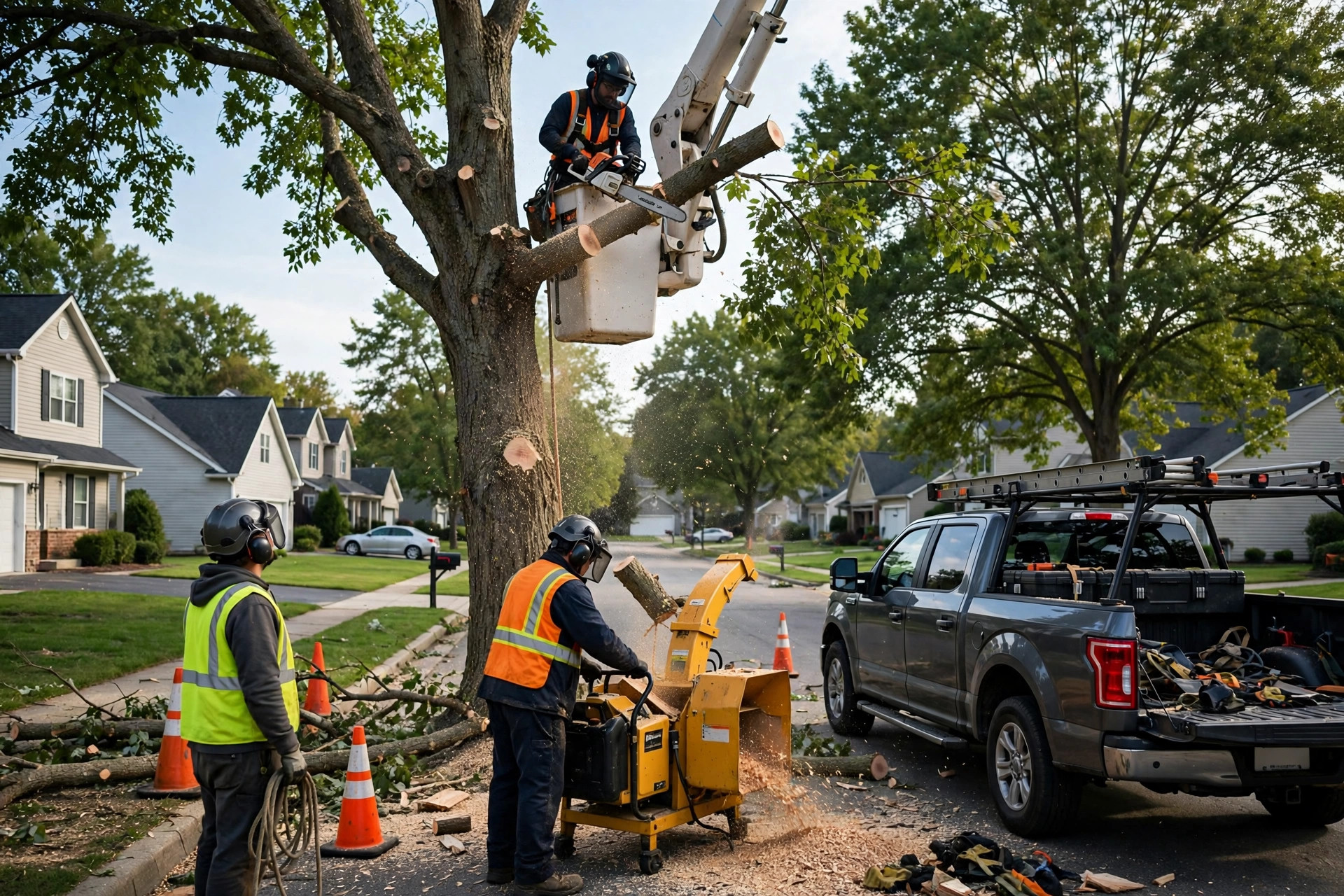
Tree work looks like a truck and a chainsaw from the curb. The business underneath is one of the most equipment-heavy in the trades: a bucket truck, a chipper, a stump grinder, and a trained crew have to arrive together, and the job pays only when the debris is hauled away. This guide covers what tree service companies actually borrow for, what starting, equipping, or growing one costs in 2026, and which product fits each need.
The funding map for a tree service starts with one question: are you buying iron, or buying time? Iron — trucks, chippers, grinders — is financed against itself. Time — the weeks between a storm, a municipal contract, and payment — is financed against cash flow. Mixing the two up is how a good crew ends up with a bad loan.
What tree service companies actually borrow for
Most tree service borrowing falls into five buckets. Fleet and iron: bucket trucks, chipper trucks, chippers, stump grinders, and trailers. Crew: hiring and training climbers, ground crew, and equipment operators ahead of the busy season, when payroll for a full crew can exceed $30,000 to $50,000 a month for larger operations. The seasonal gap: spring and fall are peak seasons, while winter in northern states and dry summers elsewhere can stall work for weeks. Larger contracts: municipal removals, utility right-of-way clearing, and property-management agreements that require mobilizing crews and equipment before the first payment arrives. And storm surge: after a major storm, the first company that answers the phone gets the work — but only if it has the crew, the fuel, and the disposal capacity ready that day.
What starting or equipping a tree service costs in 2026
The range is wide because the entry point varies. A lean owner-operator start — saws, climbing gear, a truck, and rented chippers and grinders — typically runs $15,000 to $30,000 including the first year of insurance. A fully equipped operation passes $150,000 quickly: a used bucket truck or chipper truck at $60,000 to $150,000, a new one at $90,000 to $250,000, a commercial chipper at $25,000 to $80,000 (trailer chippers from $10,000 to $50,000), a stump grinder at $5,000 to $25,000, and climbing, rigging, and safety gear for a full crew adding tens of thousands more. Insurance is the line owners underestimate: general liability, commercial auto, and workers' compensation for high-risk work typically runs $4,000 to $12,000 a year for a small operation and climbs with crew size and claims history. Add licensing, disposal fees, fuel, and a working capital buffer for the first slow stretch, and the honest planning range for a crew-ready launch is $80,000 to $250,000 before franchise-style build-outs, which run higher.
Storm season and seasonality drive the deal
Tree work is seasonal in both directions. Spring and fall bring trimming, removals, and planting work; storms bring surge demand that rewards whoever can mobilize fastest. A two- to three-person crew often needs to bill $1,500 to $3,000 a day to stay healthy once labor, insurance, fuel, equipment, and dump fees are counted — and underpriced bids are the cost that sinks new owners more than any other. Funders who understand the trade look for a crew that prices to that daily number, carries insurance without gaps, and keeps a storm reserve: fuel, disposal capacity, and a crew that can work extended days when the phones light up. A line of credit that sits unused through the busy season and covers the winter gap is often worth more to a tree service than a larger loan drawn all at once.
Which product fits which need
Equipment financing fits the iron: bucket trucks typically finance over 48 to 72 months, other equipment over 36 to 60 months, with the asset securing the loan — which usually means easier underwriting than unsecured borrowing, even for newer businesses with proof of experience or contracts. A working capital loan or line of credit fits the seasonal gap and storm mobilization: payroll, fuel, insurance premiums, and disposal costs while waiting on municipal or commercial payment. A term loan fits a planned expansion — a second crew, a crane, or a yard — on a fixed schedule. SBA loans fit larger, longer-horizon investments such as a property or a major fleet build, but take weeks to months. Revenue-based advances fit card-heavy businesses poorly here: tree work is invoice- and contract-driven, so a daily debit against lumpy commercial payments is a mismatch to avoid.
What funders weigh on a tree service file
Deposits over the last 3 to 6 months come first, then the shape of the book: recurring maintenance contracts and municipal or utility agreements read as stability, while one-off storm jobs read as windfall. Next come the risk questions a funder will ask before approving: ISA Certified Arborist credentials on staff, a clean safety record, adequate liability and workers' compensation coverage, and proper licensing — some states and municipalities require a tree service license, and trucks over 26,000 pounds GVWR require a commercial driver's license. Then the contract question: signed commercial or municipal work with payment terms the business can actually float. Credit matters, but for equipment-heavy files it sits behind the asset, the contracts, and the safety record. A crew that documents its jobs, carries insurance without gaps, and prices to its daily cost number is the file funders compete for.
Documents: what you actually need
Your last 3 months of business bank statements are the core document — funders underwrite from deposits, so statements are required. For equipment financing, add the equipment quote or invoice and proof of insurance; for contract-driven borrowing, add signed contracts and the payment schedule. A photo ID and a voided check are optional, not required, and no funder should demand them before showing you offers. New operators without statements should bring proof of experience, any contracts or revenue projections, and a safety and insurance plan — equipment lenders weigh those heavily when the asset secures the loan.
Mistakes that cost tree services real money
First, underpricing: a crew that bills below its daily cost number stays busy and goes broke, and funders read it in the statements. Second, insurance gaps — a single uncovered incident can end a business, and a lapse shows up in underwriting. Third, buying the biggest truck before the book supports it: iron without contracts is a payment without revenue. Fourth, financing a seasonal gap with a daily-debit product while waiting on 60-day municipal payment. Fifth, no storm plan: the companies that win storm work are the ones with fuel, disposal, and crew capacity arranged before the forecast, not after it.
Starting, equipping, or growing a tree service? See what you qualify for
From the first crew to the second truck — get a no-obligation quote from our #1-ranked lender, Coast to Coast Fast Funding. One application reaches multiple funders, so you see the actual market for your file.
Apply Now →Soft credit check · 60-second pre-qualification