What a tattoo studio actually costs to open — and to run
A tattoo studio is a strange business to finance: the biggest asset is the artists' hands, the most expensive line item is a room that must pass a health inspection, and the revenue arrives in lumps — a full-day session here, a slow Tuesday there, a convention weekend that pays the rent for a month. Owners who borrow well understand that shape before they pick a product.
The published ranges are wide because the business itself is wide. A solo artist taking over a small second-floor space can open for roughly $15,000 to $25,000. A small studio with two to four chairs runs roughly $30,000 to $60,000. A multi-artist studio in a prime location passes $75,000 before the doors open, and full build-outs with premium finishes run $70,500 to $350,000. The single biggest variable is the space: a turnkey spot that was already a salon or studio saves tens of thousands, while a raw commercial unit needing plumbing, partitions, and electrical becomes the largest line item on its own.
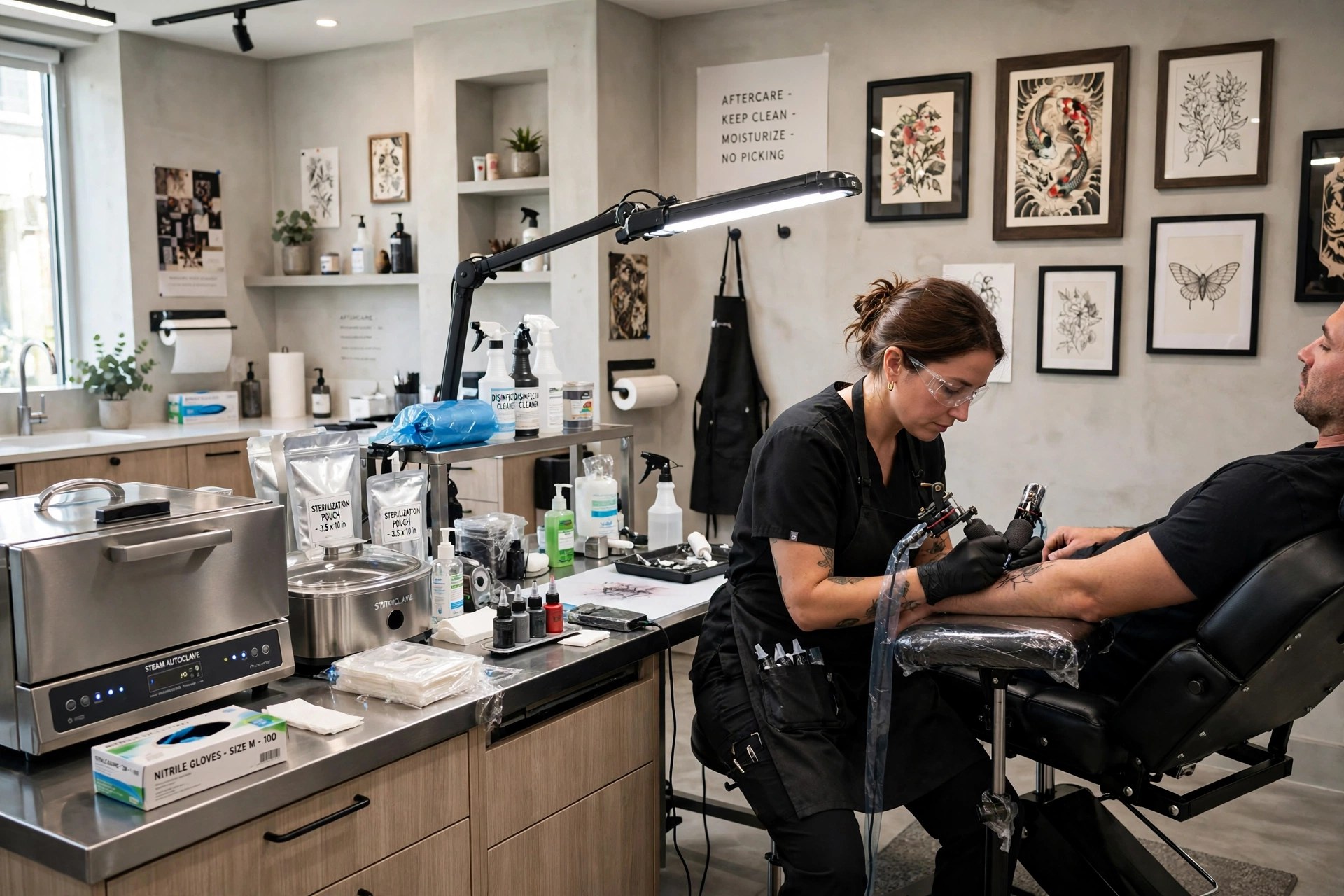
Equipment is the second-biggest category, and the one owners most commonly finance. Professional tattoo machines run $200 to $1,000 each, and working artists typically own three to six — a four-artist shop can carry $5,000 to $10,000 in machines alone. Hydraulic client chairs run $600 to $2,500 each (budget chairs $300 to $1,500). The autoclave sterilizer is non-negotiable: $2,000 to $5,000 for a certified unit with regular spore testing, required for health-department compliance in most jurisdictions. Add workstations at $198 to $332 each, professional lighting at $200 to $500 per station, and starter ink and needle stock at $500 to $2,000, and a single quality station adds up fast — which is why every artist added multiplies the equipment bill.
Then there is the monthly reality. Well-run studios typically operate on net margins of 15 to 30 percent after artist splits, rent, supplies, and marketing. Artist compensation is usually a split or booth rent, not a salary, so revenue swings land on the owner first. Insurance, licensing, and bloodborne-pathogen certification are recurring costs, not one-time ones. A studio that looks profitable on a busy Saturday can be thin across a slow month — and that is exactly what a lender will see in the statements.
The five cash demands of a tattoo studio
1. The build-out. Sinks and dedicated plumbing per station, partitions or private rooms, wipe-clean flooring, ventilation, and lighting. A light renovation runs a few thousand; a full conversion of a raw space runs $20,000 or more on its own. This is a term loan or equipment-financing job, not an advance: the room pays back over years.
2. The station package. Machines, chairs, autoclave, workstations, lighting. Equipment financing fits because the assets secure the loan and the payments match their working life. Buying used furniture is fine; anything tied to sterilization and safety is not the place to cut corners.
3. The slow-month float. January and February are slow for many studios; conventions and summer are strong. A line of credit opened during a strong stretch covers rent and supplies through the trough, then gets repaid when bookings return.
4. The growth step. Adding a chair means adding a station, an artist, and marketing — and the revenue lags the cost by weeks while the new artist builds a book. A revenue-based advance can bridge that single gap, but only when the bookings pipeline is real: a waitlist, not a hope.
5. The convention and guest-artist push. Booth fees, travel, and a guest artist's guarantee all land before the revenue does. Short-term working capital fits; a long-term loan for a weekend does not.
Need working capital this week?
Apply Now →Free to apply · Soft credit check only · Funding in 24–72 hoursThe product map: what fits which need
Build-outs and room conversions belong on term loans or SBA-backed loans: long-lived improvements repaid over years, with payments sized to the studio's average month, not its best convention weekend. Equipment packages belong on equipment financing, where the machines, chairs, and autoclave secure the loan. The slow-month float belongs on a line of credit: drawn only when needed, repaid when bookings return. A single fast gap — a station that must be replaced before a booked-out weekend, a convention booth fee due Friday — is where a revenue-based advance earns its cost, because the collection event is defined and near.
What does not fit: a daily-debit advance for rent or payroll. Those costs are permanent, and debits do not pause for a slow month. A studio paying a daily debit through a trough month is borrowing against revenue that has not arrived yet, and the debit makes the trough deeper.
What lenders check on a studio file
Lenders underwrite tattoo studios on the same core documents as any business — three months of business bank statements, time in business, and deposit consistency — plus three things specific to the trade. First, license and health standing: a current studio license, artist licenses, and a clean inspection record. A studio with a lapsed permit is a file that stalls. Second, the compensation structure: splits versus booth rent, and how much of the deposit stream the owner actually keeps after artists are paid. A lender sizes on the owner's retained revenue, not the gross booked. Third, seasonality and concentration: a studio dependent on one star artist or one convention season is riskier than a studio with four artists and a steady walk-in book.
Three things strengthen a studio file more than anything else. A bookings calendar showing real appointments, not just social-media followers. Clean statements with steady deposits and no unexplained overdrafts. And a clear separation between business and personal money — cash tips and card deposits both documented, because undocumented cash is invisible to an underwriter.
Five funding mistakes tattoo studios keep making
1. Financing the whole build-out on an advance. A $60,000 build-out repaid by daily debits crushes the studio before the chairs fill. Long-lived improvements need long repayment.
2. Adding chairs before the book exists. Every chair multiplies equipment and station costs. Grow into the space: open solo or small, then add chairs as the waitlist proves the demand.
3. Borrowing against a convention weekend. A record convention is not a run rate. Lenders size on the average month, and so should the owner.
4. Cutting corners on sterilization to save money. A failed inspection costs more than an autoclave — in fines, in closure, and in reputation. Safety equipment is the last place to economize.
5. Mixing cash tips into personal accounts. Revenue an underwriter cannot see does not exist for underwriting. Document everything, and the file gets bigger.
How fast a studio can get funded
Revenue-based products typically fund in 24 to 72 hours from a complete application, once bank statements are verified. Equipment financing takes days to weeks depending on the asset and the file. A line of credit takes days to a couple of weeks to open, then draws are immediate. SBA-backed loans for a purchase or major build-out take the longest and should be started a quarter before the money is needed.
The practical move: open the line during a strong stretch, keep it mostly undrawn, and use advances only for defined gaps. Gather three months of statements before you start, and the clock runs from day one.
Frequently asked questions
Can a tattoo studio get a business loan?
Yes. Tattoo studios qualify for lines of credit, revenue-based advances, equipment financing, and term loans through third-party funders, based on bookings, retained revenue after artist splits, seasonality, bank statements, and license standing. A bookings calendar is often the strongest part of the file.
What do lenders check for tattoo studio funding?
Studio and artist licenses, health inspection standing, the compensation structure of splits versus booth rent, retained revenue after artists are paid, seasonality, and bank statement health. A lender sizes on the revenue the owner keeps, not the gross booked.
How fast can a tattoo studio get funded?
Revenue-based products typically fund in 24 to 72 hours from a complete application, once bank statements are verified. Equipment financing takes days to weeks, and SBA-backed loans for acquisitions or build-outs take longer.
Is a merchant cash advance good for a tattoo studio?
It can be, for a single fast gap with a defined collection event, such as replacing a station before a booked-out weekend or covering a convention booth fee. For permanent costs like rent or payroll, a line of credit usually fits better, because daily debits do not pause for a slow month.
What documents does a tattoo studio need to apply?
Recent business bank statements, typically the last three months, are the core requirement. A photo ID and a voided check may be requested as optional verification items, but they are not upfront requirements for getting a quote. A bookings calendar and license documentation help where available.
How much funding can a tattoo studio get?
It depends on revenue, seasonality, and the product: revenue-based advances are usually sized as a multiple of monthly revenue, while lines, equipment loans, and term loans depend on the broader file. Ask for the total repayment in dollars before accepting any offer.
The best offer is the one you compare
Get a no-obligation quote from our #1-ranked lender, Coast to Coast Fast Funding — $5K to $5M, MCA and revenue-based products that fund in 24–72 hours with soft-pull-only applications. We shop 75+ lenders so you can compare the true cost of every offer side by side.Apply Now →Soft credit check · 60-second pre-qualification · (352) 809-3201