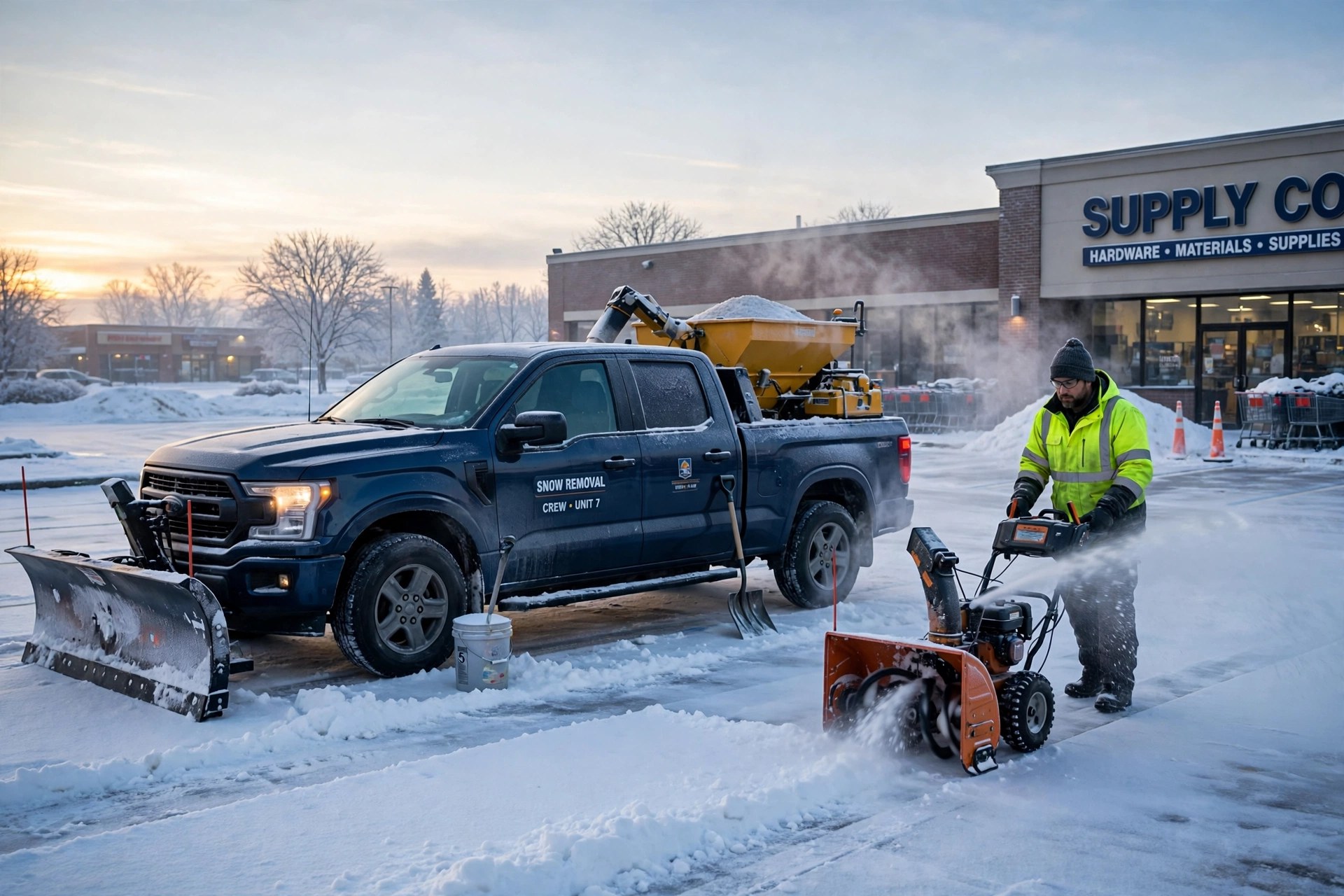
The truck math comes first
Snow removal is a seasonal business with a brutally simple equation: the winter is short, the storms are unpredictable, and the truck has to be paid for whether it snows or not. Before any funding conversation, the equipment tier sets the budget. A residential operator starting with a pickup and a plow can get moving for roughly 25,000 to 40,000 dollars all-in. A commercial operation with a dedicated plow truck, spreader, and backup equipment runs 100,000 to 160,000 dollars. A complete new plow truck alone runs 50,000 to 120,000 dollars, and a used plow truck with the plow already mounted runs 35,000 to 90,000 dollars. The plow attachment by itself runs 5,000 to 15,000 dollars, a tailgate or hopper spreader runs 500 to 3,000 dollars, and a commercial snow blower for walkways runs 600 to 2,000 dollars. Insurance runs 2,000 to 6,000 dollars a year, and permits and licensing add 500 to 2,000 dollars. A funding file that names the truck, the plow, and the route reads as a real business; a file that just says "snow removal" reads as a guess.
That is why the first question a lender asks a snow operator is not "how much do you want" but "residential or commercial, per-push or seasonal, and how many accounts are already signed?" The answers set everything: a residential route of 15 to 30 driveways on seasonal contracts is a side income of roughly 15,000 to 40,000 dollars per season for a solo driver, while a multi-truck crew with commercial accounts runs 55,000 to 120,000 dollars per season, and established operations with multiple crews and commercial contracts pass 200,000 dollars. Industry estimates put the United States snow removal market near 20.8 billion dollars a year, and margins for tight operations run 40 to 60 percent after fuel and equipment — but only when the route is dense and the contracts are signed before the first storm. Roughly 80 percent of a season's sales must close by October 1, which is why the funding calendar for this industry runs in late summer, not in January.
Five cash demands, in the order they hit
First, the truck and plow: the single largest capital line, and the one that decides whether the business can take commercial work at all. A pickup with a plow handles driveways; a commercial lot needs a heavier truck, a wider blade, and a spreader, and a municipal or hospital contract may require backup equipment on standby. Second, salt and ice melt inventory, bought before the season when prices are lowest — salt runs 500 to 2,000 dollars per season for a small operator and scales fast with commercial acreage, and running out mid-storm is a contract-ending event. Third, labor: seasonal drivers and shovel crews at 15 to 20 dollars an hour, on call at 2 a.m., in a labor market where reliability matters more than price. Fourth, the pre-season push: marketing, route building, and contract signing in September and October, when the money goes out and nothing comes back until the first snowfall. Fifth, the off-season float: from March to November the business earns nearly nothing in most climates, yet insurance, truck payments, and storage keep billing. That fifth demand is the one that sinks snow businesses — the season pays for the year, so the year has to be budgeted from the season.
Per-push, seasonal, or hybrid: the contract is the business model
Underwriting a snow business turns on the contract mix, not the truck count. Residential driveways typically price per push at 35 to 100 dollars, with small driveways at 25 to 50 dollars, medium driveways at 50 to 80 dollars, and large or circular drives at 80 to 150 dollars, triggered when snowfall passes a set depth — usually 2 inches. Commercial lots price per push at 150 to 500 dollars and up, and salting or de-icing bills 100 to 300 dollars per application. Seasonal contracts flip the risk: a fixed monthly fee from November through March regardless of snowfall, typically 200 to 600 dollars a month residential and 500 to 3,000 dollars and up commercial, with guaranteed minimums on the commercial side.
Each model breaks differently. Per-push pays beautifully in a heavy winter and starves in a mild one — a route that counted on 10 to 15 snowfalls and got four is a route that cannot make its truck payment. Seasonal contracts smooth the income but turn into loss leaders in a brutal winter, when a fixed fee has to cover twice the expected pushes. The operators who survive both winters run a hybrid: seasonal contracts on the residential base for predictable income, per-push or per-visit pricing on commercial accounts, and salting billed per application so the ice events that do not trigger a plow still pay. Lenders weight the signed contract book heavily, because an unsigned route is a hope and a signed route is revenue: show the contracts, the trigger depths, and the route density, and the file underwrites itself.
Need working capital this week?
Apply Now →Free to apply · Soft credit check only · Funding in 24–72 hoursThe product map: what fits which need
Equipment financing fits the truck and plow package itself: the truck, blade, and spreader are identifiable assets with a working life measured in years, so the term can match the asset and the equipment secures the loan. A term loan fits the full launch or expansion budget — a second truck, a salt storage setup, a commercial-grade blower fleet — because those costs pay back over multiple seasons, not one winter. A business line of credit fits the pre-season gap: salt inventory bought in September, marketing and route building in October, and the payroll float during a storm cycle before contract payments arrive. Revenue-based advances fit only one narrow case here: a single fast gap with a defined collection event, such as replacing a failed transmission mid-season when signed contracts are already paying monthly. What does not fit is funding a whole truck on a daily-debit advance repaid from one winter's storms — the truck serves for a decade, the season lasts four months, and daily debits do not pause for a snowless January.
What funders check on a snow file
Three months of business bank statements are the core document for an existing operator, and a new operator's file turns on the signed contract book, the truck and plow quotes, and the route plan. Lenders also look at time in business, deposit consistency, existing advance positions, and — for larger term loans — broader financials. For a seasonal business, the lender will annualize carefully: a single strong winter month is not a run rate, and a file that shows the summer trough honestly, with a plan for it, reads better than a file that pretends the trough does not exist. Dual-purpose trucks that work construction or landscaping in summer, or a lawn-care pairing, are a genuine underwriting plus because they answer the off-season question. Credit matters less for revenue-based products than deposit health does, but it still moves the price. If a funder will not put the total repayment in dollars in writing, that is the offer to walk away from, whatever the headline rate sounds like.
Frequently asked questions
Can a snow removal business get a business loan?
Yes. Snow removal businesses qualify for lines of credit, revenue-based advances, equipment financing, and term loans through third-party funders, based on deposits, time in business, the signed contract book, and the equipment file. A route with signed seasonal contracts underwrites very differently from an unsigned route.
What do lenders check for snow removal funding?
The signed contract book first — per-push or seasonal, trigger depths, and route density — then the truck and plow package, salt inventory, and the off-season plan. A complete new plow truck runs 50,000 to 120,000 dollars, and a file that names the truck, the plow, and the route reads as a real business.
How fast can a snow removal business get funded?
Revenue-based products typically fund in 24 to 72 hours from a complete application, once bank statements are verified. Equipment financing takes days to weeks, and SBA-backed loans for acquisitions or build-outs take longer.
Is a merchant cash advance good for a snow removal business?
It can be, for a single fast gap with a defined collection event, such as a mid-season truck repair while signed contracts are already paying monthly. For the truck itself it does not fit — a truck that serves for a decade should not be repaid from one winter of storms.
What documents does a snow removal business need to apply?
Recent business bank statements, typically the last three months, are the core requirement. A photo ID and a voided check may be requested as optional verification items, but they are not upfront requirements for getting a quote. Signed seasonal contracts, truck and plow quotes, and the route plan help where available.
How much funding can a snow removal business get?
It depends on revenue, seasonality, and the product: revenue-based advances are usually sized as a multiple of monthly revenue, while lines, equipment loans, and term loans depend on the broader file. Ask for the total repayment in dollars before accepting any offer. A residential operator starts around 25,000 to 40,000 dollars all-in, while a commercial operation with a dedicated plow truck, spreader, and backup equipment runs 100,000 to 160,000 dollars.
The best offer is the one you compare
Get a no-obligation quote from our #1-ranked lender, Coast to Coast Fast Funding — $5K to $5M, MCA and revenue-based products that fund in 24–72 hours with soft-pull-only applications. We shop 75+ lenders so you can compare the true cost of every offer side by side.Apply Now →Soft credit check · 60-second pre-qualification · (352) 809-3201