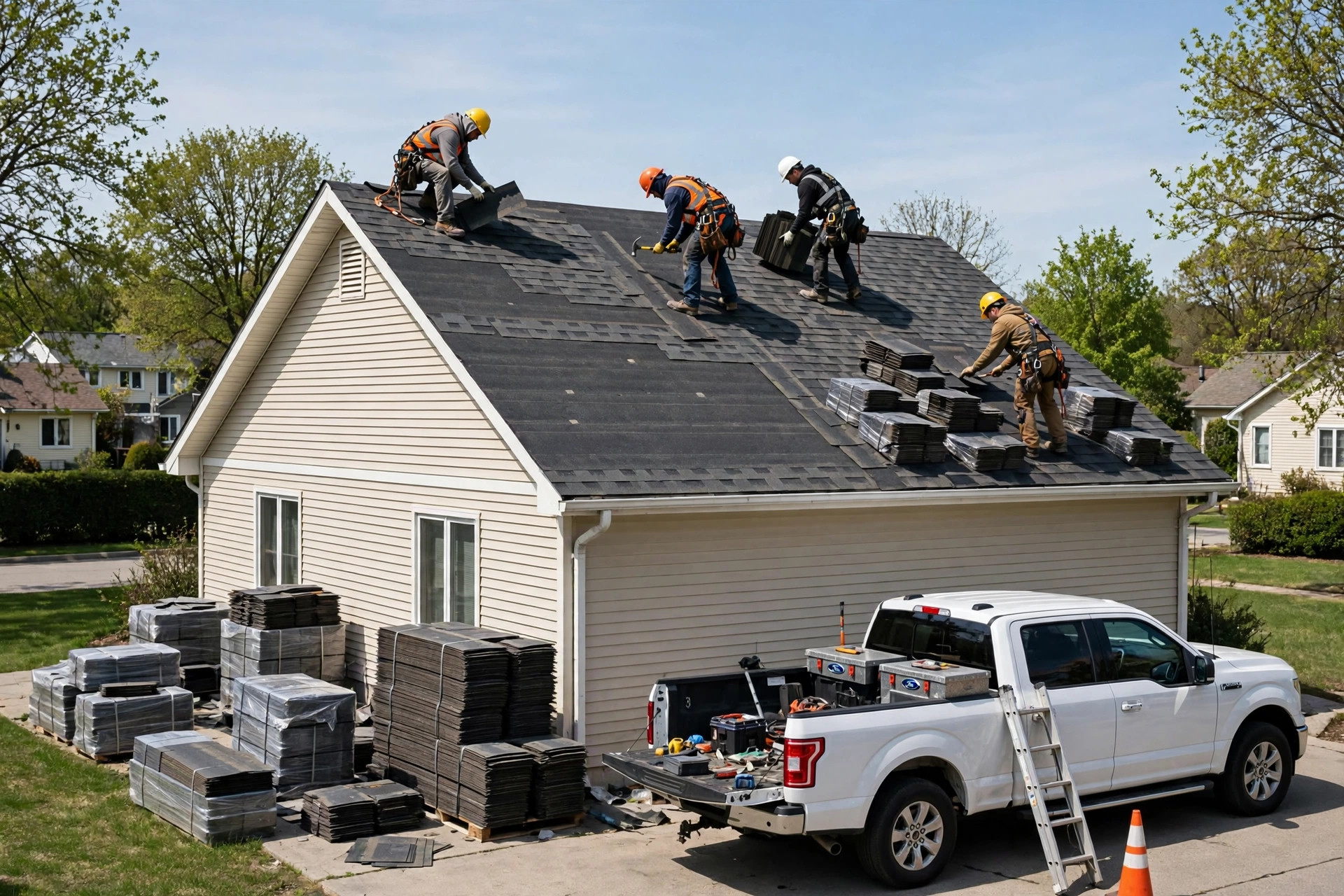
Roofing looks like a simple trade from the driveway — a crew, a truck, a dumpster — but the business underneath is one of the most cash-hungry in home services. Materials are bought before the job pays, crews are paid weekly whether the customer has paid or not, and the work itself arrives in surges: a hailstorm can fill a month's schedule in a weekend, and a quiet winter can empty it just as fast. This guide covers what roofing companies actually borrow for, what opening, growing, or equipping one costs in 2026, and which product fits each need.
The funding map for a roofing company splits into five buckets: covering materials and payroll on jobs that pay on completion, equipping trucks and crews, catching a storm surge, carrying insurance and licensing costs, and opening a second crew or branch. Each bucket has a different best product, and the single most important underwriting fact in all five is timing: the roofer pays first and gets paid last, so the product has to match the gap, not just the amount.
What roofing companies borrow for
Materials and payroll float. The most common first funding need. A roofer orders shingles, underlayment, and flashing up front — suppliers often want a deposit or payment on delivery — pays the crew weekly, and gets paid by the homeowner or insurer on completion, sometimes weeks later. A working-capital advance or line of credit sized to the average job pipeline is what keeps crews working between the supplier invoice and the final check.
Trucks, trailers, and equipment. The capital-heavy route. A work truck, an enclosed trailer, a dump trailer, ladders, nail guns, compressors, and safety gear add up fast, and a second crew needs a second set of everything. Equipment financing fits here because the truck and trailer secure the loan, which usually means easier underwriting than unsecured working capital.
Storm-surge staffing. The growth investment that arrives without warning. After a hail or wind event, a roofer's phone rings for weeks — but hiring, training, and equipping extra crews, plus the marketing to reach homeowners before competitors do, all cost money before the first storm job pays. Revenue-based funding fits the surge because it funds in days and is sized to the deposits already coming in.
Insurance, licensing, and bonding. The fixed cost every roofer underestimates. Workers' compensation in roofing is among the most expensive of any trade, general liability and commercial auto renew annually, and many commercial and municipal jobs require bonding. An annual premium that lands in one lump sum is a classic line-of-credit use: draw for the premium, repay as jobs pay out.
A second crew or a second market. The expansion need. A roofer with a full book in one city opens a second crew or a branch in the next county — new truck, new trailer, new crew, new marketing, and months of payroll before the new territory's reputation catches up. A term loan fits the expansion because the payback period is measured in years, not weeks.
What a roofing company actually costs in 2026
Roofing costs are quoted two ways, and funders think in both: residential work by the square (100 square feet of roof surface) and commercial work by the square foot. Published 2026 planning ranges anchor the conversation — actual quotes vary by market, pitch, access, and tear-off scope.
| Cost item | Published 2026 planning range | What drives it |
|---|---|---|
| 3-tab asphalt shingles, installed | $230–$280 per square | Budget residential; 15–20 year life |
| Architectural asphalt shingles, installed | $300–$400 per square | Most residential work; 25–30 year life |
| Standing seam metal, installed | $770–$1,000 per square | Premium residential and commercial; 50–70 year life |
| Flat / TPO membrane, installed | $360–$450 per square | Low-slope residential and light commercial |
| Typical residential replacement (2,000 sq ft home, architectural shingles) | $8,800–$14,400 | 22–26 squares including tear-off and underlayment |
| Commercial TPO membrane | $5.50–$10.50 per sq ft | Warehouses, retail, offices; 20–25 year life |
| Commercial EPDM membrane | $5.00–$9.00 per sq ft | Budget flat roofs; 25–30 year life |
| Commercial PVC membrane | $7.00–$14.00 per sq ft | Restaurants and food plants; grease and chemical exposure |
| Commercial standing seam metal | $10.00–$18.00 per sq ft | Long-life assets; 40–60 year life |
For the roofing company itself, the numbers that matter most are not the per-square rates but the cash cycle: materials and labor go out in week one, the final payment often arrives weeks after completion, and insurance-paid storm work adds adjuster timelines on top. A company running five jobs at once can have tens of thousands of dollars in completed work unpaid at any moment — which is why the funding conversation for roofers is almost always about float, not about a single purchase.
How a roofing company actually makes money
Retail replacements. The bread and butter. A homeowner pays a deposit, a progress payment at material delivery, and the balance on completion. Margins are set by estimating accuracy: one missed decking repair or underestimated tear-off layer can erase the profit on a job. Funders like retail books because the revenue is diversified across many small jobs — no single customer can sink the month.
Storm and insurance work. The surge revenue. After a hail or wind event, volume spikes and the average ticket rises, but payment runs through insurers: supplements, adjuster approvals, and depreciation holdback stretch the collection cycle well past retail norms. A roofer whose book is mostly storm work looks lumpy to a funder — big months, slow months — and underwrites better with a line of credit that flexes with the cycle than with a fixed daily debit sized to a peak month.
Commercial and new construction. The scale revenue. Warehouses, retail centers, and multifamily re-roofs run into six figures per job, but they pay on progress schedules and retainage, and they demand bonding, higher insurance limits, and longer warranties. Funders weigh commercial books on backlog quality: signed contracts with reputable general contractors read very differently from a pipeline of verbal estimates.
Repairs and maintenance. The steady revenue. Leak calls, flashing repairs, and maintenance contracts are small tickets but fast collections and high repeat rates — and they feed the replacement pipeline. A roofer with a real repair book underwrites better than one living job to job, because the repair base proves the phone keeps ringing between storms.
Which product fits which roofing need
| Your need | Best first product | Why |
|---|---|---|
| Float materials and payroll between jobs | Line of credit or revenue-based funding | Draws flex with the pipeline; repay as jobs pay out |
| Work truck, dump trailer, or crew equipment | Equipment financing | The asset secures it; payments match its useful life |
| Staff and market a storm surge | Revenue-based funding | Funds in days, sized to deposits already coming in |
| Annual insurance premiums or bonding | Line of credit | One lump sum, repaid across the year |
| Second crew or new market | Term loan | Long payback period; fixed monthly payment |
| Buy a building or a yard | SBA loan | Lowest cost for a long-lived asset — start early |
What funders weigh on a roofing file
Deposit consistency and backlog. Funders start with bank statements, but for roofers they also read the backlog: signed contracts, deposits collected, and jobs scheduled. A company with a full month of signed work and deposits in hand reads as lower risk than one with the same deposits but an empty schedule — the backlog is next month's revenue already sold.
Storm concentration. A book that is 90 percent insurance work in one hail corridor is a weather bet, not a business, in a funder's eyes. Diversification — retail plus storm, residential plus commercial, repairs plus replacements — smooths the file and usually improves the offer.
Seasonality and the winter gap. Roofing slows in winter in most markets. Funders price for it: a line of credit sized to the slow months, rather than a daily-debit advance sized to a summer peak, is the right product for the gap. Show last year's monthly deposits and the upcoming booked work so the funder underwrites the pattern instead of averaging it away.
Insurance standing and licensing. Lapsed workers' compensation or an expired license is a fast decline on commercial files and a red flag on any file. Keep certificates current and ready — funders ask, and a same-day answer speeds the approval.
The documents: short list, no surprises
For a revenue-based application, the standard ask is short: last 3–6 months of business bank statements and a completed application. A government-issued ID and a voided check are sometimes requested for verification on specific products before funding — but neither is a universal upfront requirement to see your offers. Bank and SBA applications add tax returns, profit-and-loss statements, and often proof of insurance and licensing. If a lender asks for far more than this list for a small revenue-based advance, that is a sign to compare offers elsewhere.
Mistakes that cost roofing companies real money
Financing a slow winter with a fast product. Daily-debit funding is built for needs that generate cash quickly — a storm surge, a materials buy for signed jobs. Using it to cover a structural winter shortfall just stacks payments on top of a shortfall.
Signing on total repayment you never saw. Always get the total repayment dollars in writing before you sign — not just the factor rate or the monthly estimate. Two offers with the same advance amount can differ by thousands in total repayment.
Sizing the advance to a storm peak. An offer sized to your best hail month becomes a burden in a normal month. Size to the average month, keep the surge capacity in a line of credit, and the payments stay survivable year-round.
Letting insurance lapse mid-term. A workers' compensation lapse can void commercial contracts and trigger a funder review. Calendar every renewal and fund the premium before it is due, not after the cancellation notice.
Opening, equipping, or growing a roofing company? See what you qualify for
From the first truck to the storm-surge crew — get a no-obligation quote from our #1-ranked lender, Coast to Coast Fast Funding. One application reaches multiple funders, so you see the actual market for your file.
Apply Now →Soft credit check · 60-second pre-qualification