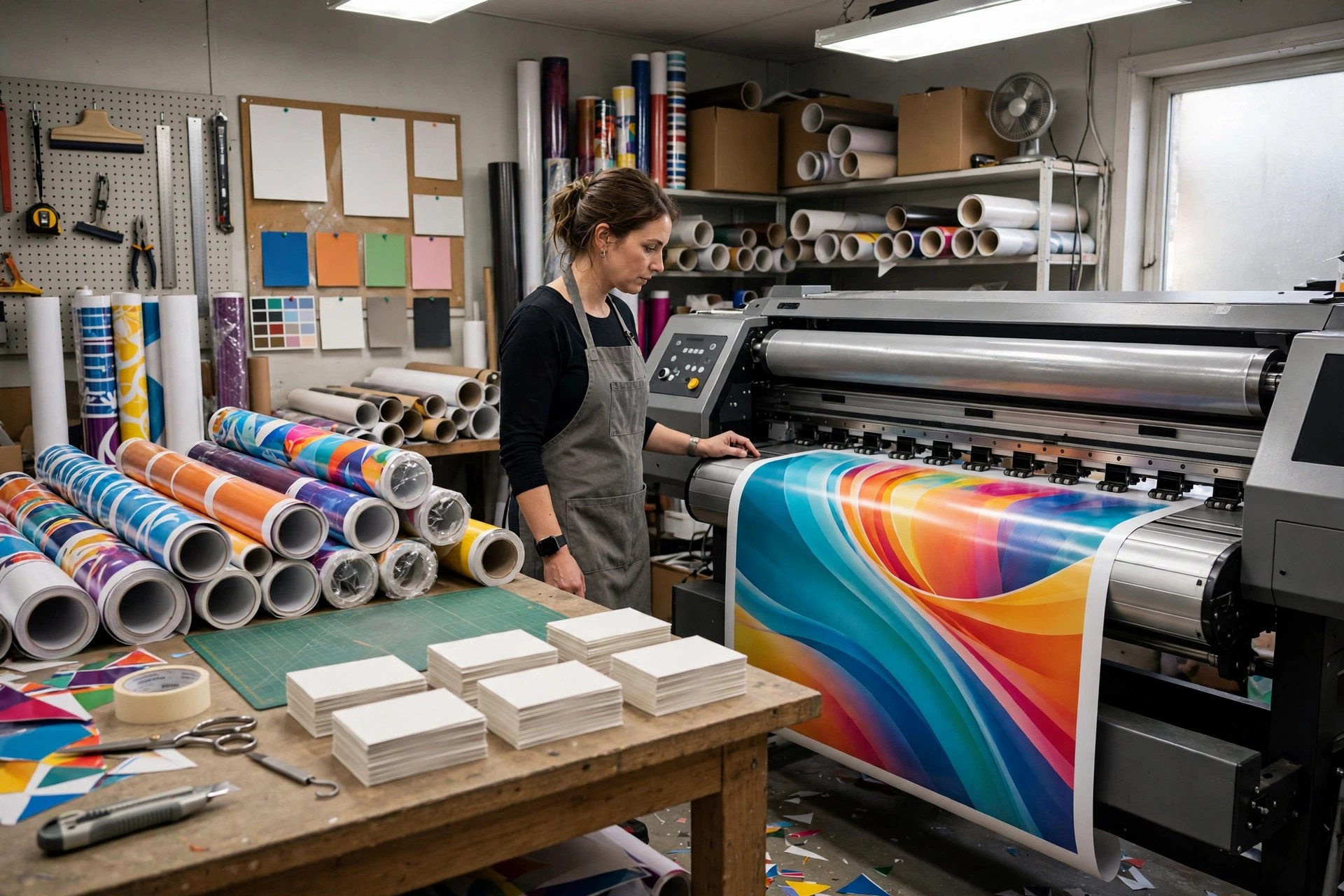
Print and sign shops do not have a cash-flow problem. They have a timing problem layered on top of an equipment problem. A wide-format printer, a flatbed printer, a laminator, and a CNC router can cost more than a year of profit, and they all wear out on the same schedule. Meanwhile the revenue arrives in lumpy jobs — a fleet wrap here, a trade-show booth there, a restaurant menu run paid net-30 — while rent, payroll, and substrate costs are due on the same day every month. That is the gap print and sign funding exists to close.
This guide covers how print and sign businesses actually borrow: the five cash demands that recur in nearly every shop, which product fits each one, what lenders check on a print file, and the five mistakes that turn a good quarter into a scramble.
Why print and sign shops borrow on a different calendar
Most retail businesses sell a product and get paid the same day. A print shop sells jobs and gets paid in pieces: walk-in retail orders paid at pickup, small-business accounts billed on delivery, and commercial and municipal accounts — hotels, franchises, school districts, contractors — that pay on net-30 terms or longer. The cost side does not wait for the slowest payer. The lease is monthly, the press operators are weekly, the wide-format printer runs daily, and a printer breakdown stops production outright.
Seasonality sharpens the edge. Back-to-school brings signage and spirit wear; fall brings trade shows, political campaigns, and holiday retail displays; spring brings real-estate signs, event banners, and construction-site signage; summer brings vehicle wraps and outdoor campaigns. A shop that staffs for the fall rush and pays for it out of winter collections is borrowing from itself — usually at the worst possible moment.
Then there is the equipment cliff. Commercial print equipment is not a small purchase. A wide-format printer, a flatbed UV printer, a laminator, a vinyl cutter, and a CNC router are capital assets with long lives and sudden failures, and a technology change — latex replacing solvent, UV flatbed replacing screen — can make a whole line obsolete at once. Shops that plan for that cliff borrow on their schedule. Shops that do not borrow on the breakdown's schedule, which is always worse.
The five cash demands of a print and sign shop
1. Presses, printers, and finishing equipment. A single wide-format or flatbed printer replacement can swallow a quarter of profit, and a new location means presses, finishing tables, ventilation, and a lease deposit before the first job ships. These are lumpy, planned-or-forced purchases that do not fit weekly cash flow.
2. Substrate and ink inventory. Vinyl, banner material, rigid substrates, inks, and laminates must be stocked before the job, and the best prices come from buying in bulk — which means cash out weeks before the job invoices.
3. The commercial-account float. A franchise rollout or municipal signage contract that pays net-30 means thirty days of labor, materials, and installation costs carried by the shop. Growth in commercial accounts is growth in float first and profit second.
4. Installation crews and vehicles. A sign installation needs a bucket truck or a wrapped van, trained installers, and permits — costs that arrive before the install invoice is ever paid.
5. Technology refresh and software. Print technology moves: new printer lines, new RIP software, new color-management tools, and web-to-print storefronts for repeat customers. Each refresh is lumpy, and deferring it loses the jobs that need the new capability.
Need working capital this week?
Apply Now →Free to apply · Soft credit check only · Funding in 24–72 hoursThe product map: what fits which need
There is no single right product for a print shop. There is a right product per need, and mismatching them is the most expensive mistake in this guide.
A business line of credit fits the commercial-account float and the substrate-buying cycle. Draw when the franchise account is outstanding, repay when it clears, and the line is there again for the next cycle. For shops with repeating commercial revenue, this is usually the core facility, and it is worth opening during a strong season rather than during a crunch.
Revenue-based advances fit a single fast gap with a defined collection event: a printer that failed on Monday and must be running by Friday, a trade-show booth order that ships this week and pays in thirty days, a lease deposit on a second location with a signed lease in hand. They fund in 24 to 72 hours from a complete application, which matters when production is stopped. They are a poor fit for permanent, repeating costs, because daily debits do not pause for a slow winter.
Equipment financing fits printers, routers, laminators, cutters, and install vehicles — assets with a serial number and a resale market. The equipment itself secures the loan, which usually means better terms than an unsecured advance, and the payment schedule can match the asset's useful life.
Term loans and SBA-backed loans fit the big, one-time moves: acquiring a competitor's shop, building out a new location, or financing a full technology refresh. They take longer — days to weeks for a term loan, longer for SBA — so they belong in planning, not in emergencies.
The rule of thumb: match the repayment schedule to the cash event that repays it. Float gets a line. A single gap gets an advance. An asset gets equipment financing. A transformation gets a term loan.
What lenders check on a print and sign file
Print files are judged on revenue mix as much as on history. Lenders will look at bank statements — typically the last three months — for deposit consistency, average balances, and overdrafts. But they will also ask what a generic application never captures: how much revenue is walk-in retail versus repeat small-business accounts versus large commercial and municipal contracts, what the average job size and repeat rate look like, and how much of the revenue is tied to a single franchise or municipal customer.
Three things strengthen a print file more than anything else. First, a revenue-mix summary: retail, repeat accounts, and commercial percentages, plus the top accounts and their payment terms. Second, an equipment list with ages — a shop whose newest printer is ten years old is a breakdown away from a forced purchase, and lenders price that. Third, a clean story on seasonality: full-year revenue, not just the fall trade-show peak, so the lender underwrites the winter trough too.
What weakens a file: deposits that never convert, a pipeline of promised franchise rollouts presented as signed contracts, and customer concentration — one account providing most of the revenue. None of these is fatal on its own. All of them together tell a lender the book is softer than the pitch claims.
Five funding mistakes print and sign shops keep making
1. Funding a permanent cost with a daily-debit advance. Press-operator payroll is forever. An advance is for a gap. Using one for the other means the debit continues long after the gap closed.
2. Taking the first offer during a breakdown. A dead printer is real pressure, but a rushed advance signed at a high factor rate costs more than the days it saved. Get the repair-or-replace quote, then compare the total repayment in dollars before signing.
3. Presenting pipeline as backlog. Lenders verify. Unsigned franchise proposals discovered during underwriting do more damage than a smaller honest book would have.
4. Ignoring the equipment age curve. If every printer in the shop is past its expected life, the funding plan must survive the next failure, not the last one. Price the replacement before it is an emergency.
5. Stocking substrates on operating cash alone. A bulk substrate buy that drains the account before the jobs invoice leaves nothing for payroll when a customer pays late. Fund the buy, then let collections repay it.
How fast print and sign funding moves
Revenue-based products typically fund in 24 to 72 hours from a complete application, once bank statements are verified. A line of credit takes longer to open — days to a couple of weeks — but once open, draws are immediate. Equipment financing usually closes in days to weeks depending on the asset and the file. SBA-backed loans for acquisitions or build-outs take the longest and should be started a quarter before the money is needed.
The practical move is to open the line during a strong season, keep it mostly undrawn, and use advances only for defined gaps. That combination — a standing line plus a fast advance for surprises — is how print shops stop letting the printer schedule run the company.
The bottom line for print and sign shops
Print and sign work is a good business with a hard calendar: cash out for presses, substrates, and installation, cash in only after retail orders, repeat accounts, and net-30 commercial contracts all clear. Funders understand that calendar when the file shows it honestly — revenue mix, commercial terms, equipment ages, and full-year seasonality. Match each need to the product built for it, compare every offer by total repayment in dollars, and open the line before you need it. The press is not the constraint. The float is.
Frequently asked questions
Can a print or sign shop get a business loan?
Yes. Print and sign shops qualify for lines of credit, revenue-based advances, equipment financing, and term loans through third-party funders, based on revenue mix, commercial accounts, bank statements, and full-year seasonality. A revenue-mix summary showing retail, repeat-account, and commercial percentages is often the strongest part of the file.
What do lenders check for print and sign shop funding?
Revenue mix across retail, repeat accounts, and commercial or municipal contracts, top accounts and their payment terms, equipment ages, customer concentration, full-year seasonality, and bank statement health. An equipment list with ages and a commercial-account summary strengthen any application.
How fast can a print or sign shop get funded?
Revenue-based products typically fund in 24 to 72 hours from a complete application, once bank statements are verified. Equipment financing takes days to weeks, and SBA-backed loans for acquisitions or build-outs take longer.
Is a merchant cash advance good for a print or sign shop?
It can be, for a single fast gap with a defined collection event, such as a printer that failed on Monday and must be running by Friday or a trade-show order that ships this week and pays in thirty days. For permanent payroll or repeating seasonal costs, a line of credit usually fits better, because daily debits do not pause for a slow winter.
What documents does a print or sign shop need to apply?
Recent business bank statements, typically the last three months, are the core requirement. A photo ID and a voided check may be requested as optional verification items, but they are not upfront requirements for getting a quote. A revenue-mix summary and an equipment list with ages help where available.
How much funding can a print or sign shop get?
It depends on revenue, seasonality, and the product: revenue-based advances are usually sized as a multiple of monthly revenue, while lines, equipment loans, and term loans depend on the broader file. Ask for the total repayment in dollars before accepting any offer.
The best offer is the one you compare
Get a no-obligation quote from our #1-ranked lender, Coast to Coast Fast Funding — $5K to $5M, MCA and revenue-based products that fund in 24–72 hours with soft-pull-only applications. We shop 75+ lenders so you can compare the true cost of every offer side by side.Apply Now →Soft credit check · 60-second pre-qualification · (352) 809-3201