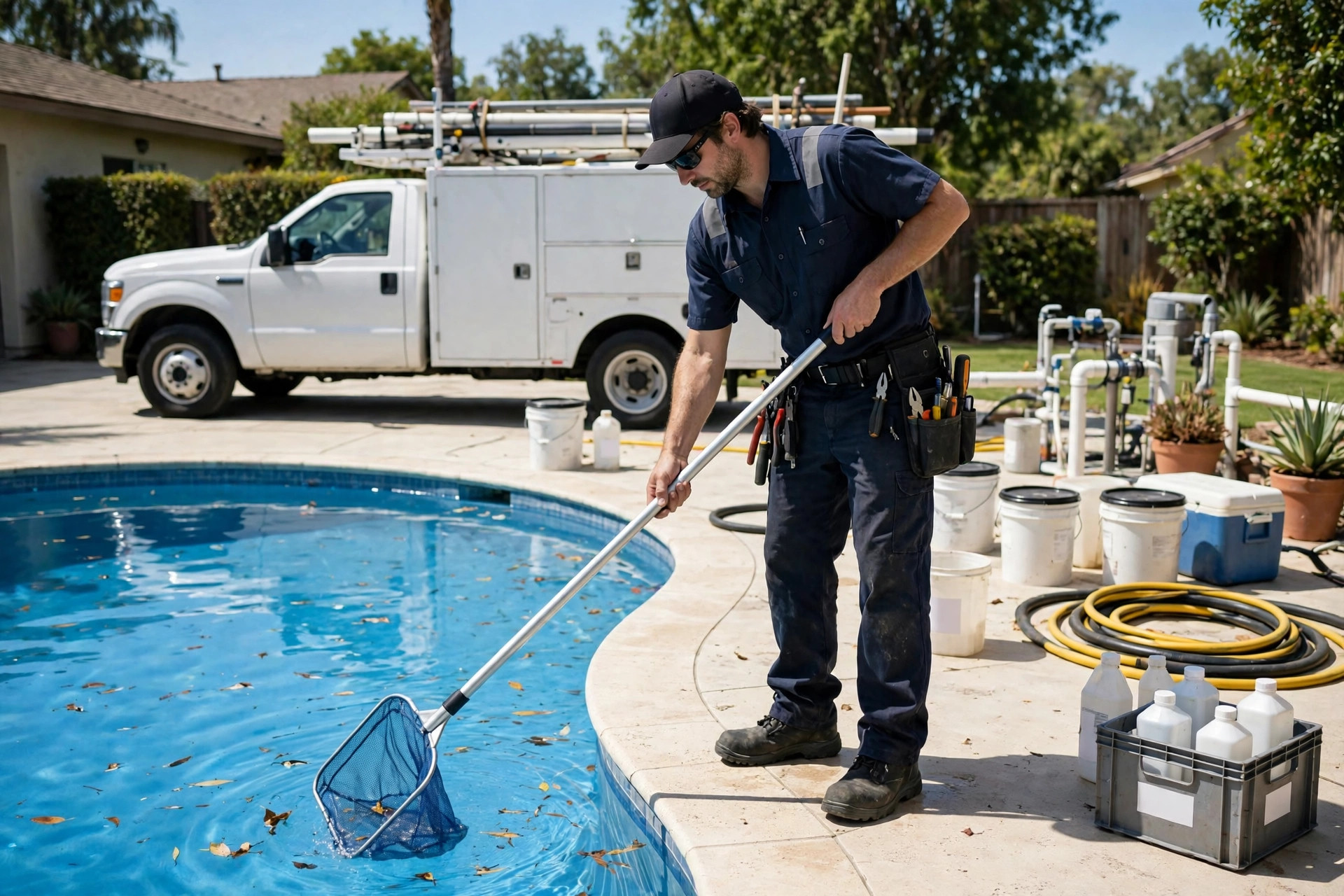
Pool service looks like a simple trade from the driveway — a truck, a pole, a pool — but the business underneath is one of the purest recurring-revenue models in services, and one of the most route-sensitive. A solo technician's income depends on how many pools sit on one tight route, chemical prices move with the season, and the truck, the chemical stock, and the route itself are three different assets that borrow three different ways. This guide covers what pool service companies actually borrow for, what opening, growing, or equipping one costs in 2026, and which product fits each need.
The funding map for a pool service company splits into five buckets: buying or building a route, equipping trucks and techs, carrying the chemical bill, adding repairs and equipment work, and surviving the off-season in seasonal markets. Each bucket has a different best product, and the single most important underwriting fact in all five is density: forty pools packed within five miles and forty pools spread across twenty-five miles are the same revenue and very different businesses.
What pool service companies borrow for
Buying a route. The fastest way to income, and the biggest single check most pool operators ever write. Routes sold through brokers typically cost 10 to 12 times monthly service billing — a route billing $7,500 a month sells for roughly $75,000 to $90,000, with Sun Belt routes commanding a 20 to 30 percent premium because the revenue runs year-round. The accounts bill from week one, which is why route purchases finance well: the income is documented, recurring, and already collected by autopay in most established routes. What funders check is retention — every account that leaves after the guarantee period raises what was really paid for the billing that stayed.
Trucks, trailers, and tech equipment. The capital route. A solo route can start with a used truck or trailer at $2,000 to $5,000, poles, brushes, nets, and a vacuum head at $300 to $600, and a water testing kit at $100 to $300. A two-to-four-tech company needs a second vehicle, scheduling software, and a chemical inventory buffer: $15,000 to $40,000 all-in. Equipment financing fits trucks and larger purchases because the vehicle itself secures the loan; poles and test kits belong on working capital, not on a term loan.
The chemical bill. The recurring cost that surprises new operators. A solo operator spends $1,200 to $1,800 a month on chemicals at 40 to 50 pools, plus $400 to $600 on fuel — and at 200 pools, chemicals run $8,500 to $10,000 a month, 28 to 33 percent of revenue. Bulk purchasing from distributors typically saves 15 to 25 percent against retail, which is why the chemical account, and the credit to carry it, matters more than the truck: cutting chemical costs by $5 per pool per month across 200 pools is $12,000 a year straight to profit. A line of credit sized to the chemical cycle — stock up before the season, draw down as billing arrives — fits better than a lump sum.
Repairs, equipment, and upgrades. The margin expander. A solo technician servicing 50 to 80 pools a week at $100 to $200 a month generates $60,000 to $150,000 a year in service revenue alone, and published guides put the step up plainly: adding equipment repairs, upgrades, and openings and closings can push annual revenue past $150,000, and certification for commercial work unlocks repair jobs that often triple the revenue per account. Pumps, filters, heaters, salt systems, and automation installs are equipment-financed or term-loan purchases, repaid from the repair revenue they create — not from the weekly service billing.
A second truck or a second territory. The growth move, and the density trap. A second tech needs a truck, a chemical stock, and a route dense enough to run 25 to 30 pools a day; a spread route runs 10 to 15. Borrowing against the first route's deposits to fund the second route's startup months is the classic way a growing pool company starves its core route — the new truck's fuel and chemical bill arrive before its billing does.
What it costs to open or grow a pool service business in 2026
Published 2026 startup guides put a solo pool cleaning route at $3,000 to $10,000, with some estimates at $5,000 to $15,000 including a vehicle, and a two-to-four-tech residential company at $15,000 to $40,000 once a second vehicle, scheduling software, and a chemical inventory buffer are included. The table below separates the lean solo start from the multi-truck operation: the difference is vehicles, chemical stock, and payroll, not the pole.
Starting lean (solo route, own truck). A used truck or trailer, a pole, brush, net, and vacuum head, a test kit, starter chemicals at $500 to $1,000, and liability insurance at $600 to $1,500 a year: roughly $3,000 to $10,000 all-in. Certification adds $200 to $400 and is required for commercial accounts — and it is what unlocks the repair work that raises revenue per account. Marketing at this stage is door hangers and referrals, not advertising spend.
Route-ready (bought route, one tech). Add the route purchase itself — 10 to 12 times monthly billing — plus a truck stock of chemicals at $1,500 to $2,500, tools at $400 to $800, insurance and certification at $1,200 to $2,000, and route software at $50 to $150 a month. A $5,000-a-month route costs roughly $50,000 to $60,000 to buy and equip. This is the band where financing earns its keep: the route bills from week one, so the loan is repaid from documented recurring revenue, not from hope.
Multi-truck operation (200 pools, three to four techs). Revenue at $150 a month average hits $30,000 a month, $360,000 a year, with net profit margins settling at 15 to 25 percent — $54,000 to $90,000 a year — in published 2026 benchmarks. The cost stack at that scale is labor at $10,000 to $14,000 a month, chemicals at $8,500 to $10,000, fuel and vehicles at $1,800 to $3,000, insurance at $1,000 to $2,000, and overhead at $1,500 to $2,500. This is line-of-credit and term-loan territory: the assets are long-lived, the contracts are recurring, and the chemical bill is a working-capital cycle.
The per-pool math funders check. Weekly service runs $80 to $100 a month for basic maintenance, $100 to $130 for standard service, and $130 to $150 for full service, with commercial accounts at $200 to $500 or more for two to three visits a week. A solo operator needs 40 to 50 weekly accounts at $125 to $150 a month to generate $5,000 to $7,500 a month gross; after chemicals, fuel, insurance, and equipment maintenance, net income lands at $3,000 to $5,500 a month. Dense routes run 25 to 30 pools a day, spread routes 10 to 15 — and a funder reading three months of statements can see the density in the fuel line.
Which product fits which need
Working capital line of credit — the chemical cycle and the float. Best for the chemical stock-up before the season and the gap between servicing a pool and collecting the monthly billing. Size it to the average month's chemical and fuel bill, not to the biggest month ever. A line that revolves is worth more than a lump sum here, because the cycle opens and closes every month.
Equipment financing — the trucks and the repair gear. Best for trucks, trailers, pumps, and diagnostic equipment. Terms follow the asset's life, the vehicle secures the loan, and used trucks finance routinely. A used work truck with a clean service history is often the best value in the fleet.
Term loan — the route purchase and the expansion. Best for planned, one-time investments repaid on a fixed schedule: buying a route, adding a second truck and territory, opening a retail chemical storefront. A route purchase repaid from the route's own documented billing is the cleanest term-loan story in the trade — but only when the account list, payment history, and rates have been checked hard before signing.
Merchant cash advance — the emergency only. Fits card-heavy businesses that need money in days. Most pool companies bill monthly by autopay or invoice, not by card, so a daily-debit product priced off card volume is usually the wrong shape. If an advance is the only product that fits the timeline, size it to the specific gap and get the total repayment dollars in writing first.
How funders underwrite a pool service company
Deposits, not estimates. Average monthly deposits over the last 3 to 6 months, and their consistency, dominate the decision. A flat line beats a spike. A route purchase helps — documented billing, autopay history, a low churn rate — but only when the deposits corroborate the story.
Route density. The variable funders ask about first in this trade, because it drives every cost line. Dense routes run more pools per day on less fuel; spread routes burn the day in drive time. A schedule that shows 25 to 30 pools a day in a tight radius is a stronger file than the same revenue spread across a county, and one unproductive tech on a poorly routed schedule can cost $15,000 to $20,000 a year in wasted drive time.
Seasonality. In Arizona, Florida, Texas, and Southern California, pool service is 12-month recurring revenue with no seasonality at all. In the Northeast, Midwest, and Pacific Northwest, pools close October to April, and operators earn 70 to 80 percent of annual revenue in five to six months, filling the winter with winterization visits at $150 to $350 each and spring equipment repair. Funders ask how the off-season is covered — and the honest answer is a reserve built in the busy season, or a line drawn only in the slow months. Borrowing for a winter gap with a product priced for summer volume is the seasonal version of the same mistake.
Concentration and churn. One commercial account supplying a large share of revenue is a concentration risk funders price in, and route churn shows up as a declining deposit line. Clean statements, a diversified route list, and billing that is collected by autopay rather than chased are what move a pool file from average to strong.
Comparing offers without getting burned
Total repayment dollars, always. Always get the total repayment dollars in writing before you sign — not just the factor rate or the monthly estimate. Two offers with the same advance amount can differ by thousands in total repayment, and the difference is pure cost.
Match the payment rhythm to the collection rhythm. Daily debits fit daily card sales. Weekly or monthly payments fit monthly route billing. A daily debit against monthly autopay billing is a cash-flow mismatch that will show up in the statements within a month.
Watch the stack. A second advance on top of a first, without a payoff plan, is what breaks otherwise healthy companies. The combined daily debit, not either advance alone, is what the route's billing has to survive.
Check the route before you buy it. A route purchase is only as good as its account list, payment history, and rates. Verify every account, confirm the billing is real and current, and run your own chemical, fuel, and labor costs through the numbers before signing — the broker's multiple is a starting point, not a valuation.
What to do this week
Pull the last 3 months of business bank statements and read them the way a funder will: average monthly deposits, the biggest single deposit, the thinnest week, and every existing vehicle payment. Then match the need to the product — route, truck, chemical cycle, or expansion — and get two quotes compared on total repayment dollars. The operator who knows the gap in dollars, and the route density that created it, negotiates from strength; the operator who asks for a round number negotiates from hope.
Frequently asked questions
How much does it cost to start a pool service business?
A solo pool cleaning route starts at 3,000 to 10,000 dollars in published 2026 startup guides, with some estimates at 5,000 to 15,000 dollars including a vehicle. A two-to-four-tech residential company costs 15,000 to 40,000 dollars once a second vehicle, scheduling software, and a chemical inventory buffer are included.
How much does a pool service route cost to buy?
Routes sold through brokers typically cost 10 to 12 times monthly service billing, plus the truck stock of chemicals, tools, insurance, and software needed to run it. A route billing 7,500 dollars a month sells for roughly 75,000 to 90,000 dollars, with Sun Belt routes commanding a 20 to 30 percent premium for year-round revenue.
Do pool service companies need bank statements to get funded?
Yes — your last 3 months of business bank statements are the core document, because funders underwrite from deposits. A photo ID and a voided check are optional, not required.
How many pools does a solo operator need to be profitable?
A solo operator needs approximately 40 to 50 weekly accounts at 125 to 150 dollars a month per pool to generate 5,000 to 7,500 dollars a month in gross revenue. After chemicals, fuel, insurance, and equipment maintenance, net income lands at 3,000 to 5,500 dollars a month — and route density decides whether those numbers hold.
How does seasonality affect pool service funding?
In Sun Belt markets pool service runs 12 months a year, while in the Northeast, Midwest, and Pacific Northwest operators earn 70 to 80 percent of annual revenue in 5 to 6 months. Funders underwrite the off-season plan, not just the peak-season deposits, and a reserve built in the busy season is the strongest answer.
Buying a route, a truck, or a second crew? See what you qualify for
From the first solo route to the multi-truck operation — get a no-obligation quote from our #1-ranked lender, Coast to Coast Fast Funding. One application reaches multiple funders, so you see the actual market for your file.
Apply Now →Soft credit check · 60-second pre-qualification