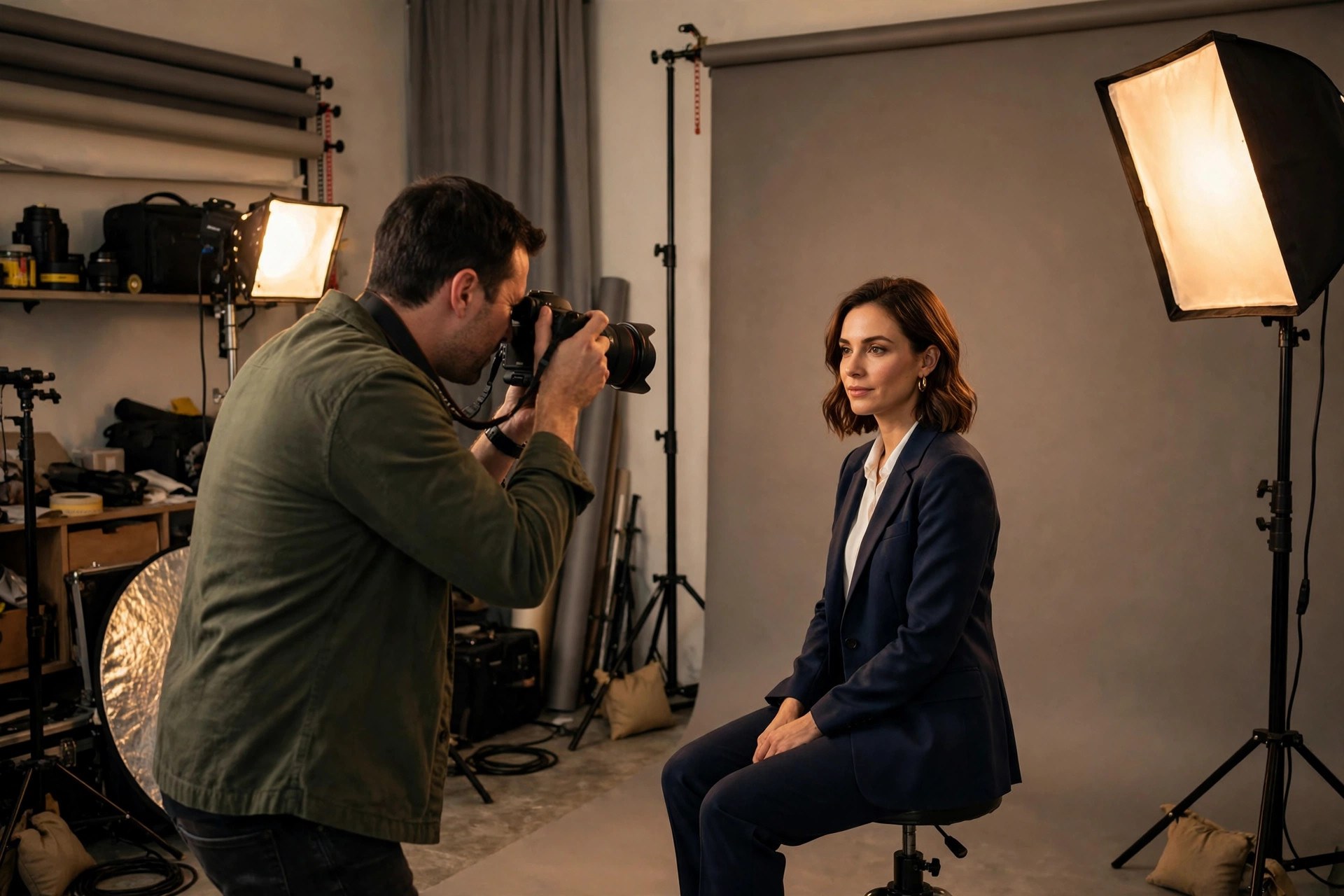
The lenses cost more than the camera
The first surprise in a photography budget is that the camera body is not the biggest line. A used Canon R6 or Sony A7III runs 1,500 to 2,000 dollars and produces professional results in every specialty — but the glass costs 500 to 3,000 dollars per lens, and a working wedding or commercial kit needs three to five lenses. The standard trinity — a 24–70mm f/2.8, a 70–200mm f/2.8, and a 35mm or 50mm prime — runs 3,000 to 7,000 dollars new, or 1,800 to 4,500 dollars used. Add lighting, backdrops, a capable editing computer, and insurance, and the honest startup bands by specialty are: portrait and family, 3,000 to 10,000 dollars; wedding, 8,000 to 25,000 dollars, where two camera bodies are non-negotiable because a single body failure mid-ceremony is unrecoverable; commercial and product, 10,000 to 30,000 dollars; real estate, 5,000 to 15,000 dollars including a drone and the FAA Part 107 exam; and a leased commercial studio, 20,000 to 60,000 dollars all-in, with full commercial build-outs reaching 30,000 to 100,000 dollars.
The second surprise is the editing load. Behind every one-hour shoot sit four to six hours of post-processing, and behind every wedding sit 15 to 30 hours. That is why photography revenue behaves so differently by specialty: real estate is the volume play at 150 to 400 dollars per property, three to five shoots a day, on tight 24-hour turnarounds; weddings pay the most per event at 3,000 to 8,000 dollars for 25 to 40 weddings a year but carry the heaviest editing debt; commercial work earns the highest day rates at 500 to 5,000 dollars plus licensing fees that can double or triple the shoot revenue — but building the agency relationships that produce those bookings takes two to four years of portfolio development. A lender reading a photography file should ask which specialty the borrower actually sells, because the cash calendar of a wedding photographer and a real-estate photographer have almost nothing in common.
Five cash demands, in the order they hit
First, the kit: bodies, lenses, lighting, and backup gear, where redundancy is not a luxury — a wedding photographer with one body is one failure from a ruined reputation. Second, the studio: a home studio setup adds 3,000 to 12,000 dollars, while a leased commercial space with lighting rigs, backdrops, and prop storage runs 30,000 to 100,000 dollars including deposit, build-out, and working capital. Third, the editing pipeline: a capable computer around 1,000 dollars or more, editing software at roughly 10 to 55 dollars a month, and a client gallery platform at 12 to 40 dollars a month. Fourth, insurance: general liability plus equipment cover runs 800 to 2,100 dollars a year and is mandatory, not optional, for any photographer working on client premises or with rented gear. Fifth, the portfolio runway: 12 to 18 months of below-market rates while the book of work is built to the point where it commands professional pricing — the working capital most new photographers forget to budget.
Need working capital this week?
Apply Now →Free to apply · Soft credit check only · Funding in 24–72 hoursThe product map: what fits which need
Equipment financing fits the kit and the studio lighting rigs: identifiable assets with a working life of years, where the term can match the asset. A term loan fits the studio build-out and the full opening budget. A business line of credit fits the operating gaps: the slow season for wedding photographers, the gap between a commercial shoot and the agency's 30-to-60-day payment, and the second-body purchase before peak season. Revenue-based advances fit only one narrow case here: a single fast gap with a defined collection event, such as a second body and backup lenses before a booked wedding season, or a drone and licensing upgrade ahead of a signed real-estate contract. What does not fit is funding the whole portfolio runway on a daily-debit advance — a 12-to-18-month brand build should not be repaid in months, and a photographer whose revenue arrives in seasonal spikes should not be debited daily through the trough.
What funders check on a photography file
Three months of business bank statements are the core document, and a photography file is read by specialty: a wedding photographer's deposits spike with booking season and delivery, a real-estate photographer's deposits are steadier and smaller per transaction, and a commercial photographer's deposits are lumpy around agency payments. Lenders also look at time in business, deposit consistency, existing advance positions, and the booking pipeline — signed weddings, agent contracts, or agency retainers — which for a photographer carries the weight a lease carries for a retailer. Credit matters less for revenue-based products than deposit health does, but it still moves the price. If a funder will not put the total repayment in dollars in writing, that is the offer to walk away from, whatever the headline rate sounds like.
Frequently asked questions
Can a photography studio get a business loan?
Yes. Photography businesses qualify for lines of credit, revenue-based advances, equipment financing, and term loans through third-party funders, based on deposits, time in business, the specialty, and the booking pipeline. Signed weddings, agent contracts, or agency retainers carry real weight in the file.
What do lenders check for photography funding?
The specialty first: wedding, real estate, commercial, and portrait photographers have very different cash calendars. Then deposits, the booking pipeline, and the kit list — a wedding file with one camera body is a risk flag, because a single body failure mid-ceremony is unrecoverable.
How fast can a photography studio get funded?
Revenue-based products typically fund in 24 to 72 hours from a complete application, once bank statements are verified. Equipment financing takes days to weeks, and SBA-backed loans for acquisitions or build-outs take longer.
Is a merchant cash advance good for a photography studio?
It can be, for a single fast gap with a defined collection event, such as a second body and backup lenses before a booked wedding season. For the 12-to-18-month portfolio runway it does not fit — a brand build should not be repaid in months.
What documents does a photography studio need to apply?
Recent business bank statements, typically the last three months, are the core requirement. A photo ID and a voided check may be requested as optional verification items, but they are not upfront requirements for getting a quote. A studio lease, equipment quotes, and the booking pipeline help where available.
How much funding can a photography studio get?
It depends on revenue, seasonality, and the product: revenue-based advances are usually sized as a multiple of monthly revenue, while lines, equipment loans, and term loans depend on the broader file. Ask for the total repayment in dollars before accepting any offer. Portrait and family studios start around 3,000 to 10,000 dollars, wedding kits run 8,000 to 25,000 dollars, and a leased commercial studio runs 20,000 to 60,000 dollars all-in.
The best offer is the one you compare
Get a no-obligation quote from our #1-ranked lender, Coast to Coast Fast Funding — $5K to $5M, MCA and revenue-based products that fund in 24–72 hours with soft-pull-only applications. We shop 75+ lenders so you can compare the true cost of every offer side by side.Apply Now →Soft credit check · 60-second pre-qualification · (352) 809-3201