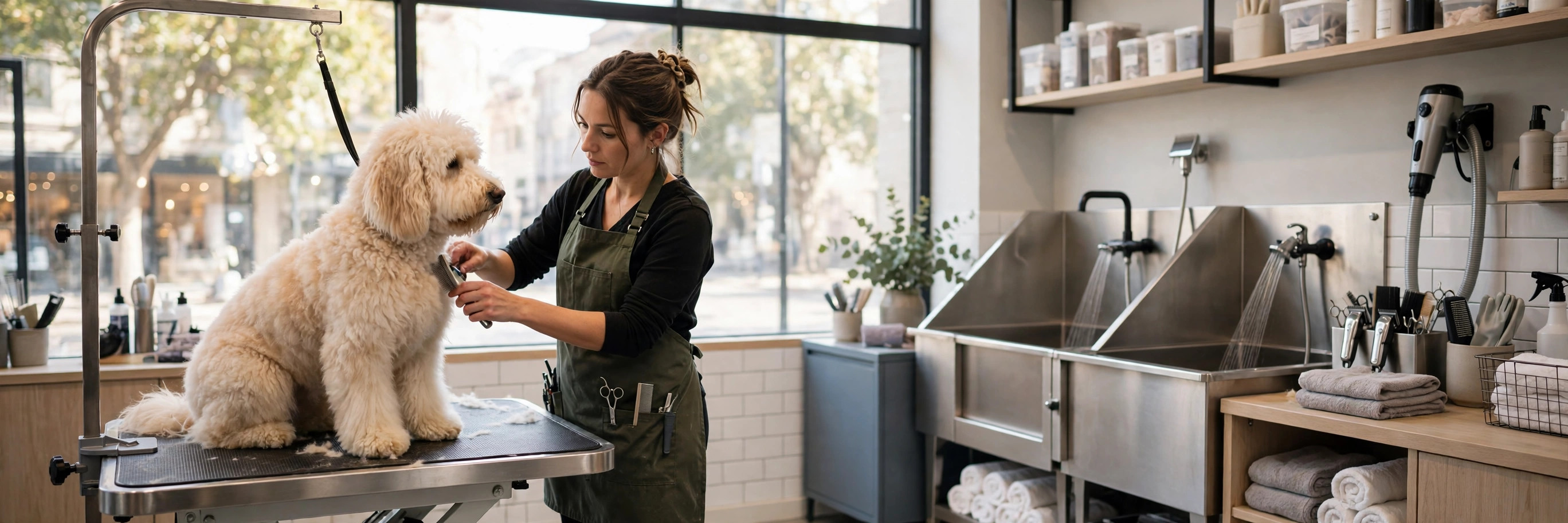
Pet grooming looks small from the outside — a storefront, a few tubs, a row of dryers — but it sits on one of the steadiest consumer trends in America: pet spending keeps rising, and owners increasingly treat grooming as a recurring service, not a luxury. The U.S. pet industry now exceeds $150 billion a year, and grooming and boarding make up a growing share of it. This guide covers what pet grooming businesses actually borrow for, what opening, buying, or expanding one costs in 2026, and which product fits each need.
The funding map for a pet grooming business splits into four buckets: opening a new salon, buying an existing one, upgrading tubs and dryers, and expanding into higher-margin services — mobile grooming vans, boarding and daycare, self-wash stations, and retail. Each bucket has a different best product, and the single most important underwriting fact in all four is the book: a grooming salon's value lives in its recurring appointment book, and a funder will price the business on how full that book is, not on how nice the storefront looks.
What pet grooming businesses borrow for
Opening a new salon. A grooming salon is a moderate-cost launch compared with most service businesses: build-out, tubs, dryers, tables, and a point-of-sale and booking system, all before the first appointment. Published 2026 planning guides put a leased storefront salon at roughly $50,000 to $150,000 all-in, with the spread driven by square footage, the number of grooming stations, and how much plumbing and electrical work the space needs. A mobile grooming van is a different model — typically $75,000 to $150,000 for a converted, fully equipped vehicle — with lower rent but higher fuel, maintenance, and insurance costs.
Buying an existing salon. Acquisitions are common and often smarter: the salon comes with an appointment book, groomers, and a client list already in place. Funding is usually an SBA loan or a term loan underwritten on the salon's historical cash flow — and on groomer retention, because a salon whose groomers leave with their clients is worth far less than its revenue suggests. Buyers should diligence the book: how many clients are recurring, how far out appointments are booked, and whether groomers are employees or contractors.
Upgrading tubs, dryers, and booking systems. The classic grooming investment: replacing aging hydraulic tubs and high-velocity dryers, adding a second or third station, or moving from a paper book to an online booking and reminder system. Better equipment shortens groom times, which raises appointments per groomer per day — the core productivity lever in the business — and online booking cuts no-shows, which is pure recovered revenue.
Adding mobile vans, boarding, daycare, and retail. The margin layer. A mobile van extends the salon's reach to clients who will pay a premium for at-home service. Boarding and daycare fill the space during grooming downtime and smooth weekday revenue. Retail — food, treats, and accessories — adds ticket size but ties up inventory cash, so it should be funded by the salon's cash flow, not by a lump-sum advance.
What a pet grooming business actually costs in 2026
| Cost item | Published 2026 planning range | What drives it |
|---|---|---|
| Build-out, plumbing, electrical, signage | $15,000–$50,000 | Square footage, tub drainage, ventilation |
| Grooming tubs (per station, hydraulic) | $1,500–$5,000 | Size, lift mechanism, stainless vs. fiberglass |
| High-velocity dryers and finishing dryers | $300–$1,500 each | Power, noise level, cage-dryer vs. stand dryer |
| Grooming tables, tools, and clippers | $2,000–$8,000 | Station count, clipper quality, tool replacement cycle |
| Booking, POS, and reminder software | $100–$400 per month | Online booking, reminders, client records |
| Mobile grooming van (converted, equipped) | $75,000–$150,000 | Vehicle, generator, water tanks, climate control |
| Lease deposit and pre-opening costs | $5,000–$20,000 | Landlord terms, market rents |
| Working capital (3–6 months of operating buffer) | $10,000–$30,000 | Payroll, supplies, slow ramp |
| Total storefront salon (leased) | $50,000–$150,000 | Published guide range; station count and market drive the spread |
These are planning ranges from published 2026 guides, not lender terms or quotes. The note that matters most for funding: a salon's economics are driven by appointments per groomer per day, not by square footage — a three-station salon that runs full books at good prices beats a six-station salon with empty chairs, and funders model it that way.
How a pet grooming business actually makes money
Funders underwrite a grooming salon on three revenue layers, and the mix between them changes the file's risk profile.
Recurring grooms. The base layer: dogs groomed every 4 to 8 weeks, cats on longer cycles, with prices varying by breed, coat, size, and condition. A salon with a deep recurring book — clients booked out weeks ahead — has predictable revenue a funder can model. A salon dependent on walk-ins and one-off holiday grooms does not, and gets a more conservative offer.
Add-on services. The margin layer: de-shedding treatments, teeth cleaning, flea baths, nail trims between full grooms, and puppy introduction packages that convert first-timers into regulars. Add-ons raise revenue per appointment without adding chairs, which is why funders like to see a rising average ticket alongside a full book.
Mobile, boarding, daycare, and retail. The expansion layer. Mobile vans command premium prices and reach clients the storefront cannot. Boarding and daycare fill capacity on weekdays and holidays. Retail adds ticket size but also inventory risk — a salon that over-stocks food and accessories ties up the working capital it needs for payroll.
The cost side is dominated by labor. Groomer pay — whether hourly, commission, or booth-rental — is the largest expense, followed by rent, then supplies (shampoos, conditioners, blades, and bows) and utilities. That is why groomer retention is a funding factor: a salon that loses groomers loses the clients who booked with them, and a funder will ask about turnover before they ask about the lease.
Which product fits which pet grooming need
| Your need | Best first product | Why |
|---|---|---|
| Open a new salon | SBA 7(a) loan or term loan | Moderate launch cost, underwritten on the owner's credentials and plan |
| Buy an existing salon | SBA or term loan | Underwritten on the salon's historical cash flow and the strength of its book |
| Add stations, tubs, dryers, or booking software | Equipment financing or term loan | Defined purchase, payments matched to the productivity gain |
| Buy a mobile grooming van | Equipment or vehicle financing | The van secures the loan; payments matched to its service life |
| Bridge a slow season or cover payroll this week | Revenue-based funding or line of credit | Funds in days — sized small, for a short gap only |
What funders actually weigh on a pet grooming file
Book depth and rebooking rate. The first question on a grooming file. Funders look at how far out appointments are booked, what share of clients rebook at checkout, and how the book has trended over 3–6 months. A salon booked three weeks out with a high rebooking rate reads as a growth file; a salon with same-week availability and falling rebooking reads as a demand problem.
Groomer retention and staffing model. Employee groomers, commission groomers, and booth renters each create a different risk profile. Employee and commission models keep the client relationship with the salon; booth rental keeps it with the groomer. Funders — and buyers — discount a book that walks out the door when a groomer leaves, so bring retention numbers and employment terms to the application.
Average ticket and capacity utilization. Funders look at revenue per appointment and appointments per groomer per day: a salon raising its average ticket while holding a full book is growing profitably, while a salon discounting to fill chairs is buying revenue. Both show up in the offer.
Seasonality. Grooming has a real seasonal pattern — holiday peaks, summer shedding season, and a January lull. A file that explains its seasonality up front (last year's monthly deposits, the upcoming holiday bookings) reads as lower risk than one that leaves the funder to guess.
The documents: short list, no surprises
- Last 3–6 months of business bank statements
- A completed application (owner, business, and revenue details)
- For purchases, add the purchase agreement, lease (with remaining term and renewal options), equipment list, and booking-system reports showing book depth and rebooking rate
- Government-issued ID and a voided check are sometimes requested for verification on specific products before funding — but neither is a universal upfront requirement to see your offers
Mistakes that cost pet grooming owners real money
Buying the salon without checking the book. Revenue history is not enough: if the book belongs to groomers who plan to leave, the revenue leaves with them. Diligence the rebooking rate, the groomers' employment terms, and how far out the book runs — before you close, not after.
Funding a van or a build-out with short-term money. A mobile van lasts years and a build-out lasts longer. Funding either with a short-term daily-debit advance mismatches the asset and the liability — use equipment or vehicle financing, or an SBA loan, where the term matches the asset's life.
Discounting to fill chairs. A salon that cuts prices to fill empty stations trains clients to expect the discount and still pays the same groomer cost. Fill chairs with rebooking discipline, reminders, and add-on services — not with price cuts that shrink the margin the funder is underwriting.
Over-stocking retail. Retail adds ticket size, but every dollar on the shelf is a dollar not available for payroll. Stock the fast movers, special-order the rest, and fund retail from the salon's cash flow.
Frequently asked questions
Can a new pet grooming salon get funded before it opens?
Yes, but the product changes. A pre-revenue startup leans on SBA loans or a term loan underwritten on the owner's credentials, experience, and business plan — not on bank statements that do not exist yet. Revenue-based products need 3–6 months of deposits, so they come after opening, not before.
Is equipment financing easier to get than a working capital loan for a grooming salon?
Usually yes. The equipment itself secures the loan, so underwriting leans on the equipment's value and the revenue it generates rather than on extensive additional collateral. Tubs, dryers, and vans all finance more readily than unsecured working capital.
What credit score does a pet grooming business need for funding?
Revenue-based funders weight bank deposits far more heavily than credit score, and scores in the 500s routinely get funded. SBA and bank products are stricter — typically 650-plus — and the score affects the cost of the offer, not usually the yes-or-no, on revenue-based files.
Do I need a voided check or photo ID to apply?
No — not to see offers. Bank statements and an application are the standard ask. A voided check or photo ID is sometimes requested for verification on specific products before funding, but neither is a universal upfront requirement.
How fast can a pet grooming business get funded?
Revenue-based products decide in hours and fund in 24–72 hours once statements are in. Equipment financing takes days to a couple of weeks; SBA products take a month or more. If the need is payroll this week, apply for the fast product and keep the SBA file for the build-out or the van.
Should I open a storefront or start with a mobile van?
It depends on the market and the capital. A storefront serves more clients per day and supports boarding and retail, but it needs a lease and a build-out. A mobile van needs no lease, commands premium prices, and reaches clients a storefront cannot — but it serves fewer clients per day and carries fuel, maintenance, and insurance costs. Many successful owners start mobile to build a book, then open a storefront once the book justifies it.
Opening, buying, or expanding a pet grooming business? See what you qualify for
From the first salon to the mobile van — get a no-obligation quote from our #1-ranked lender, Coast to Coast Fast Funding. One application reaches multiple funders, so you see the actual market for your file.
Apply Now →Soft credit check · 60-second pre-qualification