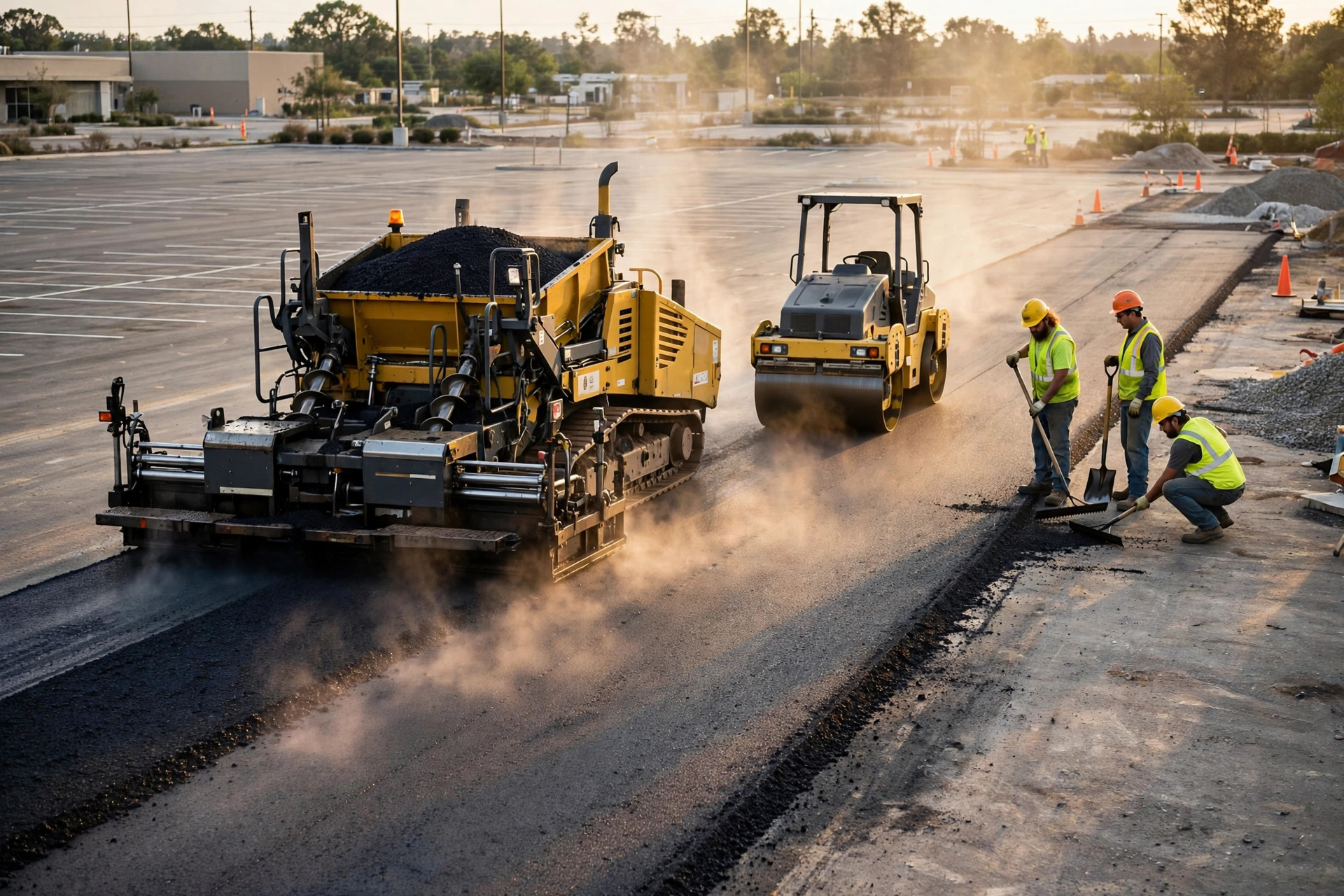
Paving sells a perishable product. Hot-mix asphalt leaves the plant at temperature, travels in an insulated truck bed, and must be laid and compacted before it cools — a clock measured in hours, not days. The business around that clock is just as unforgiving: the season ends when the plants close for winter, the client pays after the mat cools and the invoice clears, and the paver payment comes due every month whether the season is open or not. This guide is the funding map for that business — what the fleet costs in 2026, how the seasonal float actually works, and which product fits each need without turning a seasonal gap into a permanent debt.
The paving businesses in this guide run from a two-person residential crew — driveways, small lots, patching and sealcoating — to a commercial outfit bidding parking lots, roads, and municipal work with a full fleet. The fleet scales, but the shape of the money does not: materials and crew are paid now, the client pays later, and the winter pays nothing at all. Plan for all three, and the paving year becomes manageable. Plan for only the busy months, and the first quiet winter decides the business for you.
The fleet math: what paving iron costs in 2026
Every paving operation needs the same core trio at minimum: a self-propelled paver, a double-drum vibratory roller, and a dump truck for material transport, plus a trailer to move the iron. The bands below come from 2026 contractor cost guides reporting used and new prices. As with all equipment bands, configuration and condition move individual machines — a low-hour paver with a good screed is a different purchase from a high-hour machine with a tired one, even at the same price.
| Equipment | Used, 2026 band | New, 2026 band | Notes |
|---|---|---|---|
| Asphalt paver | $40,000–$85,000 | $160,000–$280,000 | The screed decides mat quality; inspect it like the machine depends on it, because it does |
| Vibratory roller | $15,000–$35,000 | $45,000–$90,000 | Compaction to 92–96% density is the durability spec; reliability is non-negotiable |
| Dump truck | $30,000–$60,000 | $120,000–$190,000 | Insulated bed keeps mix workable in transit; capacity sets loads per day |
| Equipment trailer | $8,000–$15,000 | $20,000–$35,000 | Moving the paver and roller is part of every job's cost |
Used iron is the most common route for new paving contractors, and for good reason: the price gap between used and new on a paver alone can fund the first season's working capital. The catch is the maintenance reserve. A used machine needs an immediate corrective-maintenance fund — compaction reliability is a compliance and reputation issue, not a preference, and a roller that fails mid-job can cost the day and the client. Budget the reserve at purchase, not after the first breakdown. And price the small iron too: sealcoating and crack-sealing equipment — a hot-box trailer, a melter, a mini roller — runs from a few hundred dollars for small tools to tens of thousands for production units, and it is what keeps a residential crew earning when the paving jobs thin out.
The season and the bid cycle
Paving is a seasonal trade in most of the country. Asphalt plants close or cut hours in winter, cold-weather paving risks mat quality, and municipal and commercial clients plan their paving in spring and summer. The revenue curve follows the temperature: a long, intense peak, then a cliff. The businesses that survive the cliff are the ones that planned for it in July — banking the peak, lining up sealcoating, striping, and patching work that extends the season, and keeping a line of credit undrawn as the winter bridge.
The bid cycle adds a second rhythm on top of the season. Municipal and large commercial work is bid months ahead, often with bonding and insurance requirements that cost money before the first dollar of revenue. A contractor can win the bid in March, mobilize in May, and wait 30 to 60 days after completion for payment — a four-month span between spending and collecting, bridged entirely by the business's own cash. That is the gap a line of credit exists for. It is also why the cheapest bid is not always the best bid: a job priced without the cost of carrying its own float is a job that loses money while looking busy.
Need a paver, a crew, or the float to the next bid?
Apply Now →Free to apply · Soft credit check only · Funding in 24–72 hoursThe materials float: paid upfront, collected after
Materials are paving's quietest cash drain. Hot mix is bought by the load and paid for on supplier terms that are often shorter than the client's payment terms — cash or short terms out, 30 to 60 days in. A crew laying several loads a day can burn through thousands of dollars of material before the first invoice is even sent, and a supplier that tightens terms mid-season can stop a job faster than a broken paver. The working-capital answer is the same as in every draw-based trade: a revolving line that covers the materials-and-payroll gap and clears when the client pays, sized to the largest single job's float rather than the average week's.
Supplier relationships are part of the float. A contractor with a clean payment history and a plant that knows its volume can often negotiate terms that a new shop cannot — and that difference, a few weeks of float, is worth more than a slightly lower material price. Keep the plant paid on time even in slow months. The supplier that trusts you in February is the supplier that loads your trucks first in June.
Rent, own, or finance the paver
Rental rates set the floor for the own-versus-rent decision. In 2026 guides, mini pavers rent for roughly $400 to $700 a day, parking-lot-sized pavers $800 to $1,500 a day, and full highway pavers $1,500 to $3,500 a day, excluding operator, fuel, and delivery. At those rates, a paver rented for a full working week can cost more than the monthly payment on owning one — which is why the utilization rule from the excavation trade applies here too: run it most of the time, own it (usually financed); run it occasionally, rent it. A residential crew paving three days a week through the season is usually past the own threshold by midsummer. A crew that paves one week a month is not.
Equipment financing fits paving iron well: the machine is the collateral, the payment is monthly, and the term can match the machine's working life. The seasonal wrinkle is the payment calendar — a level monthly payment through a winter with no revenue needs a reserve built during the peak, or a seasonal payment structure if the lender offers one. Ask before signing: whether the lender allows seasonal or skip payments, what the payoff looks like in year two, and whether the lien releases cleanly on payoff. A winter with a payment due and no work coming in is the scenario the loan should have been structured for in spring.
Insurance, licensing, and the cost of being legal
Insurance is the largest ongoing regulatory expense for a small paving company. Contractor cost guides put total mandatory coverage for a small asphalt patching company at roughly $7,000 to $15,000 a year before optional policies — general liability averaging about $77 a month, workers' compensation for a five-person crew roughly $300 to $500 a month depending on state rates, and commercial auto around $175 a month, plus equipment floaters and umbrella coverage on top. Licensing adds $5,000 to $15,000 in first-year expenses in many markets: business registration, contractor licensing (some states require a specific paving or earthwork license, and commercial work often needs higher bonds), DOT compliance for vehicles over 10,001 pounds, and local permits. None of this is optional spending. A bid that cannot carry its insurance and licensing cost is a bid priced to lose money politely.
Lenders notice the same things. A contractor with current insurance, clean licensing, and a bond line looks fundable; a contractor working without them looks like a claim waiting to happen. Keep the certificates current and the paperwork in one file — when a lender or a general contractor asks, the answer should take minutes, not a week of hunting.
Which product fits which need
| Need | Best-fit product | Why it fits |
|---|---|---|
| Buying the core trio (paver, roller, truck) | Equipment financing | Iron is collateral; monthly payment; term matches machine life |
| Materials and payroll float | Business line of credit | Drawn for the job, repaid when the client pays |
| Winter bridge | Line of credit + peak-season reserve | Revolving, not a one-time advance that must be repaid in the slow months |
| A one-time gap: repair, bid bond, fuel spike | Revenue-based advance | Fast and deposit-sized; expensive if it becomes the winter plan |
| One job needing a bigger machine | Rental | No commitment, no maintenance, no resale risk |
The pre-signing checklist
- Total dollars, in writing: amount funded versus total repaid, including every fee, on the same amount and term as the competing offer.
- Seasonal structure: does the payment calendar survive a winter with no revenue — reserve, seasonal payments, or a line that bridges it?
- Utilization honesty: price the rental week first. If the paver will not run most of the season, rent it and let the rental quote discipline the purchase price.
- Maintenance reserve: a used machine needs a corrective-maintenance fund at purchase, not after the first mid-job breakdown.
- Float sizing: the line should cover the largest single job's materials-and-payroll float, not the average week's.
- Documents ready: three months of business bank statements are the core requirement; photo ID and a voided check are optional verification items, never upfront requirements.
How we researched this guide
Fleet price bands, startup-capital ranges, insurance and licensing costs, and rental rates are summarized from 2026 contractor cost guides (We Love Paving's asphalt business startup costs; Get One Crew's asphalt business costs; Equipment and Contracting's full-service paving company guide; AsphaPro's 2026 paving machine guide), paraphrased in our own words. Bands are planning ranges, not quotes; verify the machine, configuration, and hours on the actual offer. For the cost side of any advance you are offered, see our offer-comparison guide and our equipment-financing comparison.
Frequently asked questions
How much does it cost to start a paving business?
A standard operation needs roughly $150,000 to $500,000 in initial capital, depending on new versus used equipment and residential versus commercial scale — covering the core fleet, licenses, insurance, and working capital for the first six months. Larger fleets with production-scale equipment run well past $1 million.
Should a paving contractor buy or rent a paver?
Own it — usually financed — if it will run most of the working season; rent it if the need is occasional or job-specific. At 2026 rental rates of roughly $800 to $1,500 a day for a parking-lot-sized paver, a full rented week can exceed a monthly ownership payment.
How do paving contractors survive the winter?
By planning for it in the peak: banking peak-season profit into a reserve, extending the season with sealcoating, striping, and patching work, and keeping a line of credit undrawn as the winter bridge. A one-time advance taken in autumn and repaid through the winter is the expensive way to bridge the season.
What funding covers the materials gap?
A business line of credit, sized to the largest job's materials-and-payroll float and repaid when the client pays. Materials are typically bought on shorter terms than clients pay on, so the float is structural — it needs a revolving product, not a one-time loan.
What documents does a paving contractor need to apply?
Three months of business bank statements are the core requirement for revenue-based and line products; equipment lenders also ask for the machine quote. Photo ID and a voided check are optional verification items, never upfront requirements before a price is shown.
Does paving work qualify for equipment financing?
Yes. Pavers, rollers, and dump trucks are standard equipment-financing collateral, with terms that can match the machine's working life. Lenders weigh the machine's value, the business's deposits, time in business, and the backlog of signed work.
The best offer is the one you compare
Get a no-obligation quote from our #1-ranked lender, Coast to Coast Fast Funding — $5K to $5M, MCA and revenue-based products that fund in 24–72 hours with soft-pull-only applications. We shop 75+ lenders so you can compare the true cost of every offer side by side.Apply Now →Soft credit check · 60-second pre-qualification · (352) 809-3201