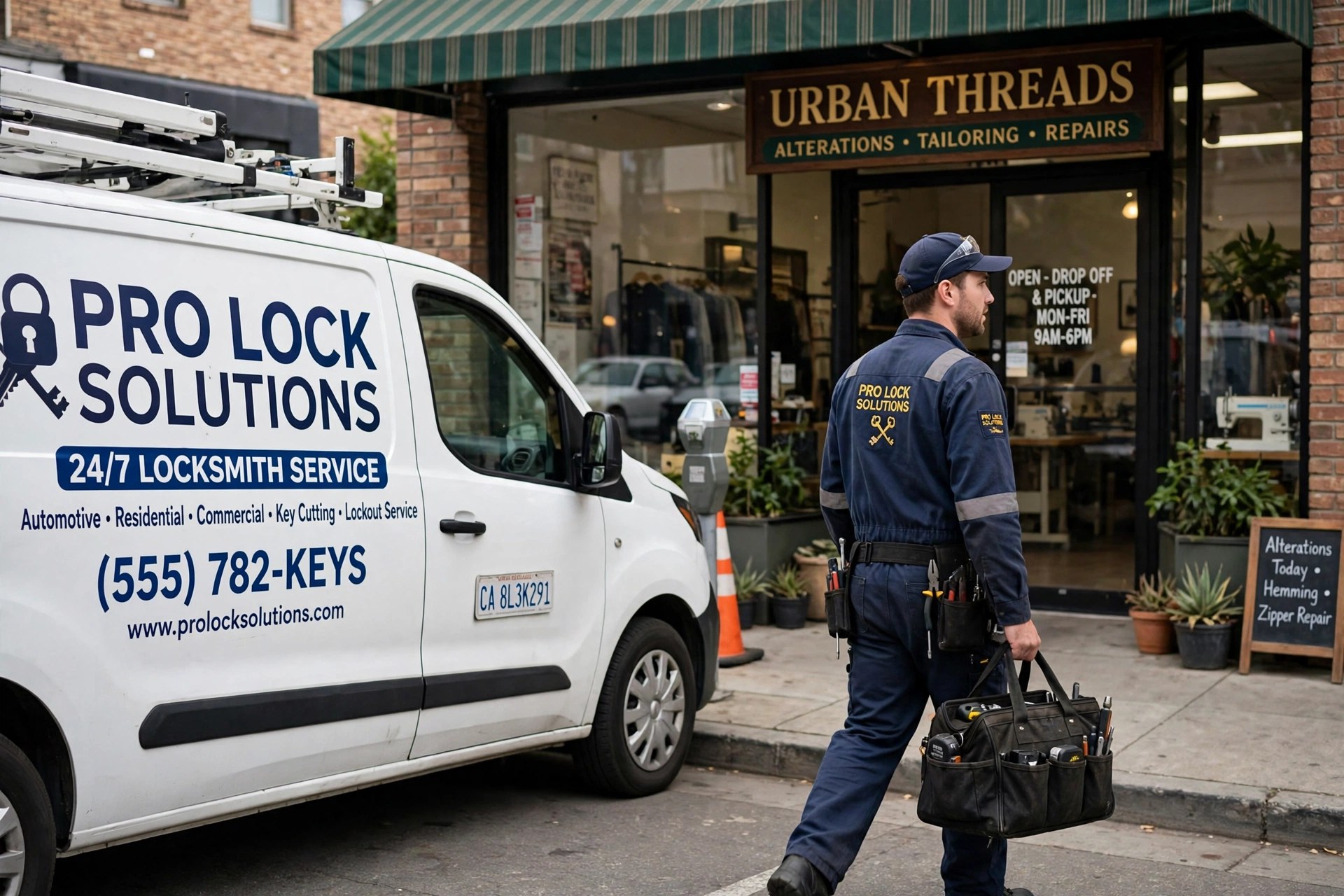
The van math comes first
A locksmith business is a van with a workshop inside it. Before any funding conversation, the equipment tier sets the budget, and the tiers are far apart. A lean startup — you already own a usable van and you skip electronic key programming at first — runs 5,500 to 9,500 dollars. A comfortable startup with transponder programming and a real inventory runs 14,000 to 25,000 dollars. A fully equipped new-vehicle setup runs 35,000 to 60,000 dollars, and a practical middle budget for a mobile operation lands at 35,000 to 85,000 dollars once the van itself is counted. A decent used service vehicle runs 25,000 to 55,000 dollars, and outfitting it with shelving, a key machine mount, an inverter or generator, and organized storage adds 3,000 to 8,000 dollars. The line items inside the van are specific: a manual key duplicator at 495 to 650 dollars, a universal pin kit at about 341 dollars, picks and tension tools for under 50 dollars, car-opening and long-reach tools at 140 to 285 dollars, and a card reader at about 299 dollars. A funding file that names the van, the programming capability, and the service menu reads as a real trade business; a file that just says "locksmith" reads as a guess.
That is why the first question a lender asks a locksmith is not "how much do you want" but "residential, commercial, automotive, or all three — and what equipment do you already own?" The answers set the ticket and the payback. A residential lockout that takes 25 minutes can bill around 185 dollars. Published car lockout ranges run 80 to 150 dollars before any key work, automotive keys bill 150 to 450 dollars each, and a single car key programming job often runs 180 to 350 dollars. The key programming tool itself is the priciest specialty add-on at 2,000 to 10,000 dollars — and it is also the fastest payback in the trade, typically paying for itself in 15 to 25 jobs. The Bureau of Labor Statistics counted 15,040 people employed as locksmiths and safe repairers in May 2025, with median pay of 51,320 dollars a year — and that count excludes the self-employed, which is to say it excludes most of the trade. This is a business of one-van and three-van shops, not chains, and the economics reward the operator who owns the van and answers the phone.
Five cash demands, in the order they hit
First, the van and its fit-out: the single largest capital line, and the one that decides whether the business can take automotive and commercial work at all. A residential-only operator can start lean; automotive programming and electronic access control each add thousands in tools before the first invoice. Second, inventory: locks, cylinders, blanks, transponder keys, remotes, and fobs, stocked across the van and the shop — a job lost because the right blank was not on the truck is a customer lost to the next listing. Third, licensing, bonding, and insurance: roughly 13 to 15 states license locksmiths, with more adding regimes each cycle, and even in unlicensed states the business needs a license, an EIN, insurance, and a bond. General liability medians run about 46 dollars a month or 550 dollars a year, a business owner's policy about 73 dollars a month, tools and equipment cover about 48 dollars a month, and commercial auto about 250 dollars a month or 3,001 dollars a year — the van is the expensive line every time. Some licensing states set the floor: Illinois requires 1,000,000 dollars of liability, and survey data records Alabama at 250,000 dollars or more and Maryland at 300,000 dollars. Fourth, the launch marketing that actually produces calls: the local search results for locksmiths are crowded with phone-bank operators, and a legitimate local shop has to out-rank and out-review them. Fifth, the working capital for the slow build: a disciplined owner-operator can reach break-even near 13,200 dollars a month in sales, and at a 150-dollar average ticket with roughly 65 percent margin, covering about 3,000 dollars a month in overhead needs roughly 1.5 jobs per working day — but those jobs have to be won one call at a time, and the first months are the thinnest.
Emergency calls pay the bills; contracts build the business
Underwriting a locksmith business turns on the revenue mix, not the van count. Emergency lockouts supply cash flow: urgent, high-margin, paid on the spot, but unpredictable and competitive. Property managers, small businesses, schools, and facility accounts supply the repeat work: rekeys between tenants, master-key systems, door hardware replacement, and access-control installs that book weeks ahead and repeat for years. The best economics come from a mixed book — urgent consumer jobs for cash flow, contract accounts for stability. Industry survey data puts mechanical door hardware in 89 percent of respondent portfolios, electrified hardware in 63.5 percent, access control in 53 percent, and automotive work in 51 percent, which is a useful map of where the trade actually earns: the operator who can do all four is rarely idle, and the operator who can do only one is at the mercy of that one market. Lenders weight the contract accounts and the service-menu breadth heavily, because a locksmith with three property-management accounts and programming capability has a floor under the revenue that a lockout-only operator does not.
Need working capital this week?
Apply Now →Free to apply · Soft credit check only · Funding in 24–72 hoursThe product map: what fits which need
Equipment financing fits the van and the big machines: the vehicle, the code machine, and the programming tools are identifiable assets with a working life measured in years, so the term can match the asset and the equipment secures the loan. A term loan fits the full launch or expansion budget — a second van, a storefront with a service counter and key-cutting workshop, or the access-control tooling that opens commercial accounts — because those costs pay back over years, not weeks. A business line of credit fits the operating gaps: inventory restocks ahead of a property-management contract, the insurance and licensing renewals that cluster in one month, and the payroll float when a second technician comes on. Revenue-based advances fit only one narrow case here: a single fast gap with a defined collection event, such as the programming tool that unlocks automotive jobs already calling in, or a van repair that has to happen before the weekend's booked jobs. What does not fit is funding a whole storefront and two vans on a daily-debit advance — durable assets should not be repaid in months, and daily debits do not pause for a slow week of calls.
What funders check on a locksmith file
Three months of business bank statements are the core document for an existing operator, and a new operator's file turns on the training and certification path, the state licensing position, the van and equipment quotes, and the launch plan for winning calls. Lenders also look at time in business, deposit consistency, existing advance positions, and — for larger term loans — broader financials. The credential story matters more here than in most trades: a foundation course aligned with the Associated Locksmiths of America, Registered Locksmith certification, any required state exam, and bonding and insurance are the difference between a legitimate local shop and a phone-bank listing, and funders know it. A realistic path to operating runs 4 to 8 months from course to certified and insured. Credit matters less for revenue-based products than deposit health does, but it still moves the price. If a funder will not put the total repayment in dollars in writing, that is the offer to walk away from, whatever the headline rate sounds like.
Frequently asked questions
Can a locksmith business get a business loan?
Yes. Locksmith businesses qualify for lines of credit, revenue-based advances, equipment financing, and term loans through third-party funders, based on deposits, time in business, the service menu, and the contract book. A shop with property-management accounts and programming capability underwrites very differently from a lockout-only operator.
What do lenders check for locksmith funding?
The service menu first — residential, commercial, automotive, or all three — then the van and equipment file, the licensing position, and the contract accounts. A lean startup runs 5,500 to 9,500 dollars with a van already owned, while a comfortable setup with programming and inventory runs 14,000 to 25,000 dollars.
How fast can a locksmith business get funded?
Revenue-based products typically fund in 24 to 72 hours from a complete application, once bank statements are verified. Equipment financing takes days to weeks, and SBA-backed loans for acquisitions or build-outs take longer.
Is a merchant cash advance good for a locksmith business?
It can be, for a single fast gap with a defined collection event, such as the programming tool that unlocks automotive jobs already calling in. For a storefront and two vans it does not fit — durable assets should not be repaid in months.
What documents does a locksmith business need to apply?
Recent business bank statements, typically the last three months, are the core requirement. A photo ID and a voided check may be requested as optional verification items, but they are not upfront requirements for getting a quote. Training and certification records, state licensing documents, van and equipment quotes, and the launch plan help where available.
How much funding can a locksmith business get?
It depends on revenue, seasonality, and the product: revenue-based advances are usually sized as a multiple of monthly revenue, while lines, equipment loans, and term loans depend on the broader file. Ask for the total repayment in dollars before accepting any offer. A lean mobile startup runs 5,500 to 9,500 dollars, a comfortable setup 14,000 to 25,000 dollars, and a fully equipped new-vehicle operation 35,000 to 60,000 dollars before a storefront.
The best offer is the one you compare
Get a no-obligation quote from our #1-ranked lender, Coast to Coast Fast Funding — $5K to $5M, MCA and revenue-based products that fund in 24–72 hours with soft-pull-only applications. We shop 75+ lenders so you can compare the true cost of every offer side by side.Apply Now →Soft credit check · 60-second pre-qualification · (352) 809-3201