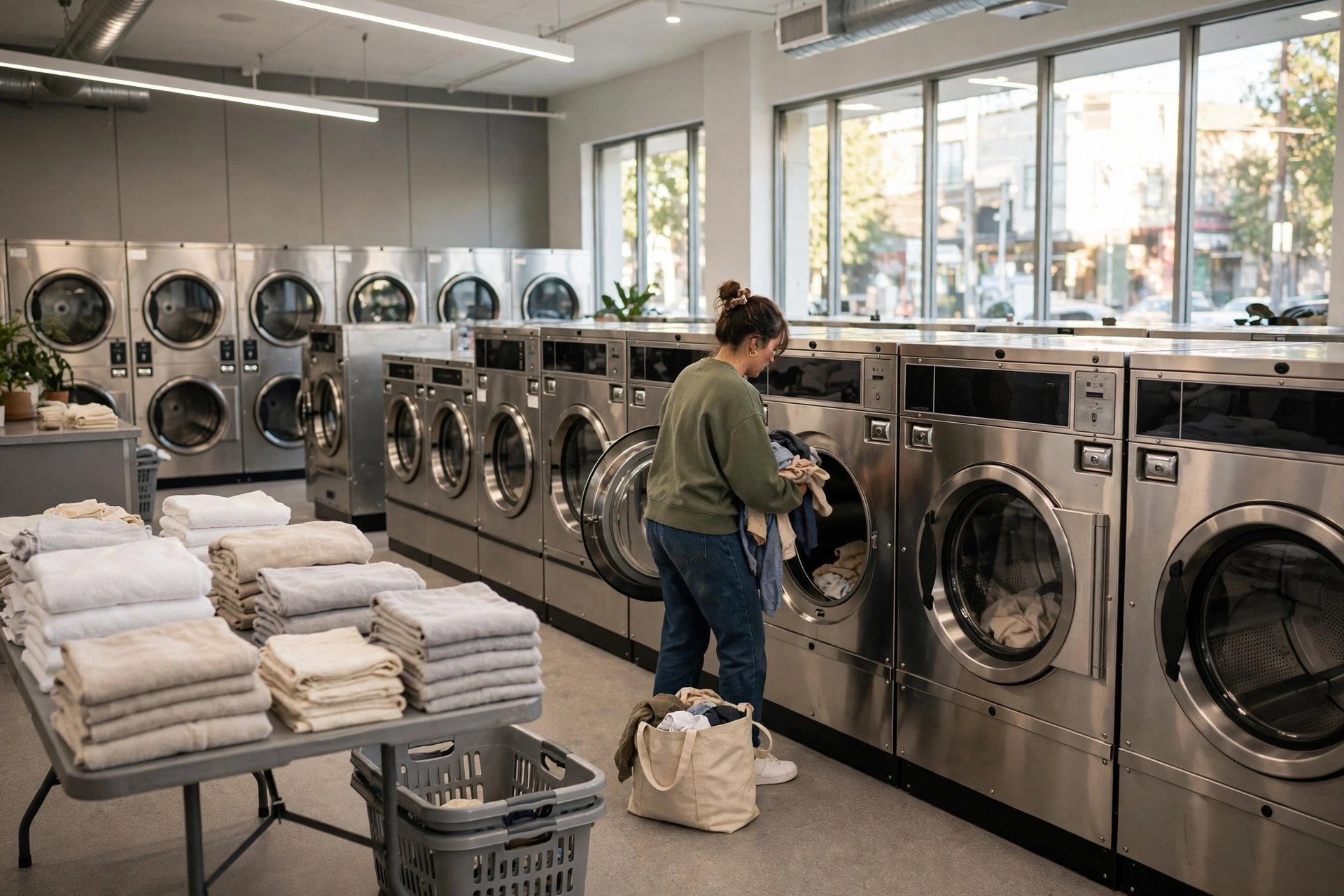
Laundromats are one of the most misunderstood businesses in small-business finance: marketed as passive income, but in reality a utility-intensive, equipment-heavy operation where the machines are the business. The U.S. laundromat industry generates over $5 billion a year across more than 30,000 locations, and a well-run store produces steady cash flow with relatively low labor — but only after a large upfront investment in machines, plumbing, and power. This guide covers what laundromats actually borrow for, what opening, buying, or retooling one costs in 2026, and which product fits each need.
The funding map for a laundromat splits into four buckets: opening a new store, buying an existing one, retooling aging machines, and adding higher-margin services — wash-dry-fold, pickup and delivery, and commercial accounts with hotels, restaurants, and salons. Each bucket has a different best product, and the single most important underwriting fact in all four is the lease: a laundromat cannot move, so the remaining lease term is effectively the life of the business.
What laundromats borrow for
Opening a new store. A new build is the most capital-intensive route: machines, build-out, utility connections, payment systems, and working capital all land before the first load. Published 2026 guides put a standard 2,000-square-foot self-service store with modern, energy-efficient equipment at roughly $226,500 to $587,000 all-in, while broader startup guides give a $100,000 to $500,000 range depending on size and market. The spread reflects real choices: machine count, new versus used equipment, and how much plumbing and electrical work the space needs.
Buying an existing laundromat. Acquisitions are common and often smarter: the store comes with a customer base, a lease, and machines already in place. Funding is usually an SBA loan or a term loan underwritten on the store's historical cash flow — and on the remaining lease term, which buyers routinely underweight. Industry acquisition guides stress that a store with 10 or more years left on its lease commands a materially higher multiple than one with 3 years left, because the lease is the asset.
Retooling aging machines. The classic laundromat investment: replacing old top-loaders with high-efficiency front-loaders. New machines cut water and gas use, shorten cycle times, and let the owner raise vend prices — which is why retools are among the most financeable projects in the industry. Commercial washers typically last 10 to 15 years and dryers 15 to 20, so a store with 12-year-old machines is a retool candidate, not a distressed asset.
Adding wash-dry-fold and commercial work. Self-service stores trade at lower multiples than stores with service revenue. Adding wash-dry-fold, pickup and delivery, or commercial accounts (hotels, restaurants, gyms, salons) raises revenue per square foot and the business's sale multiple — but it needs labor, a vehicle, and marketing capital before the contracts pay.
What a laundromat actually costs in 2026
| Cost item | Published 2026 range | What drives it |
|---|---|---|
| Commercial washers (per unit, new) | $8,000–$20,000 | Capacity, efficiency, high-speed extraction |
| Commercial dryers (per unit, new) | $6,000–$15,000 | Capacity, moisture sensors, stack vs. single |
| Mid-size equipment package (20–30 machines) | $180,000–$400,000+ | Machine count, new vs. refurbished mix |
| Renovation and build-out (plumbing, electrical, venting) | $50,000–$150,000 | Existing infrastructure, gas and sewer capacity |
| Payment systems and POS (card readers, app integration) | $5,000–$15,000 | Coin-only vs. card and app hybrid |
| Lease deposit and pre-opening costs | $5,000–$20,000 | Landlord terms, market rents |
| Working capital (3–6 months of operating buffer) | $10,000–$30,000 | Utility deposits, supplies, slow ramp |
| Total startup (2,000 sq. ft. modern store) | $226,500–$587,000 | Published guide range; smaller or used-equipment stores land lower |
These are planning ranges from published 2026 guides, not lender terms or quotes. Two notes matter for funding: installation typically adds 10% to 20% on top of equipment prices, and high-speed extraction machines cost more upfront but cut drying time and gas use — the two largest ongoing utility costs — which is exactly the argument that makes equipment financing pencil out.
How a laundromat actually makes money
Funders underwrite a laundromat on three revenue layers, and the mix between them changes the file's risk profile.
Self-service vend. The base layer: customers pay per load. It is cash-heavy (or card-heavy in modern stores), low-labor, and sensitive to neighborhood demographics — renter density, household income, and competing stores within a mile matter more than any marketing plan. Card and app payment systems improve this layer twice over: they raise the average ticket (no coin friction) and they create clean, auditable revenue records that funders trust far more than coin-box counts.
Wash-dry-fold and pickup/delivery. The margin layer. Customers pay by the pound for a service they would rather not do, and the store's labor cost is the constraint. This layer also smooths revenue: it is less weather- and season-sensitive than walk-in traffic, and it brings in customers who never set foot in the store.
Commercial accounts. The scale layer: standing weekly orders from hotels, restaurants, spas, gyms, and healthcare offices. Commercial work is lumpy — a lost hotel contract hurts — but it fills machines during off-peak hours, which is nearly pure margin once the machines are already paid for.
The cost side is dominated by utilities. Water, sewer, gas, and electricity are the largest ongoing expenses after rent, which is why the machine choice is a financial decision, not a cosmetic one: a high-efficiency washer that extracts more water per spin directly reduces dryer gas consumption on every load.
Which product fits which laundromat need
| Your need | Best first product | Why |
|---|---|---|
| Buy an existing laundromat or build a new one | SBA 7(a) loan | The most common route for purchases and build-outs — asset-heavy, cash-flow-positive businesses underwrite well |
| Retool with new washers and dryers | Equipment financing or leasing | The machines secure the loan; many manufacturers offer direct financing |
| Seller-financed acquisition | Seller financing + smaller bank loan | Lowers the bank loan amount when the current owner carries part of the price |
| Add wash-dry-fold, delivery, or a vehicle | Term loan or equipment financing | Defined purchase, payments matched to the service ramp |
| Bridge a slow season or an emergency repair | Revenue-based funding or line of credit | Funds in days — sized small, for a short gap only |
What funders actually weigh on a laundromat file
Remaining lease term. The first question on any laundromat file, and the one buyers most often underweight. A store with 3 years left on its lease is effectively a 3-year cash flow stream; a store with 12 years left, plus renewal options, is a different business. Funders — and future buyers — price that difference directly. If you are buying, negotiate the lease extension before you close the loan, not after.
Machine age and mix. A store with 12-year-old machines and a coin-only payment system is a retool story: the funder is underwriting the new machines' efficiency and pricing power, not the old store's history. A store with modern card-equipped machines and clean digital revenue records underwrites faster, because the revenue is verifiable.
Utility costs and vend pricing. Funders look at utility bills against revenue: a store spending an outsized share on water and gas has a machine problem, and a store that has not raised vend prices in years has a pricing opportunity. Both show up in the offer — the first as risk, the second as upside.
Revenue visibility. Card and app systems produce statements a funder can verify. Coin-only stores require more documentation and get more conservative offers, because the funder cannot verify the coin box. If you are planning to apply, switching to card readers before you apply is one of the highest-return moves available.
The documents: short list, no surprises
- Last 3–6 months of business bank statements
- A completed application (owner, business, and revenue details)
- For purchases, add the purchase agreement, lease (with remaining term and renewal options), equipment list with ages, and utility bills
- Government-issued ID and a voided check are sometimes requested for verification on specific products before funding — but neither is a universal upfront requirement to see your offers
Mistakes that cost laundromat owners real money
Buying the store without securing the lease. The machines are worthless without the location. A short remaining term, a landlord who will not approve an assignment, or a rent escalation that eats the retool savings can each turn a good deal into a loss. Lease first, loan second.
Retooling with daily-debit money. New machines last 10 to 20 years. Funding a 15-year asset with a short-term daily-debit advance mismatches the asset and the liability — use equipment financing or an SBA loan, where the term matches the machines' life.
Staying coin-only. Coin-only operation costs you twice: customers spend less per visit, and funders discount revenue they cannot verify. Card and app systems pay for themselves in higher tickets and better funding terms.
Underpricing the wash. Owners who have not raised vend prices in years are subsidizing every load. A retool is the natural moment to reprice — new machines, faster cycles, and a cleaner store justify a higher vend, and the funder's model assumes you will take it.
Frequently asked questions
Can a new laundromat get funded before it opens?
Yes, but the product changes. A pre-revenue startup leans on SBA loans or a term loan underwritten on the owner's credentials, experience, and business plan — not on bank statements that do not exist yet. Revenue-based products need 3–6 months of deposits, so they come after opening, not before.
Is equipment financing easier to get than a working capital loan for a laundromat?
Usually yes. The machines themselves secure the loan, so underwriting leans on the equipment's value and the revenue it generates rather than on extensive additional collateral. Many washer and dryer manufacturers also offer direct financing, which can lower the upfront cash needed.
What credit score does a laundromat need for funding?
Revenue-based funders weight bank deposits far more heavily than credit score, and scores in the 500s routinely get funded. SBA and bank products are stricter — typically 650-plus — and the score affects the cost of the offer, not usually the yes-or-no, on revenue-based files.
Do I need a voided check or photo ID to apply?
No — not to see offers. Bank statements and an application are the standard ask. A voided check or photo ID is sometimes requested for verification on specific products before funding, but neither is a universal upfront requirement.
How fast can a laundromat get funded?
Revenue-based products decide in hours and fund in 24–72 hours once statements are in. Equipment financing takes days to a couple of weeks; SBA products take a month or more. If the need is a broken machine this week, apply for the fast product and keep the SBA file for the full retool.
Should I buy new or used machines?
New machines cost more upfront but cut water and gas use, shorten cycles, and support higher vend prices — and they finance more easily, because the lender can value them. Used machines lower the entry price but raise maintenance and utility costs and shorten the retool runway. Many successful owners split the difference: new high-capacity washers where efficiency matters most, refurbished dryers where it matters less.
Opening, buying, or retooling a laundromat? See what you qualify for
From the first washer to the full retool — get a no-obligation quote from our #1-ranked lender, Coast to Coast Fast Funding. One application reaches multiple funders, so you see the actual market for your file.
Apply Now →Soft credit check · 60-second pre-qualification