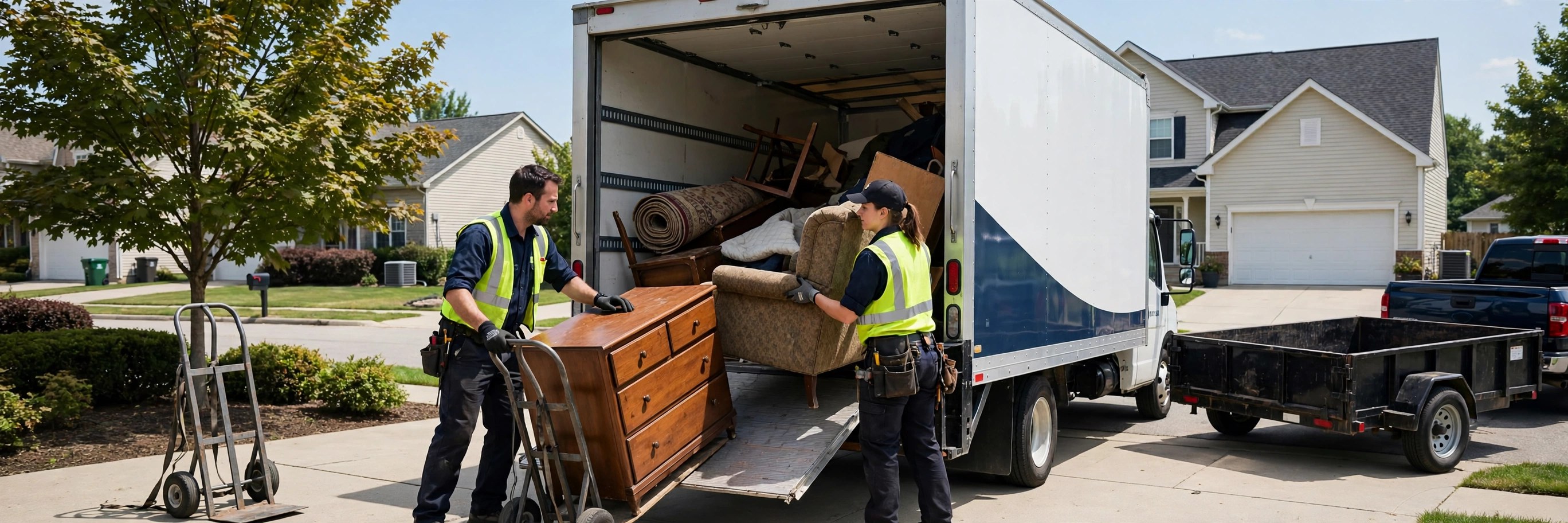
The truck is not the business. The route, the dump account, and the price list are. Junk removal looks like the simplest business in the trades — a truck, two people, and a phone — and it is, which is exactly why new operators fail at the same three points: they price by the load and pay by the ton, they buy the truck before they have the jobs, and they treat the dump as an afterthought instead of the second-largest cost on every ticket. Get those three right and a single truck is a genuinely profitable small business; get them wrong and the truck owns you.
The startup tiers: trailer, truck, or franchise
A lean start runs 5,000 to 10,000 dollars if you already own a pickup: a 12- to 14-foot hydraulic dump trailer at 4,000 to 9,000 dollars, dollies, straps, tarps, insurance, permits, and a website. A used 14- to 16-foot dump or box truck pushes the total to 30,000 to 40,000 dollars, and a full-time independent launch with a bought truck lands at 25,000 to 40,000 dollars all-in. Published independent ranges run 7,500 to 28,000 dollars, with the vehicle as nearly the whole spread. The franchise path is a different business: 96,000 to 350,000 dollars to open, with a 40,000-dollar franchise fee at the best-known brand, in exchange for the booking system, the brand, and the call center.
The trailer-first rule is the cheapest good advice in this industry. A trailer behind a pickup you own lets you take paying jobs in your second or third week, learn your real dump costs on small loads, and buy the truck from revenue once the route proves itself. A truck bought before the first job reverses that order: the payment is due whether the phone rings or not. A normal solo or two-person pace is three to five jobs a day, and a solo operator doing two jobs a day at a 275-dollar average grosses about 11,000 dollars a month before disposal, fuel, and insurance.
The disposal math that eats new operators
Junk removal earns by volume and pays by weight, and that mismatch is the whole business. Customers pay for a fraction of the truck — a minimum or single item at 100 to 175 dollars, a quarter load at 200 to 300 dollars, a half load at 350 to 475 dollars, a full 12- to 15-cubic-yard truck at 550 to 800 dollars — while landfills charge by the ton. The national average landfill tipping fee was 62 dollars and 28 cents a ton in 2024, and some counties charge far more: 148 dollars a ton in Hillsborough County, Florida, and 160 dollars a ton in Snohomish County, Washington. A half load of wet drywall or concrete can cost more to dump than a full load of furniture.
Work the numbers before you quote. A full-truck job at about 475 dollars carries roughly 190 dollars of variable cost — dump fees, fuel, and a helper — leaving close to 280 dollars of contribution margin. Disposal fees run 10 to 20 percent of revenue on a normal route, and a full load costs about 80 to 150 dollars to dispose of before fuel or labor. Mattresses, tires, appliances, and electronics carry per-item surcharges of 10 to 50 dollars at the dump, so they carry surcharges on the quote too. Well-run single trucks hold net margins of 40 to 55 percent; the operators who lose money are the ones who quoted the labor and ate the disposal.
The account matters as much as the price. Open the transfer-station or landfill account before the first job — 200 to 500 dollars to open at most sites — and learn which sites take which materials, because a load refused at the gate is a load driven twice. Donation and scrap diversion help twice: they cut the tonnage you pay to dump, and they give the quote a second story for customers who would rather see a couch reused than buried.
Where the jobs actually come from
Junk removal has no trade license in most places, which means the barrier to entry is low and the barrier to being found is everything. The first 20 jobs come from Google reviews, Local Services Ads, and realtor offices — the three channels every operator guide names first — plus property managers, estate attorneys, and contractors clearing renovation debris. A route built on one-off residential calls is a route that starts over every Monday; a route built on realtor, property-manager, and contractor accounts is a route with a calendar.
Insurance is part of the sales pitch, not just a cost line. General liability for debris and junk removal work averages about 93 dollars a month, roughly 1,100 dollars a year, and commercial auto runs 150 to 300 dollars a month — the largest recurring cost. Customers handing you the keys to a house they are selling want the certificate before they want the price, and property managers will not put an uninsured crew on their buildings at any price.
Need working capital this week?
Apply Now →Free to apply · Soft credit check only · Funding in 24–72 hoursThe product map: what fits which need
A dump trailer or a first used truck is an equipment purchase, and equipment financing fits it: the trailer or truck secures the loan, the term can match the asset's working life, and the payment is fixed while the route grows into it. A business line of credit fits the float between doing the job and getting paid — the dump-fee float, the fuel card, the helper payroll in a week with five estate cleanouts — because the draw rises and falls with the route. A revenue-based advance fits a single fast gap with a defined collection event, such as a second truck for a property-management contract that starts Monday, not a whole fleet expansion. A term loan fits the full expansion budget — a second truck, a shop, a hired crew — because those costs pay back over years, not weeks. Franchises, with six-figure opening costs, usually need the term-loan or SBA-backed route, and should expect the franchisor's own financing requirements to shape the file.
What funders check on a junk removal file
Funders underwrite the route, not the truck. They want the deposit history, the job log — how many jobs a week, at what average ticket — the dump account standing, the insurance binder, and the repeat-booking sources. A route with realtor and property-manager accounts underwrites very differently from a route living on one-off calls, because the accounts are the closest thing this business has to contracted revenue. A new operator with a trailer, a signed dump account, and ten booked jobs reads better than a new operator with a financed truck and no calendar.
Frequently asked questions
Can a junk removal business get a business loan?
Yes. Junk removal businesses qualify for lines of credit, revenue-based advances, equipment financing, and term loans through third-party funders, based on deposits, time in business, the truck file, and above all the route book. A route with realtor and property-manager accounts underwrites very differently from one living on one-off calls.
What do lenders check for junk removal funding?
The route book first — how many jobs a week, at what average ticket, and from which repeat sources — then the truck and trailer file, the dump account standing, and the insurance binder. A lean start runs 5,000 to 10,000 dollars with a trailer behind a pickup you own, while a full-time launch with a bought truck runs 25,000 to 40,000 dollars.
How fast can a junk removal business get funded?
Revenue-based products typically fund in 24 to 72 hours from a complete application, once bank statements are verified. Equipment financing takes days to weeks, and SBA-backed loans for acquisitions or build-outs take longer.
Is a merchant cash advance good for a junk removal business?
It can be, for a single fast gap with a defined collection event, such as a second truck for a property-management contract that starts Monday while the first truck already pays weekly. For a whole fleet it does not fit — the fleet pays back over years.
What documents does a junk removal business need to apply?
Recent business bank statements, typically the last three months, are the core requirement. A photo ID and a voided check may be requested as optional verification items, but they are not upfront requirements for getting a quote. Truck or trailer quotes, the dump account standing, the insurance binder, and any realtor, property-manager, or contractor account agreements help where available.
How much funding can a junk removal business get?
It depends on revenue, seasonality, and the product: revenue-based advances are usually sized as a multiple of monthly revenue, while lines, equipment loans, and term loans depend on the broader file. Ask for the total repayment in dollars before accepting any offer. A lean start runs 5,000 to 10,000 dollars, a full-time launch with a bought truck 25,000 to 40,000 dollars, and a franchise opening 96,000 to 350,000 dollars.
The best offer is the one you compare
Get a no-obligation quote from our #1-ranked lender, Coast to Coast Fast Funding — $5K to $5M, MCA and revenue-based products that fund in 24–72 hours with soft-pull-only applications. We shop 75+ lenders so you can compare the true cost of every offer side by side.Apply Now →Soft credit check · 60-second pre-qualification · (352) 809-3201