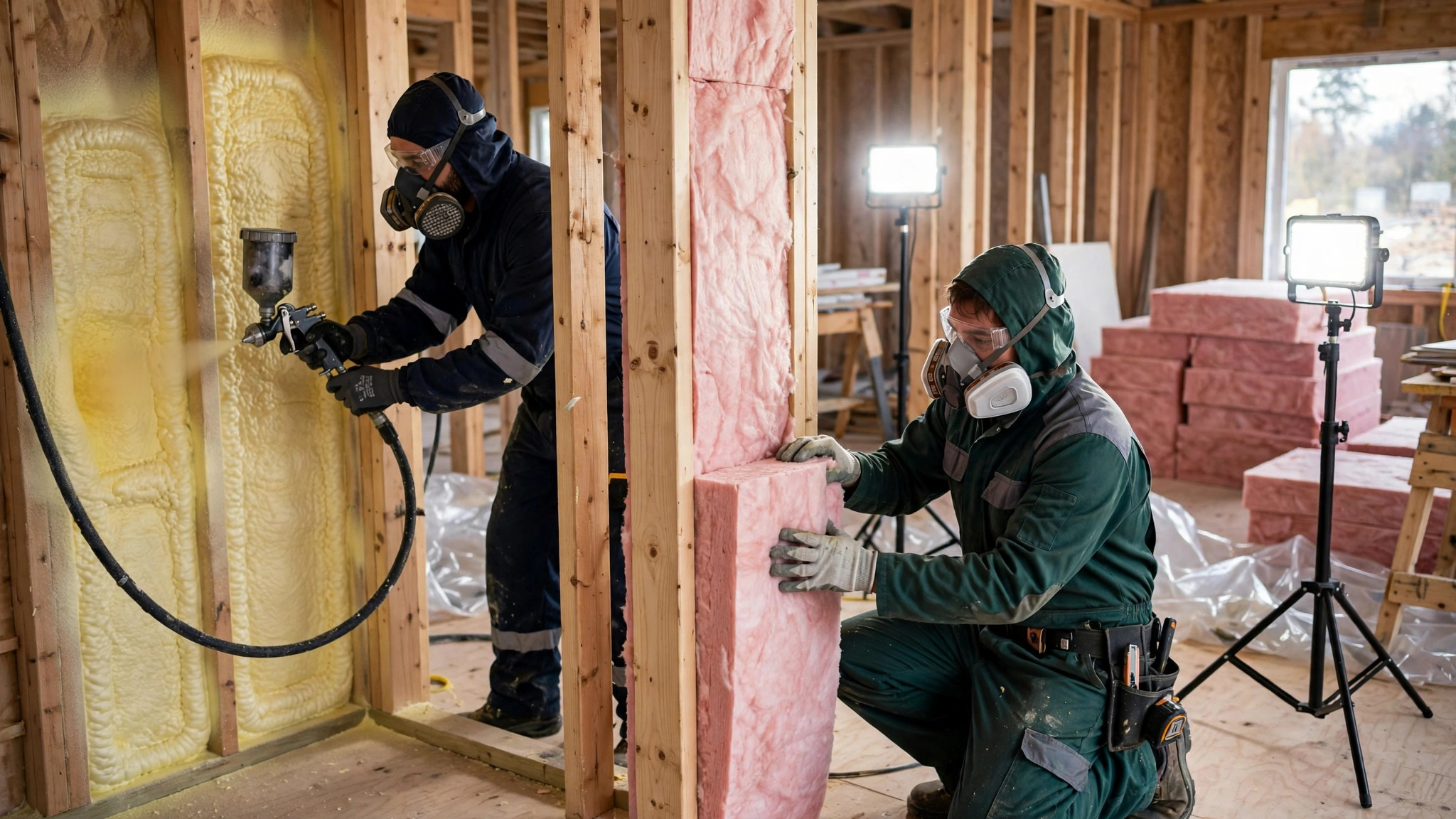
An insulation company is a project business with contractor cash flow. Jobs are quoted one at a time, crews are paid weekly, foam chemicals and blown-in material are bought by the truckload, and the money arrives after the work — often 30 to 60 days after, when the customer is a builder paying on a draw schedule. Meanwhile the rig that makes the work possible costs as much as a house deposit. That combination — expensive equipment, materials bought before payment, and demand that surges with the weather — is why insulation owners borrow, and why the product they borrow with matters as much as the amount.
This guide covers business funding for insulation companies: what owners borrow for, how the five main funding options compare, what lenders look for in a trade file, and a worked example for a $100,000 advance. Industry figures below come from IBISWorld 2026 reporting, U.S. Census data, and trade pricing guides — and where the sources disagree, the disagreement is stated, not smoothed over.
The industry, in numbers lenders actually use
IBISWorld's insulation-contractor count for 2026 is 28,498 businesses, up 0.7% from 2025 and growing about 0.9% a year since 2021. That is the narrow definition: companies whose primary work is installing insulation. Widen the lens and the numbers change fast. IBISWorld's broader drywall-and-insulation category (NAICS 23831) puts the 2026 market at $75.1 billion across 118,930 businesses — but that includes drywall contractors, who are the majority. Census Bureau Statistics of U.S. Businesses data, cited by CoreCredit, puts the drywall-and-insulation establishment count at roughly 52,000, with insulation and weatherization contracting revenue of about $19.1 billion in 2024 and an estimated $21.6 billion in 2026. A separate trade guide puts the U.S. insulation market alone at $13.6 billion, growing about 8.6% a year. The honest summary: the industry is somewhere between $14 billion and $22 billion depending on what you count, and it is made up of tens of thousands of small, mostly owner-operated companies.
The industry is highly fragmented: no single company holds a meaningful share of the market, and the largest operators are regional platforms, not national brands. That fragmentation is good news for an insulation owner seeking funding — there is no dominant chain setting the terms for everyone — but it also means your numbers have to speak for themselves: a lender underwrites your deposits, your backlog, and your equipment, not your brand.
| 2026, IBISWorld / Census / trade sources | Figure |
|---|---|
| U.S. insulation contractors (IBISWorld, narrow definition) | 28,498 (up 0.7% from 2025) |
| U.S. drywall & insulation businesses (IBISWorld, NAICS 23831) | 118,930 |
| Insulation & weatherization revenue (CoreCredit, Census/IBISWorld) | $19.1B in 2024; ~$21.6B estimated 2026 |
| U.S. insulation market, trade-guide estimate (FieldCamp) | $13.6B, growing ~8.6% a year |
| Establishments, drywall & insulation (Census SUSB) | ~52,000+ |
| Single-family homes still under-insulated | About 89% |
| Industry employment (BLS, NAICS 238310) | ~210,000 workers |
Margins are where the sources genuinely conflict, and the conflict tells you something useful. Trade guides aimed at owner-operators report gross margins of 45 to 55% and net margins around 25%, with spray foam the highest-margin work at 50% gross or better. Industry financial benchmarks from RMA and IBISWorld, by contrast, put the median net margin for insulation and weatherization contractors at 4.8%. Both can be true at once: a two-person spray foam crew running its own rig at high utilization keeps far more of each dollar than a larger contractor carrying office staff, a fleet, and builder contracts priced to win bids. When a funder reads your statements, it will price the business you actually run — not the industry average, and not the best-case crew.
What a job is worth
Insulation pricing is quoted per square foot of treated area, and the material sets the range. Open-cell spray foam runs about $1.00 to $3.50 per square foot installed; closed-cell foam, which insulates better per inch and acts as a vapor barrier, runs about $1.50 to $5.00. Blown-in fiberglass or cellulose is far cheaper — roughly $1.25 to $3.00 per square foot — which is why it still dominates attic top-ups and retrofits even though foam pays better per job. A typical attic job lands between $1,500 and $7,000 depending on material, depth, and access, and most contractors charge a minimum job fee of $500 to $750, with some sources reporting minimums of $1,000 to $2,000 for foam work.
| Service | Installed price per sq ft | Typical job |
|---|---|---|
| Open-cell spray foam | $1.00 to $3.50 | 1,000 sq ft attic: $1,500 to $3,500 |
| Closed-cell spray foam | $1.50 to $5.00 | 1,000 sq ft attic deck: $4,500 to $7,000 |
| Blown-in fiberglass | $1.50 to $2.50 | 1,000 sq ft attic: $1,500 to $2,500 |
| Blown-in cellulose | $1.25 to $2.25 | 1,000 sq ft attic: $1,500 to $2,500 |
| Fiberglass batts | $1.00 to $2.00 | Smaller jobs, new construction |
| Insulation removal (old material) | $1.00 to $2.00 extra | Adds $500 to $1,500 per job |
Two things about that table matter for funding. First, spray foam jobs are two to five times the ticket of blown-in jobs, so a company that adds foam capability roughly doubles its revenue per crew-day — which is exactly why the rig is worth financing. Second, the work is lumpy: a company can bill $15,000 one week and $2,000 the next, and the lender that prices your file will see the lumpiness in your deposits. Steady deposits matter more than a big month.
The equipment that drives the borrowing
For most insulation companies, the single biggest capital decision is the spray foam rig. A complete rig — proportioner, heated hose, spray gun, compressor, generator, and the trailer or truck carrying it — generally runs $30,000 to $150,000 depending on size and output. Entry-level trailer rigs sit around $38,000 to $60,000; mid-range production rigs run $60,000 to $120,000; high-output diesel rigs run $120,000 or more; and a fully equipped box-truck system can reach $130,000 to $200,000. The proportioner alone — a Graco Reactor E-20 runs about $28,000, an H-40 about $45,000 to $55,000 — costs more than some contractors' first truck.
| Equipment | Typical cost | What it does |
|---|---|---|
| Entry spray foam trailer rig | $38,000 to $60,000 | Residential attics, crawlspaces, small retrofits |
| Mid-range spray foam rig | $60,000 to $120,000 | Full homes and light commercial work |
| High-output diesel rig | $120,000 or more | Continuous commercial spraying |
| Box-truck rig system | $130,000 to $200,000 | Turnkey mobile foam operation |
| Proportioner alone (Graco Reactor E-20 / H-40) | $28,000 to $55,000 | The heart of the rig; meters and heats the foam |
| Commercial blowing machine (cellulose/fiberglass) | $5,000 to $40,000 | Entry $5K–$10K; mid $10K–$18K; high-volume $18K–$40K |
| Truck or enclosed trailer | $8,000 to $35,000 | Hauling the rig and crew, new vs. used |
| Opening foam chemical stock (A-side & B-side sets) | $3,000 to $10,000 | Consumed per job; reordered constantly |
A single spray foam rig with a two-person crew can gross $830,000 to $1.04 million a year at healthy utilization, with materials running 20 to 30% of revenue and labor 15 to 25%. That is the number that makes a rig loan work: the equipment pays for itself in months when it stays busy, and sits as an expensive depreciating asset when it does not. Utilization, not the sticker price, is the real underwriting question — and it is the question a lender will ask first.
Seasonality: the fall rush and the winter spike
Insulation demand follows the weather, and the pattern is well documented. Trade guides put peak demand from August through November, as homeowners rush to insulate before winter. Google Trends data for the search term "insulation" shows the same shape: interest peaks in January and again in October and November, and falls to roughly half that level in the spring months. Contractor guides agree that summer and winter are the busiest seasons — summer because attic work is practical in dry weather and homeowners prepare for winter, winter because cold rooms and drafty floors make the problem impossible to ignore — while spring and early fall are the slower shoulder seasons, when scheduling is easier and pricing is occasionally softer.
The cash-flow consequence is straightforward: revenue concentrates in the second half of the year, while payroll, fuel, insurance, and the truck payment run every month. A company that staffs up for the fall rush needs the money in July and August, before the rush pays for itself. The companies that borrow well treat that as a planning problem, not a surprise: a line of credit drawn in late summer and repaid by December costs far less than an advance taken in a panic in October.
One change for 2026: the federal 25C energy-efficient home improvement credit — 30% of qualifying insulation costs, up to $1,200 a year — expired on December 31, 2025, according to 2026 pricing guides. Older sources still describe it as running through 2032, so expect customers to ask about it; the current position is that it is no longer available for 2026 installs. Demand has not waited for the credit: about 89% of U.S. single-family homes are still under-insulated, and tightening energy codes keep pushing new-construction work toward insulation contractors.
What insulation company owners actually fund
A spray foam rig
Adding foam capability is the highest-return purchase most insulation companies make — foam jobs bill two to five times a blown-in job — and it is also the most expensive single purchase. A rig is the textbook case for equipment financing: the rig secures the loan, the term roughly matches its working life, and the monthly payment is predictable. Buying the rig with a short-term advance instead is the most common expensive mistake in this trade.
Trucks and trailers
A rig needs a properly rated tow vehicle — a loaded 8-by-16 trailer can pass 10,000 pounds gross weight, which calls for a 3/4-ton or 1-ton pickup — and a second crew needs a second truck. Trucks are also equipment-financing purchases, and a used truck at $8,000 to $35,000 is often the right first step before a new one.
Materials float
Foam chemicals, blown-in material, and batts are bought by the truckload and consumed per job, while builder customers pay on draw schedules that run 30 to 60 days. Opening chemical stock alone runs $3,000 to $10,000, and a busy month can burn through several sets. A business line of credit fits this pattern better than a lump sum: you draw for the material, repay when the job pays, and draw again.
Hiring and a second crew
Growth in this trade means a second crew — two trained installers, a truck, and a rig or blower — and the crew costs money for weeks before its jobs are billed and paid. A short-term loan or advance can fund the hire and the first month of payroll, but only if the backlog is real: hiring into an empty schedule is how a second crew becomes a second problem.
Weatherization and energy-program work
Utility rebate programs and weatherization assistance work can be steady, contract-like revenue — but they pay on government timelines, which are slower than homeowner timelines. Companies that take on program work often need a line of credit to bridge the gap between doing the work and getting the check.
Funding options for insulation companies, compared
| Option | Best for | Typical speed | Repayment |
|---|---|---|---|
| Merchant cash advance | Fast gaps, fall-rush staffing, short needs | 24 to 72 hours | Daily or weekly, from revenue |
| Short-term business loan | Planned hires, seasonal pushes | Days to a few weeks | Monthly or weekly installments |
| Equipment financing | Rigs, trucks, blowing machines | Days to weeks | Monthly, secured by the equipment |
| Business line of credit | Materials float, draw-schedule gaps | Days to weeks | Monthly, on what you drew |
| SBA 7(a) loan | Second crew, major expansion, property | 30 to 90-plus days | Monthly, up to 10 years (25 for real estate) |
Merchant cash advance (MCA)
An MCA is a lump sum in exchange for a fixed amount of your future sales, collected as a percentage of daily card sales or as fixed daily debits. It is the fastest option — funding often lands in 24 to 72 hours — and it qualifies mainly on revenue and bank deposits rather than credit score. Insulation companies are a workable fit because the work is steady and project-based, with regular deposits from homeowners and builders. The trade-off is cost and rhythm: the total repayment is fixed up front as a factor rate, and a fixed daily debit keeps coming on slow days as well as good ones — and in this trade, slow days are real.
Short-term business loan
A short-term term loan works like a conventional loan with a shorter life, typically repaid monthly or weekly over months rather than years. It fits a planned purchase with a known payoff date — hiring a second crew ahead of the fall rush, or a bulk chemical order before a big builder contract. The cost is quoted as an interest rate rather than a factor rate, so it is easier to compare with other loans.
Equipment financing
Equipment financing is the right tool whenever the purchase is a piece of equipment. The lender funds the rig, the truck, or the blowing machine, the equipment secures the loan, and you repay monthly over a term that roughly matches how long the equipment will last. For a $60,000 to $120,000 rig, this is almost always cheaper than any unsecured option.
Business line of credit
A line of credit is revolving: you draw what you need, repay it, and draw again. For an insulation company, the recurring gap is usually materials bought this week for a job that pays next month, or a builder's draw landing after payroll. A line fits that pattern better than a lump sum, because you only pay interest on what you drew.
SBA 7(a) loan
The SBA 7(a) program is the standard route for large, long-lived insulation needs. The maximum loan is $5 million, with terms of up to 10 years for working capital and equipment and up to 25 years for real estate, and the SBA guarantees up to 85% of loans of $150,000 or less and up to 75% of larger loans. The price is time and paperwork: applications typically take 30 to 90-plus days, so start months before you need the money.
Need funding for your insulation company this week?
Apply Now →Free to apply · Soft credit check only · Funding in 24–72 hoursWhat funders look for in an insulation company file
- Steady deposits, not a big month. For an MCA or a short-term loan, consistent monthly deposits matter more than any single month — and insulation deposits are lumpy by nature, so a funder will look at the trend across three to six months.
- Backlog and pipeline. Signed quotes, builder contracts, and a scheduled book of jobs are a funding asset. A funder that can see next month's work already booked prices the file better than one looking at an empty calendar.
- Retail vs. builder mix. Homeowner jobs usually pay on completion; builder work pays on draws, 30 to 60 days out. A company heavy on builder work needs a bigger cushion, and a funder will price that in.
- Rig utilization. A rig that runs four or five days a week is a money machine; a rig that runs twice a month is a liability. Be ready to show how busy the equipment actually is.
- Time in business and ownership. Six months of operating history is a common floor for fast funding, and a year or more opens better pricing.
- Existing advances and debt. A company already repaying one or two advances is a stacking risk. Disclose every open advance up front.
- Credit — as a secondary factor. Personal credit matters less for an MCA than for a bank loan. It does move pricing: stronger credit generally earns a lower factor rate.
A $100,000 worked example — illustrative rates only
The numbers below are an illustration, not an offer. The factor rates are clearly labeled as illustrative examples; real factor rates vary by file, and no lender's actual rate is stated here. Ask any funder for the total repayment in dollars before you sign, and compare offers on that number.
Suppose a mid-size insulation company — one spray foam rig and a blown-in crew, grossing about $60,000 a month, or $720,000 a year — takes a $100,000 advance to buy a second mid-range rig and fund the chemical stock and payroll to run it. At an illustrative factor rate of 1.30, the total repayment is $100,000 times 1.30, or $130,000 — the $100,000 received plus $30,000 of cost. Collected as fixed daily debits over 200 business days, the debit is $130,000 divided by 200, or $650 per business day.
| Advance | Illustrative factor rate | Total repayment | Cost | Daily debit over 200 business days |
|---|---|---|---|---|
| $100,000 | 1.20 (illustrative) | $120,000 | $20,000 | $600 |
| $100,000 | 1.30 (illustrative) | $130,000 | $30,000 | $650 |
| $100,000 | 1.40 (illustrative) | $140,000 | $40,000 | $700 |
Now run the affordability check, because the size of the advance matters as much as the rate. A $650 daily debit works out to about $14,100 a month (200 business days is roughly 9¼ months). Against $60,000 a month in revenue, that is about 23% of revenue before payroll, fuel, chemicals, and insurance — heavy, but workable if the second rig is busy. Against a smaller company's $25,000 a month, the same debit would take about 56% of revenue — not workable, and the advance should be smaller. And remember what the money is buying: trade guides put a single rig with a two-person crew at $830,000 to $1.04 million a year in gross revenue at healthy utilization. If the second rig runs at that pace, the $30,000 cost of the advance is a small price for the capacity. If it runs twice a month, the advance is a problem — so the real question is not the factor rate, it is the backlog.
Before signing, run the dead-season test on the daily figure: take your thinnest normal month's deposits — usually a spring month, not a fall month — subtract payroll, fuel, chemicals, insurance, and the truck payment, and check that the debit still fits. Also confirm in writing how the debit adjusts if revenue falls, what early payoff costs, and how quickly any lien is released after payoff.
Typical timelines
| Product | Decision | Funding after approval |
|---|---|---|
| Merchant cash advance | Same day to 24 hours | 24 to 72 hours |
| Short-term business loan | 1 to 3 days | Days to a few weeks |
| Equipment financing | 1 to 5 days | Days to weeks, often tied to delivery |
| Business line of credit | Days to weeks | Days after approval |
| SBA 7(a) loan | Weeks | 30 to 90-plus days from application |
Documents you will need
For fast funding — an MCA or a short-term loan — the file is short. The one document genuinely required is your business bank statements, usually the last three to six months, because the offer is priced on your deposits. A photo ID and a voided check are optional verification items in most applications, not requirements.
Equipment financing adds the supplier's written quote for the rig, truck, or blower. An SBA loan needs tax returns, financial statements, a business plan, and the lease.
Five checks before you sign
- Total dollars in writing. Advance amount, factor rate or interest rate, total repayment, and any fees — all of them, before signature.
- The dead-season test. Confirm the payment fits your thinnest normal month, not your fall peak, after payroll, fuel, chemicals, insurance, and the truck payment.
- The match. Short money for short needs, long money for long needs. An advance for fall-rush payroll is a tool; an advance for a $100,000 rig is a mistake — finance the rig.
- The backlog picture. If the second rig or crew has no booked work behind it, fix the pipeline before borrowing against the revenue it has not earned yet.
- The exit. What does early payoff cost, is there a discount, and how quickly is any lien released after payoff?
An insulation company is one of the more fundable trades in America: essential work, steady demand, expensive equipment that earns its keep, and a market where about 89% of single-family homes are still under-insulated. The companies that borrow well are the ones that borrow against that reality — equipment financing for the rig, a line for the materials float, a short advance for a short gap — and that know their own numbers before a funder asks for them.
Educational information only; this guide is not financial, legal, or tax advice. Rates, terms, and qualification standards vary by funder and by file. Talk to a CPA or attorney about the accounting and tax treatment of any advance for your business.
Frequently asked questions
How much funding can an insulation company get?
It depends on revenue, time in business, and the product. A merchant cash advance is typically sized as a multiple of monthly deposits, so a company grossing $60,000 a month can usually access far more than one grossing $15,000. An SBA 7(a) loan can go up to $5 million for a large expansion, rig fleet, or property purchase.
Can an insulation company get a merchant cash advance?
Yes. Insulation companies are a workable fit for merchant cash advances because the work is steady and project-based, with regular deposits from homeowners and builders. Funders look at the last three to six months of bank statements to size the advance.
What credit score do you need for insulation company financing?
There is no single minimum, and it varies by product. Merchant cash advances qualify mainly on revenue and bank deposits, so a weaker credit score usually means a higher factor rate rather than an automatic decline. SBA and bank term loans have stricter credit requirements.
How fast can an insulation company get funding?
A merchant cash advance typically funds in 24 to 72 hours from a complete application, with same-day decisions common. Short-term loans and equipment financing take days to a few weeks, and an SBA 7(a) loan typically takes 30 to 90-plus days.
Can I use insulation company funding to buy a spray foam rig?
Yes, and equipment financing is usually the best fit for a rig: the rig secures the loan, the term roughly matches its working life, and monthly payments are predictable. A complete rig runs about $30,000 to $150,000 depending on size and output, so the loan amount should match the specific rig you are buying.
Do I need a photo ID or a voided check to apply?
No — a photo ID and a voided check are optional verification items in most applications, not requirements. Fast funding is priced on your bank statements, usually the last three to six months.
Fund your insulation company on the terms that fit it
Get a no-obligation quote from our #1-ranked lender, Coast to Coast Fast Funding — $5K to $5M, MCA and revenue-based products that fund in 24–72 hours with soft-pull-only applications. We shop 75+ lenders so you can compare the true cost of every offer side by side.
Apply Now →Soft credit check · 60-second pre-qualification · (352) 809-3201