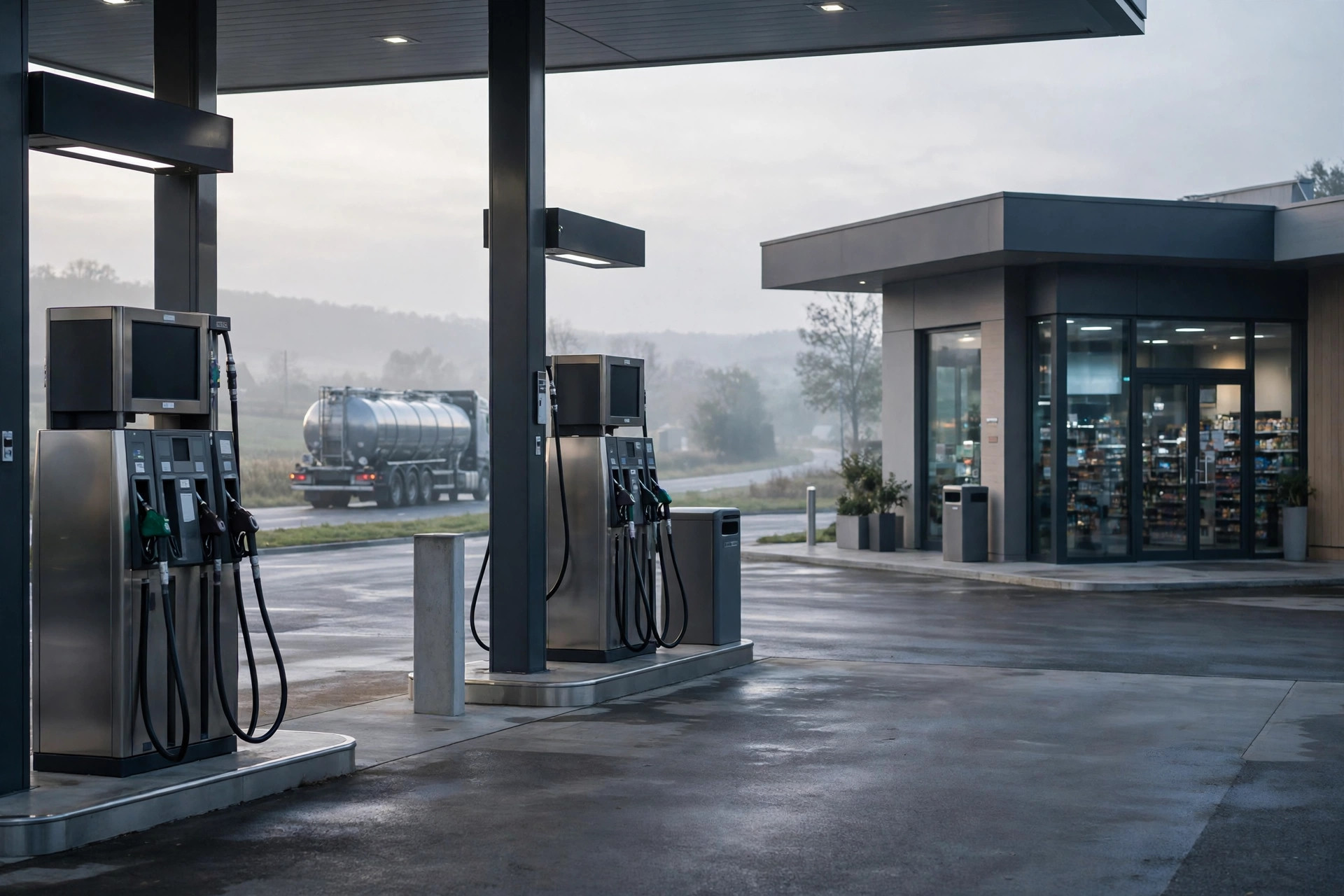
A gas station is two businesses sharing one address, and they obey different economics. The forecourt sells fuel at a thin margin on enormous volume. The store sells food, drinks, tobacco, lottery, and services at far better margins on far smaller tickets. The tanks underneath tie the two together with a liability no ordinary retailer carries: environmental responsibility that follows the owner, inspections that never stop, and capital projects — a tank, a dispenser, a canopy, a car wash — priced like construction, not like retail fixtures. Funding a gas station means funding all three at once, with the right product for each, because the product that fits the fuel float will ruin a tank project and the product that fits a tank project will starve the float.
This guide is for independent owners and small operators — one station or a handful, branded or unbranded — not for the national chains, whose capital comes from corporate balance sheets and public markets. The numbers below come from industry data published in 2025 and 2026, attributed where they appear. Where a figure is a range from operator worksheets rather than a published benchmark, it is labeled as one.
The margin split: fuel is traffic, the store is profit
The NACS split is the single most important fact in this business. Fuel dominates the top line and under-delivers the profit; the store is a minority of sales and the majority of the money the owner keeps. That is why the chains and the best independents run the forecourt as a traffic engine for the store: the pumps get the customer onto the lot, and the food, coffee, car wash, and merchandise earn the keep. A station that prices fuel to maximize gallons and ignores the inside business is optimizing the wrong number.
Inside the store, the margins stack in a clear order. Foodservice is the profit engine — operator worksheets put prepared-food gross margins near 40%, with a blended inside margin around 25% — while tobacco runs much thinner, roughly 10% to 15%. Lottery, ATM fees, and car wash income add up as small, high-margin lines that cost little incremental labor. None of this is a reason to neglect fuel: without competitive fuel pricing and a clean, working forecourt, the store traffic never arrives. It is a reason to judge the business on gross profit dollars and cash flow, never on gallons or top-line sales alone. Lenders read it the same way.
The fuel float: paid upfront, collected in drips, squeezed by card fees
Fuel is bought by the load and paid for on supplier terms that are often shorter than the time it takes the money to come back through the pumps — cash or short terms out, card settlements and store sales trickling in over days and weeks. A station moving serious volume can have tens of thousands of dollars of fuel in its tanks and in transit at any moment, all of it paid for before a single gallon is sold. When wholesale prices rise, the float gets bigger without the business selling one more gallon: the same load costs more, the card fee on each sale rises with the pump price, and the net margin per gallon barely moves. As one 2025 industry analysis put it, a high pump price is not a good year for a station — it is a working capital problem with a thinner net margin attached.
Card interchange is the largest single deduction from the gross fuel margin, and it scales with the fuel price rather than with volume — the operator's cost of selling a gallon rises every time the commodity does. Labor, electricity for the dispensers and canopy, dispenser maintenance, environmental compliance, and the cost of the tanks themselves take the rest, which is how a gross margin in the 20s or 30s becomes a net margin of 10 to 15 cents. The working-capital answer is structural: a revolving line of credit sized to a full load cycle, drawn when a load is bought and repaid as it sells through, not a one-time advance that must be repaid while the float is still open.
Tanks and compliance: the liability under the lot
Underground storage tanks are the part of this business no other retailer has to think about. Federal rules require owners and operators of petroleum underground storage tanks at petroleum marketing facilities — gas stations — to demonstrate financial responsibility of $1 million per occurrence, under 40 CFR 280.93, at sites handling more than 10,000 gallons a month on average, with a $1 million annual aggregate for 1 to 100 tanks. Budget meeting that requirement as a recurring operating expense, because it recurs every year, and expect a lender to ask how you meet it before discussing anything else.
Beyond the federal floor, states run their own inspection, upgrade, and replacement regimes — double-wall requirements, leak-detection standards, and deadlines that have already forced hundreds of small stations in some states to choose between a major capital project and closing. A tank or dispenser project is construction: excavation, environmental testing, permits, and downtime while the forecourt is closed or partly closed. It is also the project where the wrong financing hurts most. A short-term advance repaid from daily debits while the pumps are down is a recipe for a missed payment; a term loan or SBA-backed loan with a payment calendar that survives the construction window is the product built for it. Before any tank project, get the compliance file in order — tank age, inspection history, and any outstanding findings — because a lender's first question will be the tanks, and an unanswered one ends the conversation.
Need fuel float, a tank project, or a store upgrade?
Apply Now →Free to apply · Soft credit check only · Funding in 24–72 hoursBranded or unbranded: read the supply contract, not the canopy
The brand on the canopy is not the deal. The deal is the fuel supply contract: its term, its volume commitments, its pricing formula, its image and upgrade requirements, and what happens if you miss a commitment or want out early. A branded contract can bring supply security, brand marketing, and sometimes support for image upgrades — and it can also bring mandatory upgrades, minimum volumes, and a long commitment that outlives the business plan. An unbranded station keeps pricing freedom and avoids brand fees, but carries its own supply and marketing burden.
Give the lender the supply contract itself, not a summary. Lenders in this sector want to see the term against the loan term, the volume against the gallons in the statements, and the upgrade obligations against the capital plan. If the contract requires an image upgrade in year two and the loan amortizes over ten, that mismatch belongs in the application, not as a surprise in year two. And never assume terms from the brand name: two stations under the same canopy can hold very different contracts.
Which product fits which need
| Need | Best-fit product | Why it fits |
|---|---|---|
| Buying the station, land, or a tank project | SBA-backed loan | Longest term, lowest cost; term can match the asset life — plan months ahead |
| Fuel float: loads bought before they sell through | Business line of credit | Drawn for the load, repaid as it sells; revolving, not one-time |
| Dispensers, car wash, kitchen, POS | Equipment financing | Asset is collateral; monthly payment; term matches useful life |
| A one-time gap: repair, slow week, supply spike | Revenue-based advance | Fast, sized to deposits; expensive if it becomes permanent |
| Store remodel or foodservice build-out | Term loan or SBA-backed loan | Capital project with a multi-year payoff — needs a multi-year term |
The expensive mistake in this trade is matching a long-lived need to a short-term product: funding a tank replacement with a six-month advance, or funding a permanent payroll increase with a one-time advance and discovering the gap is still there next quarter. The second expensive mistake is the reverse — waiting months for a bank process when the fuel float is due Friday. Match the term to the use, compare total dollars repaid, and keep the fast product for the fast problem.
What a lender actually checks
A gas station lender checks four things: the gallons, the inside sales, the tanks, and the operator. Gallons and inside sales come from the bank statements and the point-of-sale records — three months of business bank statements are the core requirement, showing deposits that support the payment alongside fuel purchases and payroll. The tanks come from the compliance file: age, inspections, findings, and the financial-responsibility coverage. The operator comes from experience: who runs the pumps and the store, and what fuel and retail experience they bring. A lease matters too — if you lease the site, the lender wants enough years left on the lease to cover the loan, and a landlord who will cooperate with a lender's requirements.
Photo ID and a voided check are optional verification items that may be requested later in the process; they are never upfront requirements, and no legitimate lender needs them before showing you a price. If a funder demands more documents before quoting terms, ask why, and shop the file elsewhere.
The pre-signing checklist
- Total dollars, in writing: the amount funded versus the total repaid, including every fee, on the same amount and term as the competing offer.
- Float sizing: the line of credit should cover a full load cycle — purchase to sell-through — not one slow week.
- Tank file complete: tank age, inspection history, outstanding findings, and financial-responsibility coverage documented before you apply.
- Supply contract in hand: term, volume commitments, pricing formula, and upgrade obligations matched against the loan term.
- Inside-sales plan: foodservice and car wash are the profit engines — the application should show how the store earns, not just how many gallons move.
- Construction window: for any tank or remodel project, the payment calendar must survive the weeks the forecourt is down.
How we researched this guide
The fuel-versus-store profit split, the 80% share of U.S. fuel sold through convenience stores, and the foodservice share of in-store gross profit are from NACS 2025 State of the Industry data as reported in 2026 gas-station financing coverage. Gross and net fuel-margin ranges are from NACS estimates and operator valuation worksheets (Global Petro Advisors; Vanta Insights, 2025 data), paraphrased in our own words; the gross-versus-net distinction is theirs and it matters — a benchmark that quotes fuel margin without saying which is not usable. The $1 million financial-responsibility figures are from 40 CFR 280.93. Margin ranges are planning figures, not quotes; verify the supply contract, the tank file, and the actual offer before you sign. For the cost side of any advance you are offered, see our MCA cost guide and our offer-comparison guide.
Frequently asked questions
How much profit does a gas station make per gallon?
Gross margins typically run roughly 15 to 35 cents a gallon in operator worksheets, about 23 cents typical — but the net margin after card fees, labor, electricity, maintenance, and compliance is far thinner, with NACS estimating 10 to 15 cents a gallon. Always ask whether a quoted margin is gross or net.
What makes more money: fuel or the store?
The store, per dollar of sales. Fuel was 65.0% of convenience-store sales dollars but only 38.8% of gross profit dollars in NACS 2025 data, while foodservice alone produced 38.9% of in-store gross profit. Fuel brings the traffic; the store keeps the profit.
What is the $1 million tank financial-responsibility rule?
Under 40 CFR 280.93, owners or operators of petroleum underground storage tanks at marketing facilities handling more than 10,000 gallons a month on average must demonstrate $1 million of financial responsibility per occurrence, with a $1 million annual aggregate for 1 to 100 tanks. It is a recurring operating cost, not a one-time fee.
Should a gas station be branded or unbranded?
It depends on the supply contract, not the canopy. Branded contracts can bring supply security and marketing support with upgrade and volume commitments; unbranded stations keep pricing freedom and carry their own supply burden. Read the contract term, volume commitments, and upgrade obligations before deciding.
What documents does a gas station need to apply for funding?
Three months of business bank statements are the core requirement, plus the fuel supply contract and the tank compliance file (age, inspections, findings, coverage). Photo ID and a voided check are optional verification items, never upfront requirements.
Can a gas station get an SBA loan for a tank replacement?
Yes — tank projects and station acquisitions are the classic SBA-backed use case in this trade, because the term can match the asset life. Expect the lender to underwrite the tanks, the supply contract, the lease term, and the operator's experience alongside the financials, and plan months ahead rather than weeks.
The best offer is the one you compare
Get a no-obligation quote from our #1-ranked lender, Coast to Coast Fast Funding — $5K to $5M, MCA and revenue-based products that fund in 24–72 hours with soft-pull-only applications. We shop 75+ lenders so you can compare the true cost of every offer side by side.Apply Now →Soft credit check · 60-second pre-qualification · (352) 809-3201