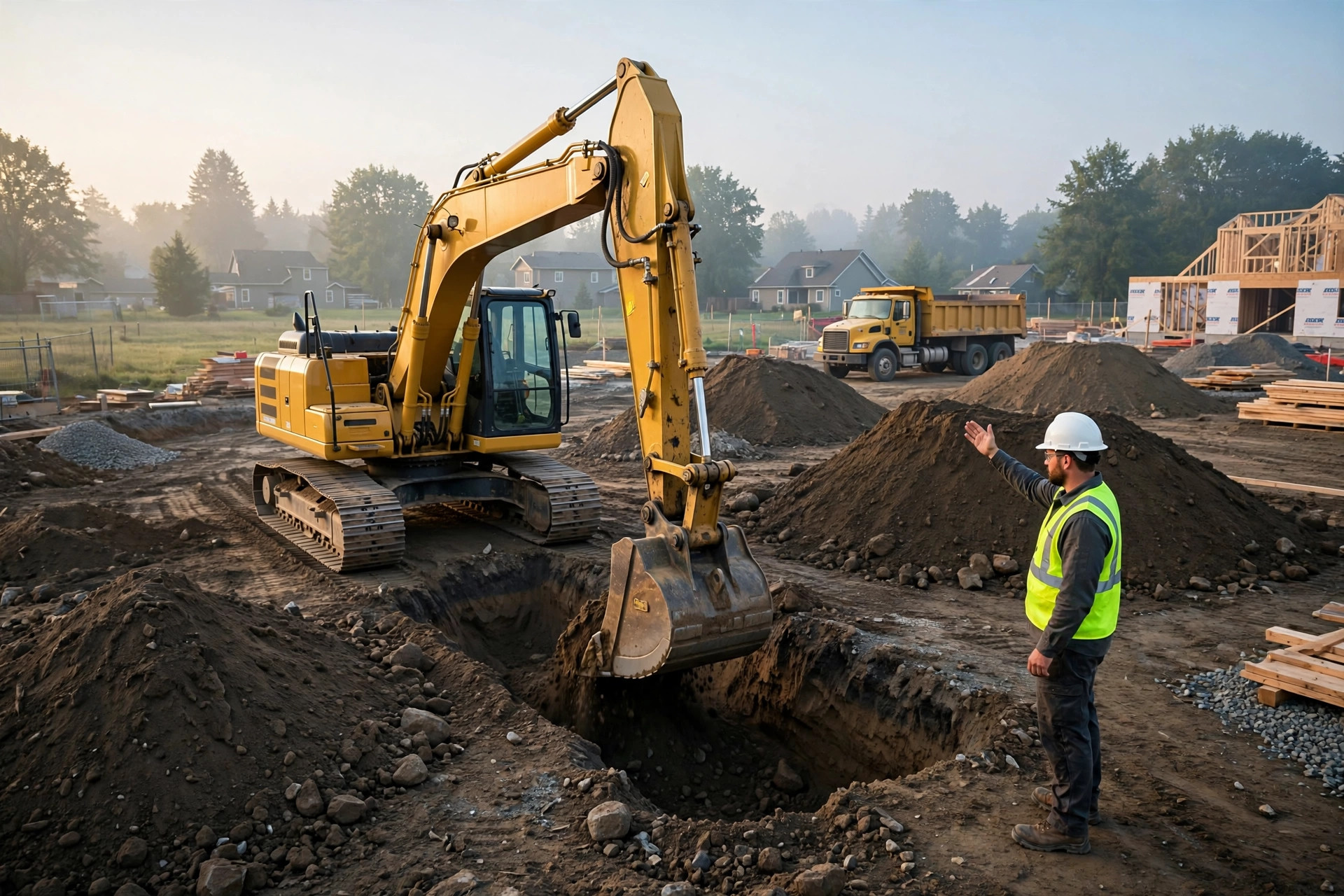
Excavation is an iron-first business. Before the first trench, before the first crew, there is a machine — and the machine decides almost everything else: which jobs you can bid, how fast you can finish them, what breaks down in week three, and how much of the draw you keep. A contractor with the right iron and no working capital still stalls, because excavation is paid in arrears and spent in advance. A contractor with working capital and the wrong iron stalls differently, renting a machine that costs more per month than the payment on owning it. This guide covers both halves: what the iron actually costs in 2026, and how the money moves through an excavation business between mobilization and the first draw.
The businesses in this guide range from a one-operator residential shop — foundations, septic systems, driveways, land clearing — to a multi-crew outfit doing site work for homebuilders and commercial general contractors. The funding needs rhyme across that range. The iron gets bigger, the draws get slower, and the float gets longer. The products that fit are the same four: equipment financing for machines, a line of credit for the float, a revenue-based advance for short gaps, and, for the larger shops, an SBA-backed loan for the fleet and the yard.
The iron math: what machines cost in 2026
Equipment prices are the first reality check in this trade, because they set the size of every other decision. The bands below come from 2026 equipment-financing market surveys, which report new-list ranges by machine class. Treat them as planning bands, not quotes: configuration, attachments, hours, and region move any single machine well outside the middle of its band.
| Machine | New, 2026 band | Used, late-model | What it does in this trade |
|---|---|---|---|
| Mini excavator | $30,000–$90,000 | 50–75% of new list | Residential foundations, septic, tight-lot work, utility trenches |
| Skid steer / compact track loader | $40,000–$95,000 | 50–75% of new list | Grading, backfill, material handling, attachments |
| Mid-size hydraulic excavator | $150,000–$350,000 | 50–75% of new list | Commercial site work, deep utilities, mass excavation |
| Wheel loader | $120,000–$400,000+ | 50–75% of new list | Loading, stockpiling, aggregate and site material |
| Dozer | $150,000–$500,000+ | 50–75% of new list | Mass grading, road building, large site prep |
The purchase price is not the ownership cost. A 2026 ownership-cost breakdown for contractors puts preventive maintenance and wear parts at roughly $3,000 to $15,000 a year per machine, equipment insurance at roughly $1,000 to $5,000 a year, and a single breakdown's downtime at $500 to $5,000 a day in missed deadlines and idle crew. Depreciation is the quiet one: equipment typically loses 20% to 40% of its value in the first few years, which is why buying late-model used is often the better capital decision for a machine that will run hard from day one. Budget the ownership costs alongside the payment, or the first repair season will budget them for you.
Attachments change the math in your favor. A mini excavator with a breaker, auger, grapple, and tilt bucket does four jobs that would otherwise need four rentals or a second machine. When you price a machine, price it with the attachments that earn its keep — and when you finance it, ask whether the attachments can ride on the same equipment loan. Often they can, which spreads their cost over the same term as the machine instead of draining the operating account in month one.
The draw-schedule float: where excavation businesses actually break
Almost no excavation job pays when the work is done. Commercial and homebuilder work pays in progress draws: a percentage of the contract billed as milestones are reached, with a portion — retainage, often 5% to 10% — held back until the whole project completes. The contractor pays for fuel, operators, trucking, and repairs in real time and gets paid in arrears, sometimes 30 to 60 days after the draw is submitted, longer when the general contractor's own payment is slow. The gap between mobilization and the first cleared draw is the float, and it is the most common reason a busy excavation contractor runs out of money: plenty of work, plenty of receivables, no cash in the account.
Weather makes the float worse in exactly the wrong direction. Rain stops the work but not the costs — the crew is still paid or still expects hours, the machine payment still comes due, the insurance still renews — and the draw schedule slips by the same number of lost days. A business that survives on one job's float is one rained-out month from a missed payroll. The fix is structural, not heroic: a line of credit sized to one full draw cycle, drawn only when the float is open, repaid when the draw clears. Businesses that treat the line as a permanent balance eventually pay permanent interest for a temporary problem; businesses that treat it as a bridge use it and clear it, draw after draw.
Need a machine, a crew, or the float to the first draw?
Apply Now →Free to apply · Soft credit check only · Funding in 24–72 hoursRent, buy, or finance: the utilization rule
The rent-versus-buy question has a clean rule of thumb, and it is the only one worth memorizing: if a machine will be used more than about 60% of the time, buying — usually financed — beats renting; if it will be used occasionally, renting beats owning. The logic is arithmetic, not philosophy. A rental machine earns nothing on the days it sits, and you pay for delivery, pickup, and the days you keep it past the job. An owned machine earns on every day it works and costs you on every day it does not — the payment, the insurance, the storage — so ownership only wins when utilization is high and steady.
Financing sits between the two for most growing shops. Equipment financing uses the machine itself as collateral, which usually means easier approval and longer terms than an unsecured advance, and the payment is monthly rather than daily — a meaningful difference for a business paid in draws. The trade is commitment: a 48- or 60-month term on a machine that turns out to be the wrong size is a slow, expensive lesson. Before signing, check the exit: what the payoff looks like in year two, whether the loan allows an early payoff without penalty, and whether the machine's resale value at that point covers the remaining balance. A machine that holds its value is a financing decision; a machine that does not is a rental decision wearing a loan's clothes.
Which product fits which need
| Need | Best-fit product | Why it fits |
|---|---|---|
| Adding a machine you will run daily | Equipment financing | Machine is collateral; monthly payment; term matches useful life |
| Covering the draw float | Business line of credit | Drawn only while the draw is open; repaid when it clears |
| A one-time gap: repair, fuel spike, payroll week | Revenue-based advance | Fast, sized to deposits; expensive if it becomes permanent |
| Fleet expansion + yard + working capital together | SBA-backed loan | Longest term, lowest cost; slowest process — plan months ahead |
| A machine you need for one job | Rental | No commitment, no maintenance, no resale risk |
The expensive mistake in this trade is matching a long-lived need to a short-term product: financing a five-year machine with a six-month advance, or covering a permanent payroll increase with a one-time advance and discovering the gap is still there next quarter. The second expensive mistake is the reverse — waiting six weeks for a bank process when the draw gap is due Friday. Match the term to the use, compare total dollars repaid, and keep the fast product for the fast problem.
What a lender actually checks
Equipment lenders check three things: the machine, the business, and the backlog. The machine's value sets the loan-to-value and the term — a lender will not finance a 10-year-old machine over 60 months. The business's bank statements set the affordability case: three months of statements are the core requirement, showing deposits that support the payment alongside payroll and fuel. The backlog — signed contracts, scheduled work, a general contractor relationship — is what separates a contractor buying a machine for work already sold from a contractor buying a machine and hoping work appears. Bring the contracts to the application if you have them; they are the strongest page in the file.
For revenue-based products, the check is narrower and faster: deposits, consistency, and time in business. Lenders look for steady deposit history rather than one big month, and they discount deposits that are not really revenue — transfers, loans, one-off asset sales. Photo ID and a voided check are optional verification items that may be requested later in the process; they are never upfront requirements, and no legitimate lender needs them before showing you a price. If a funder demands more documents before quoting terms, ask why, and shop the file elsewhere.
The pre-signing checklist
- Total dollars, in writing: the amount funded versus the total repaid, including every fee, on the same amount and term as the competing offer.
- Repayment mechanics: monthly payment, weekly debit, or daily debit — and what each does to cash flow in a rained-out month, not a perfect one.
- Utilization honesty: will this machine run more than 60% of the time? If not, price the rental first and let the rental quote discipline the purchase price.
- Ownership costs budgeted: maintenance $3,000–$15,000 a year per machine, insurance, and a downtime reserve, on top of the payment.
- Draw-cycle sizing: the line of credit should cover one full draw cycle — mobilization to cleared draw — not one payroll.
- Exit terms: early-payoff treatment, lien release on payoff, and whether the payoff letter commits the release in writing with a timeframe.
How we researched this guide
Machine price bands, used-equipment values, maintenance and insurance ranges, downtime costs, and the 60% utilization rule are summarized from 2026 equipment-financing market surveys and contractor ownership-cost breakdowns (Crestmont Capital's 2026 construction equipment financing statistics and equipment costs index; Boom and Bucket's 2026 heavy equipment ownership costs breakdown), paraphrased in our own words. Bands are planning ranges, not quotes; verify the machine, configuration, and hours on the actual offer before you sign. For the cost side of any advance you are offered, see our MCA cost guide and our offer-comparison guide.
Frequently asked questions
How much does it cost to start an excavation business?
It depends on the iron. A lean one-operator residential shop can start with a used mini excavator and a truck and trailer for well under $150,000 all-in; a crew-ready commercial operation with a mid-size excavator, loader, and trucks runs several hundred thousand dollars before the first draw clears. The two biggest variables are new versus used iron and whether you rent the second machine instead of owning it.
Should an excavation contractor buy or rent equipment?
Buy — usually financed — when a machine will run more than about 60% of the time. Rent when the need is occasional or job-specific. Financing sits between the two: the machine is collateral, the payment is monthly, and the term should match the machine's useful life.
What funding fits the draw-schedule float?
A business line of credit, sized to one full draw cycle and repaid when each draw clears. Revenue-based advances can cover a one-time gap, but a permanent float problem needs a revolving product, not a one-time advance that must be repaid while the float is still open.
Can a new excavation business get equipment financing?
Yes, more easily than unsecured funding, because the machine secures the loan. Lenders weigh the machine's value, the business's deposits, time in business, and the backlog of signed work. A signed contract for the work the machine will do is the strongest page in the file.
What documents does an excavation contractor need to apply?
Three months of business bank statements are the core requirement. Equipment lenders may also ask for the machine quote, and revenue-based lenders for ownership details. Photo ID and a voided check are optional verification items, never upfront requirements.
How long does equipment financing take?
Days to a couple of weeks for most equipment loans once the machine and quote are set — faster than a bank term loan, slower than a revenue-based advance. If the machine is needed for a job starting next week, start the application before the job is scheduled, not after.
The best offer is the one you compare
Get a no-obligation quote from our #1-ranked lender, Coast to Coast Fast Funding — $5K to $5M, MCA and revenue-based products that fund in 24–72 hours with soft-pull-only applications. We shop 75+ lenders so you can compare the true cost of every offer side by side.Apply Now →Soft credit check · 60-second pre-qualification · (352) 809-3201