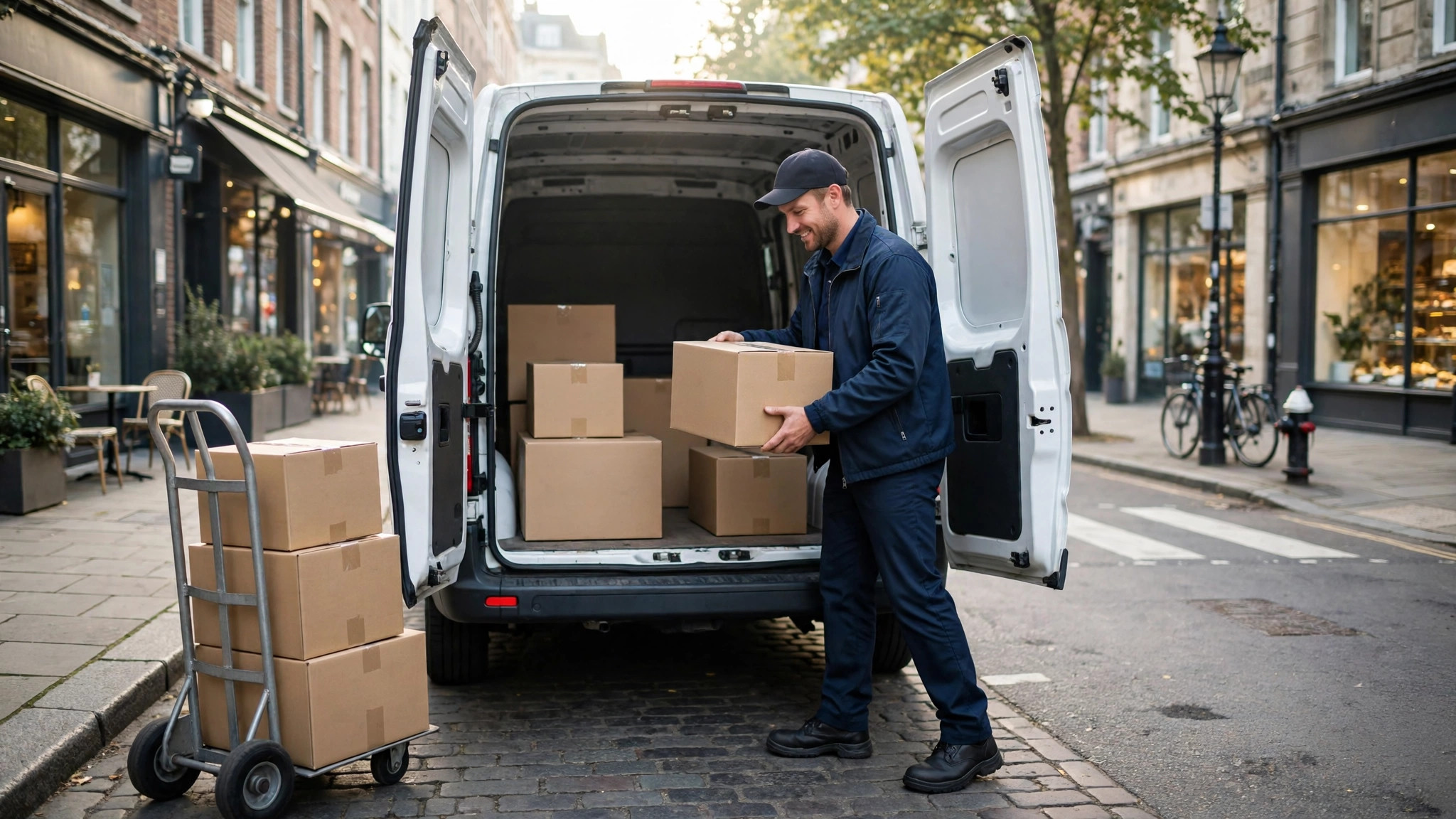
A courier business runs on cash flow timing. The van needs fuel and insurance today, the driver needs paying on Friday, and the client who owes you for last month's deliveries pays on net-30 — or net-45, if they feel like it. That gap between spending and collecting is why courier funding exists, and why the wrong product can hurt: a loan priced for a five-year asset does not help a two-week fuel crunch, and a cash advance priced for speed does not help buy a fleet.
The courier industry in numbers
Delivery is a large and still-growing market. IBISWorld puts the US couriers and local delivery services industry at $241.3 billion in 2026, growing at a 5.9% compound annual rate between 2021 and 2026. The same research counts about 2.54 million businesses in the industry in 2026 — up 20% from 2025 — a figure that includes the huge number of owner-operators and independent drivers. Counting employer firms only, Vertical IQ puts the industry at roughly 10,880 companies employing about 1.1 million workers.
Volume keeps the wheels turning: US domestic parcel throughput topped 23.8 billion pieces in 2024, with e-commerce as the main driver. Amazon Logistics moved about 6.7 billion of those parcels and took the top spot by volume for the first time. For a small courier, that scale is the opportunity — the national carriers subcontract routes and local businesses need same-day delivery — and it is also the pressure, because the work is won on reliability and price, and both depend on having vehicles on the road.
What courier businesses actually spend funding on
Courier spending is lumpy, and the lumps are what funding smooths out. The big five:
- Vans and upfitting. A new 2026 Ford Transit cargo van starts at about $49,400 before taxes, destination charges, and upfitting — shelving, bulkheads, GPS, and branding add thousands more. A three-van expansion is a $150,000 decision before a single parcel is delivered.
- Fuel. A van running 150 to 250 miles a day burns through fuel every week, and fuel is a cash cost that cannot be deferred. When fuel prices spike, the weekly bill can jump hundreds of dollars with no warning.
- Insurance. Commercial auto insurance for a delivery or courier service typically runs $1,500 to $2,500 per vehicle per year, and general liability averages around $191 a month. Contracted work raises the bar: Amazon requires its Delivery Service Partners to carry $1 million in auto liability per occurrence and $1 million per occurrence / $2 million aggregate in general liability. Personal auto policies exclude commercial use — a claim on a personal policy while delivering will be denied.
- Payroll and driver costs. Drivers, dispatchers, background checks, and uniforms all get paid weekly, while clients pay monthly. A growing route book means payroll grows weeks before revenue catches up.
- Routes and contracts. Taking on a contracted delivery territory — Amazon DSP, FedEx Ground, or a regional shipper — usually means hiring and insuring drivers before the first route payment arrives. Amazon estimates startup costs for a new Delivery Service Partner at as low as $10,000 (vehicles leased separately), and the application requires at least $30,000 in liquid assets.
The five funding products that fit courier businesses
| Product | Best for | Typical speed | What to know |
|---|---|---|---|
| Merchant cash advance (MCA) | Urgent working capital: fuel, payroll, a repair | 24 to 72 hours | Revenue-based; repaid daily or weekly; factor rate, not APR |
| Term loan | Planned growth: a depot, a second territory | Days to weeks | Monthly payments; credit and history matter more |
| SBA 7(a) loan | Larger, cheaper long-term funding | 30 to 90 days | Up to $5 million; up to 10 years for working capital and equipment, up to 25 years for real estate; usually about 10% down |
| Equipment financing | Vans and trucks | A few days to a week | The vehicle secures the loan, so newer businesses can often qualify |
| Business line of credit | Recurring gaps: fuel, payroll float | Days to weeks | Draw only what you need; interest only on the drawn balance |
The pattern to notice: the faster the money, the shorter the term it is priced for. An MCA funds in days because it is priced for months; an SBA loan takes a month or three because it is priced for years.
Need working capital this week?
Apply Now →Free to apply · Soft credit check only · Funding in 24–72 hoursA worked example: $100,000 for a courier fleet
Say a courier with three vans and steady contract revenue needs $100,000 — two more vans and a cash cushion for fuel and payroll while the new routes ramp up. Here is what that looks like as a merchant cash advance, with the math shown. These are illustrative figures, not an offer: real factor rates vary by file.
| Amount | |
|---|---|
| Advance received | $100,000 |
| Illustrative factor rate | 1.30 |
| Total repayment ($100,000 × 1.30) | $130,000 |
| Cost of the money | $30,000 |
| Daily debit ($130,000 ÷ 260 business days) | $500 per day |
The daily debit is the number that decides whether the deal works. At $500 a day, the advance costs $2,500 a week, every week. Before signing, run the dead-week test: take your worst normal week's deposits, subtract fuel, payroll, insurance, and rent, and check that $500 a day fits. If it only fits in good weeks, the advance will create the cash crisis it was supposed to solve.
What funders check before approving a courier file
Typical qualification checklist
- Time in business: six months of operating history is a common floor for revenue-based funding; a year or more opens better pricing.
- Monthly deposits: steady deposits of $10,000 or more a month is a common starting point for MCA funders; consistency matters more than one big month.
- Bank-account health: average daily balance and negative days — an account that ends most days near zero or shows frequent overdrafts signals that a daily debit will strain the business.
- Contracts and route revenue: signed delivery contracts or a stable route book strengthen the file, because they show where next month's deposits come from.
The application file is short for most fast funding: an application and the last three months of business bank statements. Bank statements are required — they are what the offer is priced on. A photo ID and a voided check are optional verification items in most applications, not requirements.
How to compare courier funding offers
- Total dollars in writing. Advance amount, factor rate or interest rate, total repayment, and any fees — all four, before signature. If a funder quotes only a daily or monthly payment, ask for the rest.
- The dead-week test. Confirm the payment fits your worst normal week, not your average week.
- The reconciliation clause. On a fixed-debit advance, confirm in writing how the debit adjusts if revenue drops, and what you must submit to trigger it.
- Match the term to the asset. Vans last years — finance them over years. A fuel crunch lasts weeks — finance it over weeks or months, not years.
- The exit. What does early payoff cost — is there a discount, and how much? Does the funder release its lien on the vehicles promptly after payoff?
One more courier-specific check: if the funding is tied to a contracted route, read the contract's assignment and insurance clauses before you borrow against it. Some route contracts restrict assigning the revenue, and some require specific coverage limits — borrow against revenue you are not free to pledge and the deal can unravel on both sides.
Educational information only; this guide is not financial, legal, or tax advice. Factor rates, terms, and qualification standards vary by funder and by file. Talk to a CPA or attorney about the accounting and tax treatment of any advance for your business.
Frequently asked questions
What is the best funding for a courier business?
It depends on the need. Equipment financing fits vans, an MCA fits urgent working capital, an SBA 7(a) loan fits larger planned expansion, and a line of credit fits recurring fuel and payroll gaps.
Can a new courier business get funding?
Yes, but options are narrower. Most revenue-based funders want at least six months of operating history and steady bank deposits. A brand-new courier can usually still get equipment financing secured by the van itself.
How much does a delivery van cost?
A new 2026 Ford Transit cargo van starts at about $49,400 before taxes, destination, and upfitting. Used vans, leasing, and equipment financing spread that cost out instead of requiring it up front.
Do courier businesses qualify for SBA loans?
Yes. Courier services are eligible for SBA 7(a) loans, which go up to $5 million with terms of up to 10 years for working capital and equipment and up to 25 years for real estate.
What documents do I need to apply for courier business funding?
Usually an application and the last three months of business bank statements. A photo ID and a voided check are optional verification items in most applications, not requirements.
How fast can a courier business get funded?
A merchant cash advance typically funds in 24 to 72 hours from a complete application. Equipment financing usually takes a few days to a week. SBA 7(a) loans commonly take 30 to 90 days.
The best offer is the one you compare
Get a no-obligation quote from our #1-ranked lender, Coast to Coast Fast Funding — $5K to $5M, MCA and revenue-based products that fund in 24–72 hours with soft-pull-only applications. We shop 75+ lenders so you can compare the true cost of every offer side by side.Apply Now →Soft credit check · 60-second pre-qualification · (352) 809-3201