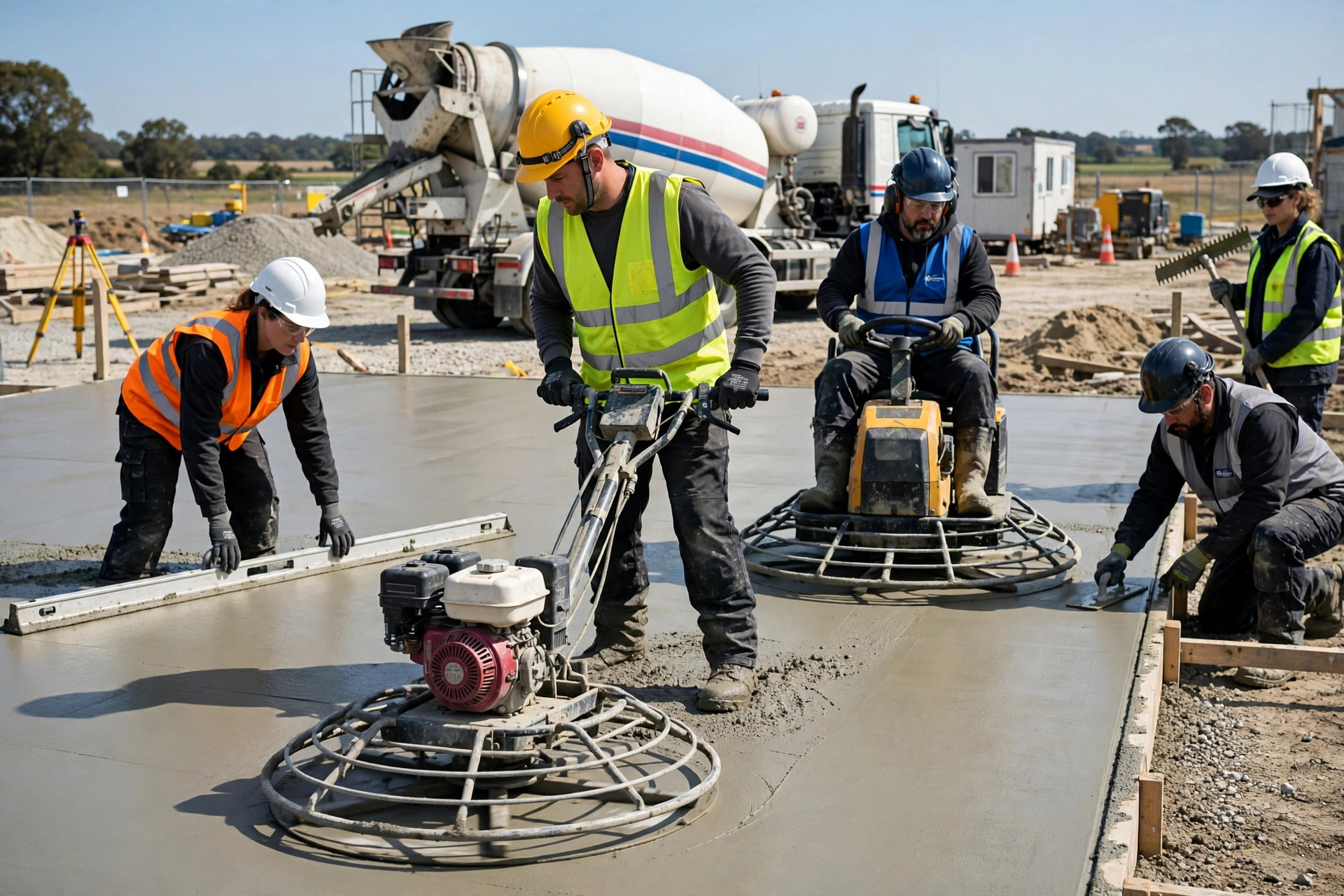
Concrete contracting looks like a simple trade from the curb — a truck, a crew, a slab — but the business underneath is one of the most cash-sensitive in construction. Materials are bought before the job pays, commercial clients pay on 30- to 60-day cycles, a share of the contract is commonly held back until completion, and the work itself is weather-bound: a rained-out pour is a crew paid for a day with nothing to bill. This guide covers what concrete contractors actually borrow for, what opening, growing, or equipping one costs in 2026, and which product fits each need.
The funding map for a concrete contractor splits into five buckets: covering materials and payroll on jobs that pay after completion, equipping crews and trucks, catching a commercial surge or a big pour, carrying insurance, licensing, and bonding costs, and adding a second crew or a pumping division. Each bucket has a different best product, and the single most important underwriting fact in all five is timing: the contractor pays first and gets paid last, so the product has to match the gap, not just the amount.
What concrete contractors borrow for
Materials and payroll float. The most common first funding need. Ready-mix concrete in 2026 runs roughly $125 to $175 per cubic yard for material, with the average band in North Carolina and Virginia around $135 to $148 per yard for 3,000 PSI — and the supplier wants payment on delivery or on short terms while the client pays weeks later. A working-capital advance or line of credit sized to the average job pipeline is what keeps crews working between the batch plant invoice and the final check.
Trucks, pumps, and finishing equipment. The capital-heavy route. A new concrete mixer truck typically runs $150,000 to $250,000 or more; quality used mixers run $30,000 to $150,000 depending on age, drum condition, and hours. A trailer-mounted concrete pump starts around $30,000, while larger boom pumps pass $200,000. Forms run $10,000 to $30,000 for a pour-in-place set, and a basic finishing package — power trowels, screeds, saws, vibrators — runs around $25,000. Equipment financing fits all of them because the machine itself secures the loan.
Commercial surges and big pours. A warehouse slab, a parking structure, or a municipal job can triple a month's materials bill before the first progress payment arrives. Funders weigh signed contracts and deposits collected heavily here: a contractor with a full month of booked work and deposits in hand typically qualifies for more than one with the same deposits but an empty schedule.
Insurance, licensing, and bonding. General liability and commercial vehicle coverage for a concrete operation runs roughly $20,000 a year in published startup estimates, before workers' compensation — and premiums are often due in lump sums. Licensing thresholds vary by state, and bonded public work can require bid, performance, and payment bonds that tie up capacity. Funding the premium before it is due, rather than after a cancellation notice, is cheaper than the lapse.
A second crew or a new division. Flatwork, decorative and stamped work, and pumping are different businesses sharing one yard. Each needs its own crew lead, its own equipment set, and a payroll float before its first invoice clears. Borrowing against the existing crew's deposits to fund the new crew's startup months is the classic way a growing concrete company starves its core work.
What it costs to open or grow a concrete contracting business in 2026
Published 2026 startup guides put a small concrete operation's equipment investment at $50,000 to $100,000, with comprehensive operations reaching $150,000 to $250,000 or more once trucks, pumps, and finishing equipment are included. A full ready-mix operation is a different scale entirely — $500,000 to over $1 million including trucks and a yard. The table below separates the contractor's world from the producer's: most contractors buy ready-mix by the yard and never own a batch plant.
Starting lean (flatwork crew, ready-mix delivered). A used pickup and trailer, forms, a power trowel, screeds, saws, vibrators, and hand tools: roughly $50,000 to $100,000 all-in, plus working capital. Renting forms and specialty tools for the first jobs keeps this band honest — buying a full form set before the backlog exists is how lean startups become equipment-rich and cash-poor.
Crew-ready (two crews, own finishing fleet). Add a second finishing package, a second truck and trailer, a trailer pump, and a larger form inventory: $150,000 to $250,000. This is the band where equipment financing earns its keep — each machine is financed against itself, so the yard does not swallow the working capital.
Ready-mix and pumping (producer scale). Mixer trucks at $150,000 to $250,000 new each, a yard, and a pump fleet. Published estimates for a full ready-mix startup run $500,000 to over $1 million. This is SBA, term-loan, and equipment-finance territory, not advance territory — the assets are long-lived and the contracts are long-dated.
The per-job math funders check. Installed residential flatwork lands around $6 to $12 per square foot in 2026 cost guides. Inside that number, published contractor estimating breakdowns put materials at roughly $2.42 to $8.47 per square foot and labor at $1.82 to $9.68, with formwork, reinforcement, finishing, curing, permits, and disposal layered on top. A quote that prices only the concrete is a quote that loses money on the pour — and a funder reading three months of statements can see the margin leak in the deposits.
Which product fits which need
Working capital advance or line of credit — the float. Best for materials and payroll between pour and payment. Size it to the average month's gap, not to the biggest job ever landed. A line that revolves is worth more than a lump sum here, because the gap opens and closes with every job.
Equipment financing — the machines. Best for mixer trucks, pumps, trowels, and saws. Terms follow the asset's life, the machine secures the loan, and used equipment finances routinely — lenders weigh age, condition, drum hours, and maintenance records. A used mixer at $75,000 to $100,000 with a documented drum and service history is often the best value in the yard.
Term loan — the yard, the expansion, the second division. Best for planned, one-time investments repaid on a fixed schedule: a leased yard build-out, a second crew's startup months, a pumping division. SBA loans fit here too, for larger, longer-horizon investments — but they take weeks to months, so they are the wrong tool for a Friday payroll emergency.
Merchant cash advance — the emergency only. Fits card-heavy businesses that need money in days. Most concrete contractors bill by check, ACH, or draw — not by card — so a daily-debit product priced off card volume is usually the wrong shape. If an advance is the only product that fits the timeline, size it to the specific gap and get the total repayment dollars in writing first.
How funders underwrite a concrete contractor
Deposits, not estimates. Average monthly deposits over the last 3 to 6 months, and their consistency, dominate the decision. A flat line beats a spike. Backlog helps — signed contracts, deposits collected, and a booked calendar — but only when the deposits corroborate the story.
The retainage and draw problem. Commercial work routinely holds back a percentage of each payment until completion, and draws arrive on the general contractor's schedule, not the concrete crew's. Funders who know construction underwrite the draw schedule, not the contract total: a $400,000 contract paying in four draws with retainage is not $400,000 of available cash flow.
Weather and seasonality. Cold-weather markets pour fewer months of the year, and a freeze can delay a pour by weeks. Funders ask how the slow season is covered — and the honest answer is a reserve built in the busy season, or a line drawn only in the slow months. Borrowing for a winter gap with a product priced for summer volume is the seasonal version of the same mistake.
Concentration and callbacks. One general contractor supplying most of the work is a concentration risk funders price in. Callback and warranty exposure matters too: a slab that cracks is a crew pulled off paying work. Clean statements, a diversified customer list, and a backlog that is booked rather than hoped-for are what move a concrete file from average to strong.
Comparing offers without getting burned
Total repayment dollars, always. Always get the total repayment dollars in writing before you sign — not just the factor rate or the monthly estimate. Two offers with the same advance amount can differ by thousands in total repayment, and the difference is pure cost.
Match the payment rhythm to the collection rhythm. Daily debits fit daily card sales. Weekly or monthly payments fit draw schedules. A daily debit against a 45-day draw cycle is a cash-flow mismatch that will show up in the statements within a month.
Watch the stack. A second advance on top of a first, without a payoff plan, is what breaks otherwise healthy contractors. The combined daily debit, not either advance alone, is what the crew's payroll has to survive.
Keep licensing and insurance current mid-term. A license lapse can void commercial contracts and trigger a funder review. Calendar every renewal and fund the premium before it is due, not after the cancellation notice.
What to do this week
Pull the last 3 months of business bank statements and read them the way a funder will: average monthly deposits, the biggest single deposit, the thinnest week, and every existing equipment payment. Then match the need to the product — float, machine, or expansion — and get two quotes compared on total repayment dollars. The contractor who knows the gap in dollars, and the draw schedule that created it, negotiates from strength; the contractor who asks for a round number negotiates from hope.
Frequently asked questions
How much does it cost to start a concrete contracting business?
A small flatwork operation starts at 50,000 to 100,000 dollars in equipment, with comprehensive operations reaching 150,000 to 250,000 dollars or more once trucks, pumps, and finishing equipment are included. A full ready-mix operation is a different scale at 500,000 dollars to over 1 million.
How much does a concrete mixer truck cost?
A new mixer truck typically runs 150,000 to 250,000 dollars or more, while quality used mixers run 30,000 to 150,000 dollars depending on age, drum condition, and hours. Drum condition and maintenance records matter more than mileage alone.
Do concrete contractors need bank statements to get funded?
Yes — your last 3 months of business bank statements are the core document, because funders underwrite from deposits. A photo ID and a voided check are optional, not required.
What equipment do concrete contractors finance most often?
Mixer trucks first, then pumps, power trowels, screeds, saws, and form sets. Equipment financing fits all of them because the machine itself secures the loan.
How do draw schedules affect concrete contractor funding?
Commercial work pays on draws with a percentage held back until completion, so funders underwrite the draw schedule rather than the contract total. A line of credit sized to the gap between pour and payment fits better than a lump sum priced as if the contract were cash in hand.
Adding a truck, a pump, or a second crew? See what you qualify for
From the first flatwork crew to the pumping division — get a no-obligation quote from our #1-ranked lender, Coast to Coast Fast Funding. One application reaches multiple funders, so you see the actual market for your file.
Apply Now →Soft credit check · 60-second pre-qualification