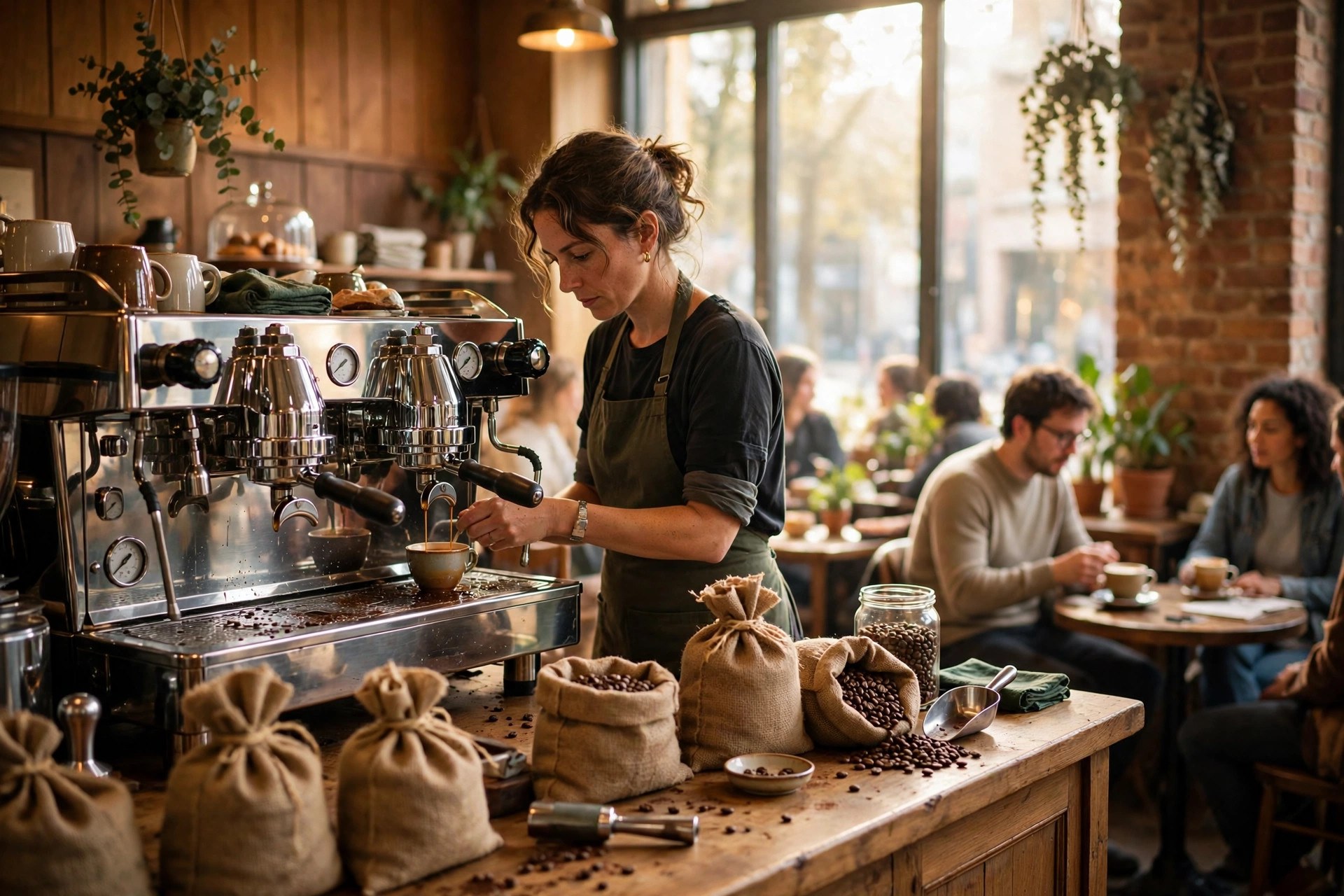
A coffee shop is not a bakery with better branding, and it is not a restaurant with a shorter menu. It is a drink-led business built around one expensive machine, a roaster relationship, and a morning rush that lasts about three hours. Get those three things right and a shop can run on some of the best gross margins in food service. Get the machine wrong — too small for the peak, too slow for the line — and every service hour of every day pays for the mistake. Coffee shop funding follows the same logic: the money should match the format, the machine, and the calendar that repays it.
The five cash demands of a coffee shop
First, the espresso machine and the bar. This is the business, not an accessory to it. A fully equipped coffee shop runs 20,000 to 80,000 dollars in equipment, with the core coffee setup — espresso machine, grinders, brewers — accounting for 8,000 to 50,000 dollars of that total. A commercial espresso machine alone runs 5,000 to 20,000 dollars, a quality grinder 1,500 to 3,500 dollars, a batch brewer 500 to 3,000 dollars, refrigeration 3,000 to 10,000 dollars, a point-of-sale system 1,000 to 3,000 dollars, and smallwares 1,000 to 3,000 dollars. The machine decision deserves more thought than any other line item: invest 40 to 50 percent of the equipment budget in the machine and grinder, because a 15,000 dollar machine with a 3,000 dollar grinder will outperform a 25,000 dollar machine with a 500 dollar grinder.
Second, the build-out. Converting raw retail space into a cafe with proper plumbing, ventilation, and finishes is usually the single largest startup cost, and it is the one most often underestimated. A sit-down cafe runs 80,000 to 350,000 dollars to open in the United States, with the build-out alone running roughly 150 to 300 dollars a square foot once plumbing, ventilation, and accessible restrooms are counted. A kiosk or cart, by contrast, can start at 25,000 to 75,000 dollars, and a drive-thru stand at 80,000 to 200,000 dollars. Format is the highest-leverage decision in the whole budget: the same menu served from three different formats can differ by more than 200,000 dollars in startup cost.
Third, the roaster and the bean bill. Green coffee prices move, roasters change, and a shop that has not locked in its supply learns about it on a Saturday morning. A good roaster trains staff, dials in the espresso on the shop's own machine, and delivers fast when beans run out. The bean bill is also where margins live or die: espresso drinks carry 60 to 80 percent gross margins in food service, the highest in the industry, but only if the shop is not over-portioning, wasting milk, or discounting its way out of a slow month.
Fourth, the morning rush and the dead afternoon. Coffee demand is brutally concentrated. The National Coffee Association's Fall 2026 survey found 66 percent of American adults had drunk coffee in the past day, but most of that drinking happens before noon. A shop that staffs for the 7 to 10 a.m. peak and carries that payroll into a dead 2 p.m. will bleed. The businesses that borrow well size repayment to the full-day average, not the morning peak — and they find afternoon revenue, from beans, merchandise, pastries, or catering, to fill the trough.
Fifth, the second location trap. The most common way a good coffee shop dies is opening shop number two before shop number one is truly profitable. A second lease doubles the fixed cost while the owner splits attention across two bars, two staffs, and two roaster deliveries. Lenders know this pattern and price it: a second-location file needs the first shop's statements showing real profit, not just busy mornings.
Need working capital this week?
Apply Now →Free to apply · Soft credit check only · Funding in 24–72 hoursThe product map: what fits which need
Equipment financing fits the espresso machine, grinders, and brewers, because the asset secures the loan and the term matches its working life. A machine that will pull shots for a decade should not be repaid in six months on a daily-debit advance. A line of credit fits the bean bill, the seasonal inventory build, and the gap between a catering deposit and the event. A revenue-based advance fits a single fast gap with a defined collection event — a machine replacement before a holiday rush, a build-out deposit on a signed lease — and it fits coffee shops better than most businesses, because repayment flexes with card volume in percentage-split deals. A term loan fits the build-out itself or a second location that the first shop's numbers already justify. An SBA-backed loan fits a full acquisition or a major build-out, on a timeline of weeks to months, not days.
What lenders check on a coffee shop file
Underwriting starts with the format and the machine. A kiosk file is underwritten on the location agreement and the operator's history; a full cafe file is underwritten on the lease, the build-out budget, and the deposit history. For an existing shop, three months of business bank statements are the core document, and they tell the story the application cannot: the morning peak, the afternoon trough, the bean bill, and whether the owner is already carrying an advance. Lenders also look at time in business, deposit consistency, existing advance positions, and — for larger term loans — broader financials. Credit matters less for revenue-based products than deposit health does, but it still moves the price. A photo ID and a voided check may be requested as optional verification items, but they are not upfront requirements for getting a quote.
Two numbers matter more for coffee shops than for most borrowers. The first is cups per day against machine capacity: a one-group machine rated for under 100 drinks a day will choke on a 250-drink morning, and a lender that understands the bar will ask about it. The second is average ticket: a shop selling 4 dollar drip coffee needs twice the volume of a shop selling 8 dollar signature drinks, and the funding amount should reflect that math, not just the monthly deposit total.
Three mistakes coffee shops make when borrowing
Buying the machine on a daily-debit advance. A 20,000 dollar machine repaid in daily debits over six months will cost more in cash-flow stress than the machine is worth. Match the term to the asset: equipment financing for equipment, always.
Sizing the loan to the morning. A shop that borrows against its best month and repays through its slowest will be in trouble by February. Size every repayment to the slowest month on the statements, not the best one.
Opening the second shop on the first shop's buzz. Lines out the door are not profit. If the first shop's statements do not show real, repeatable profit after rent, payroll, and beans, the second location is a second burn rate, not a second income.
Frequently asked questions
Can a coffee shop get a business loan?
Yes. Coffee shops qualify for lines of credit, revenue-based advances, equipment financing, and term loans through third-party funders, based on deposits, time in business, the format, and the equipment file. An existing shop's bank statements do most of the underwriting work.
What do lenders check for coffee shop funding?
The format and the machine first, then deposits and time in business. A kiosk file turns on the location agreement; a full cafe file turns on the lease and build-out budget. Lenders also check cups per day against machine capacity and the average ticket, because a shop selling four-dollar drip needs twice the volume of a shop selling eight-dollar signature drinks.
How fast can a coffee shop get funded?
Revenue-based products typically fund in 24 to 72 hours from a complete application, once bank statements are verified. Equipment financing takes days to weeks, and SBA-backed loans for acquisitions or build-outs take longer.
Is a merchant cash advance good for a coffee shop?
It can be, for a single fast gap with a defined collection event, such as replacing a failed espresso machine before a holiday rush. For the machine itself, equipment financing fits better, because the term matches the asset's working life and daily debits do not pause for a slow afternoon.
What documents does a coffee shop need to apply?
Recent business bank statements, typically the last three months, are the core requirement. A photo ID and a voided check may be requested as optional verification items, but they are not upfront requirements for getting a quote. A lease or location agreement and equipment quotes help where available.
How much funding can a coffee shop get?
It depends on revenue, seasonality, and the product: revenue-based advances are usually sized as a multiple of monthly revenue, while lines, equipment loans, and term loans depend on the broader file. Ask for the total repayment in dollars before accepting any offer. Kiosks start around 25,000 to 75,000 dollars all-in, while a full cafe with seating runs 80,000 to 350,000 dollars to open.
The best offer is the one you compare
Get a no-obligation quote from our #1-ranked lender, Coast to Coast Fast Funding — $5K to $5M, MCA and revenue-based products that fund in 24–72 hours with soft-pull-only applications. We shop 75+ lenders so you can compare the true cost of every offer side by side.Apply Now →Soft credit check · 60-second pre-qualification · (352) 809-3201