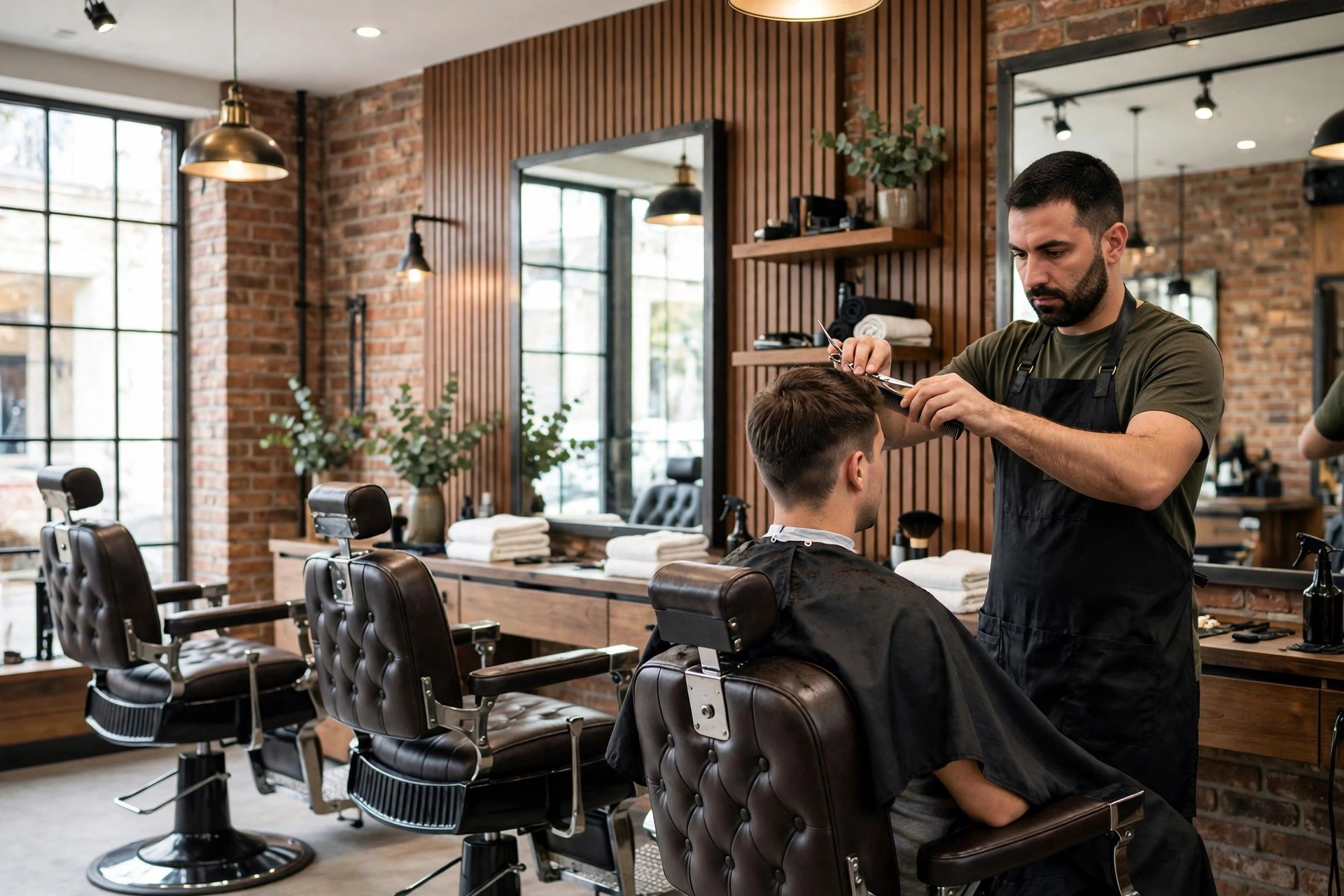
A barbershop can open on eight thousand dollars or on two hundred thousand, and both figures answer the same question honestly. What splits them apart is not the neighborhood or a lucky lease. It is one decision made before a single chair gets bolted to the floor: whether the barbers working there rent their own station and bring their own tools, insurance, and client list, or whether the shop hires them, pays a wage or commission, and carries the overhead itself. Booth rental keeps the shop lean and the owner's fixed costs low. Commission keeps control of pricing and the client experience, but it makes payroll the shop's problem every week. Every funding decision after that follows from the model chosen first.
The five cash demands of a barbershop
First, the chairs and stations. Professional barber chairs run 300 to 1,500 dollars each at the standard range, and 500 to 2,500 dollars each once high-end hydraulics enter the picture. Full stations and tools push the equipment total to 5,000 to 15,000 dollars for a typical shop, before a dollar of furniture or decor. Chairs are the one purchase a shop should never cheap out on: a barber spends the whole day in one, and a failing hydraulic in week three costs more in lost bookings than the upgrade would have.
Second, the build-out. Minor renovations and light construction — sinks, counters, lighting, plumbing for wash stations — run 8,000 to 30,000 dollars, and full build-outs run 30 to 100 dollars per square foot. A shop moving into existing retail space with plumbing already in place lands at the lean end; a raw space needing wash stations, waiting areas, and code-compliant ventilation lands at the other.
Third, the opening float. Lease deposits run 6,000 to 20,000 dollars, opening product inventory runs 650 to 1,500 dollars, furniture and waiting-area decor runs 2,000 to 10,000 dollars, and licenses, permits, registration, and insurance run 3,000 to 5,000 dollars. Put together, the lean one-time package lands between 8,000 and 25,000 dollars — and a commission shop that also banks its team's first month or two of payroll pushes toward 25,000 to 200,000 dollars.
Fourth, the slow-chair month. A shop with empty chairs still pays rent, utilities, laundry, and software. The capacity math is unforgiving: a barber cutting 3 clients an hour across 4 peak hours a day, 5 days a week, holds 60 weekly slots, and at a 30 dollar ticket that is 1,800 dollars a week gross per chair — before rent, product, or splits. A month where two chairs sit half-empty is a working-capital problem, not a quality problem, and it is the most common reason an otherwise good shop reaches for funding.
Fifth, the second shop or the franchise step. A proven shop expanding to a second location, or a barber buying into a franchise, faces the full startup package again — 75,000 to 200,000 dollars for a franchise or larger build-out — plus franchise fees around 25,000 dollars where they apply. This is term-loan territory, not advance territory: the money buys a durable asset with years of earnings ahead of it.
The booth-rent versus commission decision, in numbers
Under booth rental, each barber pays a flat fee for the chair — typically 200 to 1,500 dollars a month depending on the market, often quoted by the week at 200 to 225 dollars — and supplies their own clippers, blades, chair-side product, and liability coverage. The shop's income is rent, predictable and decoupled from ticket volume, and the shop's costs stay low. The trade-off is control: the shop does not set the renter's prices or keep the renter's client list, and a renter who leaves takes their book with them.
Under commission, barbers earn 30 to 70 percent of their ticket, and the shop keeps the rest plus retail. The shop controls pricing, booking, and the client experience, and it keeps the client list — but it carries payroll, product, laundry, and the slow weeks. Well-managed shops run 10 to 20 percent profit margins, the average owner profit lands around 35,000 dollars a year, and owners with several chairs report 70,000 dollars and higher. The funding implication is direct: a booth-rental shop borrows for the room, while a commission shop borrows for the room plus the payroll float, and lenders underwrite those two files very differently.
Need working capital this week?
Apply Now →Free to apply · Soft credit check only · Funding in 24–72 hoursThe product map: what fits which need
Chairs, stations, and shop equipment fit equipment financing, where the asset secures the loan and the term matches its working life — and where a lender can underwrite a 2,500 dollar chair without asking the shop to pledge its lease. A build-out fits a term loan when the space will pay for itself over years, or a line of credit when the work is phased and the draws come in stages.
The slow-chair month fits a business line of credit drawn when chairs sit empty and repaid when bookings recover — the only product on this list whose repayment genuinely flexes with the shop's calendar. A revenue-based advance fits a single fast gap with a defined collection event, such as replacing a failed chair before a booked-out weekend or stocking retail ahead of the holidays. What does not fit is borrowing permanent payroll on a daily-debit advance: debits do not pause for a slow month, and a commission shop's payroll is permanent.
A second location or franchise purchase fits a term loan sized to the new shop's projected revenue, with the build-out budget, franchise fee, and opening float in one file. Start that conversation before the lease is signed: term underwriting takes weeks, and a signed lease with no funding in motion is the most expensive negotiating position a barber can hold.
What lenders check on a barbershop file
Barbershop underwriting starts with the model: booth rental or commission, how many chairs, and what each chair actually produces. A bookings history — walk-ins plus appointments, chair utilization, average ticket — is often the strongest part of the file, because it shows whether the shop's revenue is a real book or a hope. Licenses matter too: every barber holds a state license earned through schooling and a board exam, and the shop itself carries an establishment license, so a file with licensing gaps reads as a risk file before the numbers are even opened.
Then the statements. Recent business bank statements, typically the last three months, are the core requirement, and for a barbershop they tell the model story: steady booth-rent deposits read differently from lumpy commission weeks, and a lender that understands the difference prices the file better. A photo ID and a voided check may be requested as optional verification items, but they are not upfront requirements for getting a quote. For larger term loans, tax returns and a build-out budget join the file.
Three mistakes barbershops make when borrowing
Buying all the chairs on day one. Start with the chairs the book can fill — one or two for a small shop, four to eight for a mid-range shop — and add stations as bookings justify them. Empty chairs cost rent, not revenue.
Funding payroll with an advance. A daily-debit product repays out of the same slow weeks it was meant to cover. Payroll belongs on a line of credit or on retained earnings, never on a short-term advance.
Pricing to the cheapest shop on the block. Cuts run 20 to 90 dollars depending on market, service, and experience, and a shop that prices below its cost structure cannot service any loan, however cheap. Raise prices 10 to 15 percent when prime hours hit 75 percent utilization — demand is telling you the price is wrong.
Frequently asked questions
Can a barbershop get a business loan?
Yes. Barbershops qualify for lines of credit, revenue-based advances, equipment financing, and term loans through third-party funders, based on bookings, chair utilization, the booth-rental or commission model, bank statements, and license standing. A bookings history is often the strongest part of the file.
What do lenders check for barbershop funding?
The staffing model and what each chair actually produces, bookings and average ticket, license standing for the barbers and the shop, and bank statement health. Steady booth-rent deposits read differently from lumpy commission weeks, and a lender that understands the difference prices the file better.
How fast can a barbershop get funded?
Revenue-based products typically fund in 24 to 72 hours from a complete application, once bank statements are verified. Equipment financing takes days to weeks, and SBA-backed loans for acquisitions or build-outs take longer.
Is a merchant cash advance good for a barbershop?
It can be, for a single fast gap with a defined collection event, such as replacing a failed chair before a booked-out weekend. For permanent costs like commission payroll, a line of credit usually fits better, because daily debits do not pause for a slow month.
What documents does a barbershop need to apply?
Recent business bank statements, typically the last three months, are the core requirement. A photo ID and a voided check may be requested as optional verification items, but they are not upfront requirements for getting a quote. Booking records and license documentation help where available.
How much funding can a barbershop get?
It depends on revenue, seasonality, and the product: revenue-based advances are usually sized as a multiple of monthly revenue, while lines, equipment loans, and term loans depend on the broader file. Ask for the total repayment in dollars before accepting any offer.
The best offer is the one you compare
Get a no-obligation quote from our #1-ranked lender, Coast to Coast Fast Funding — $5K to $5M, MCA and revenue-based products that fund in 24–72 hours with soft-pull-only applications. We shop 75+ lenders so you can compare the true cost of every offer side by side.Apply Now →Soft credit check · 60-second pre-qualification · (352) 809-3201