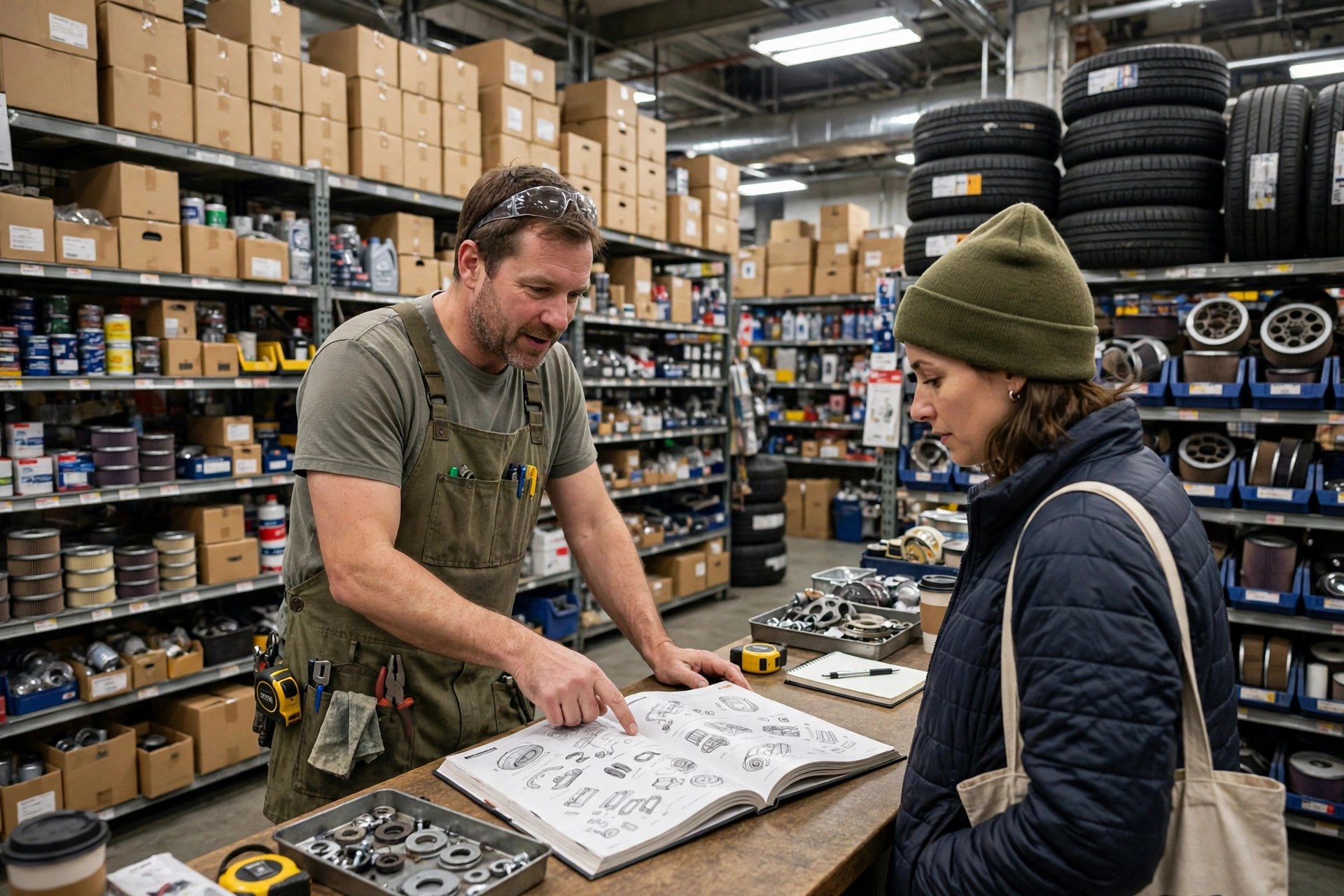
An auto parts business is an inventory business wearing a storefront. Thousands of SKUs, from $4 filters to $4,000 transmissions. Wholesale accounts that pay on net-30 or net-60 terms. Retail customers who need the part today, not next week. And suppliers who offer a discount for paying early and a penalty, in lost fill rate, for paying late. When the shelves are thin, the shop down the street gets the job — and the wholesale account that would have ordered twice a month orders once.
That is why parts businesses borrow differently from the shops they supply. The funding question is rarely "can I make payroll this week" and usually "can I carry the inventory depth that wins the account, on terms that do not eat the margin." This guide covers the products that fit each version of that question, for retail counters, wholesale distributors, and online parts sellers.
Why parts businesses need capital in the first place
Five cash demands stack up in a parts business, and they peak at different times. Inventory depth is the first: a store that stocks only fast movers loses the job to the competitor who stocks the slow mover, but every slow mover on the shelf is cash sitting still. Seasonality is the second: batteries and wipers before winter, air-conditioning parts before summer, filters and fluids around every oil-change cycle — demand surges that must be stocked before they arrive. Wholesale receivables are the third: repair shops and fleets buy on account and pay in 30 to 60 days, so the distributor funds the gap between paying the supplier and collecting from the shop. Growth is the fourth: a second counter, a delivery territory, or an online storefront all cost money months before they produce it. And equipment is the fifth: delivery vehicles, warehouse racking, forklifts, and inventory systems are lumpy purchases that do not fit a monthly budget.
The common mistake is financing all five with one product. Inventory that turns four times a year should not be financed with a daily-debit advance priced for a 90-day need, and a delivery van should not be financed with a working capital line that could have funded the next stocking cycle. Match the money to the asset's life, and the margins survive.
The five products, matched to parts-business needs
1. Business line of credit — the workhorse
A revolving line is the natural fit for inventory and receivables: draw to stock up before a seasonal surge or to cover a wholesale account's payment gap, repay as the stock sells and the accounts collect, draw again for the next cycle. You pay interest only on what you draw, and the line is there when a supplier offers early-payment terms or a distressed competitor's stock comes up for sale. Lines for parts businesses commonly run from $25,000 to $500,000 depending on revenue and history, and approval typically takes days to a week. The discipline it demands is real: a line used to cover operating losses becomes permanent debt, and lenders review lines annually — a year of declining turns can shrink the limit at the worst moment.
2. Equipment financing — vans, racking, and warehouse gear
Delivery vehicles, forklifts, pallet racking, and warehouse systems are financed against themselves: the asset secures the loan, which keeps pricing lower than unsecured money, and the term can run to the asset's useful life. A delivery van financed over four to five years costs less per month than the same van on a short advance, and it leaves the credit line free for inventory. For a distributor adding a territory, the usual package is a van plus a racking build-out financed together, with working capital from the line covering the first stocking cycle.
3. Term loans — expansion, second locations, and acquisitions
A second counter, a warehouse expansion, or buying out a retiring competitor's store is a multi-year investment, and it should be financed as one: a term loan with monthly payments over two to five years, or an SBA-backed loan up to $5 million for larger acquisitions and owner-occupied property. Term loans take longer to approve — weeks for online lenders, longer for SBA — and they want stronger files: a year or more of history, tax returns, and a clear use of funds. Start the application before the lease is signed, not after.
4. Revenue-based advances — fast restocks, used sparingly
An advance funds in 24 to 72 hours and qualifies on deposits, which makes it the right tool for a short, specific need: a supplier's limited-time discount on a fast-moving line, a fleet account's opening order that must be filled this week, a breakdown in the delivery fleet that cannot wait for a term loan. It is the wrong tool for carrying inventory month after month, because the daily or weekly debit does not pause while the stock sits. Rule of thumb for parts businesses: if the stock will not sell within the advance's repayment window, do not finance it with an advance.
5. SBA-backed loans — the big, slow, cheap option
For acquisitions, major build-outs, and owner-occupied warehouses, SBA-backed loans offer the longest terms and lowest pricing a parts business will see — at the cost of time (weeks to months), paperwork, and collateral requirements. If the need is a property or a business purchase, the SBA timeline is worth planning around. If the need is next month's stock, it is not.
| Need | Best-fit product | Typical speed | Watch out for |
|---|---|---|---|
| Seasonal stock-up / wholesale receivables gap | Business line of credit | Days to a week | Using the line to cover losses |
| Delivery van, forklift, racking | Equipment financing | Days | Financing short-life gear on long terms |
| Second location / acquisition | Term loan or SBA-backed loan | Weeks to months | Starting the application too late |
| Urgent restock / supplier discount deadline | Revenue-based advance | 24 to 72 hours | Daily debits on slow-moving stock |
| Warehouse purchase | SBA-backed loan | Months | Collateral and personal guarantee terms |
Retail counter, wholesale distributor, or online seller — the file differs
Retail counters live on card sales and walk-in traffic, so their files look like a typical retail funding file: deposits, seasonality, and location matter most, and revenue-based products price cleanly off card volume. Wholesale distributors live on receivables: lenders will read the accounts-receivable aging report closely — how much is current, how much is 60-plus days, and whether any single shop dominates the book. A distributor whose top three accounts are half the receivables is a concentration risk, and pricing reflects it. Online parts sellers live on marketplace and platform payouts: lenders want to see payout statements and return rates alongside bank deposits, because platform holds and return reserves change what the deposits mean. In all three cases, the application itself is the same — a short form and three months of business bank statements, with a photo ID and a voided check as optional verification items — but the supporting story you tell with it should match your model.
Stocking up before the season turns?
Apply Now →Free to apply · Soft credit check only · Funding in 24–72 hoursWhat lenders check on a parts-business file
- Inventory turn and obsolescence. How fast stock sells, and how much of it is dead — parts for models that stopped selling. A shelf full of obsolete SKUs is a lender's warning sign, and clearing it before applying can change the offer.
- Supplier terms. Net-30, net-60, or early-payment discounts — and whether you actually take them. A business that pays suppliers late while asking for growth capital raises a question the file must answer.
- Receivables aging. For distributors, the aging report is the second bank statement. Current receivables support a line; a book full of 90-day balances supports a smaller one.
- Revenue trend and seasonality. Lenders expect parts revenue to be seasonal. What they want is a clean seasonal pattern, not a declining one — show the same quarter year over year, not just the last three months.
- Deposit mix. Card sales, wholesale checks, platform payouts — each tells a different story about stability. Mixed, documented revenue underwrites better than a single unexplained deposit stream.
Five funding mistakes parts businesses make
- Financing slow stock with fast money. A daily-debit advance for parts that turn twice a year guarantees a cash squeeze. Match the term to the turn.
- Borrowing against a peak month. Size the facility to the average month, not the best one. A line sized to December will be overdrawn by March.
- Ignoring obsolescence. Every dollar in dead stock is a dollar that cannot be borrowed against and cannot be sold. Write it down, clear it, and show the lender a clean shelf.
- Letting one account dominate. A wholesale book where one fleet or chain is half of receivables is a single point of failure. Diversify before you borrow against it.
- Skipping the supplier discount math. A 2% early-payment discount is worth roughly 36% annualized on a 30-day cycle. If a line of credit costs less than the discount it captures, drawing the line is profitable — run that comparison before declining it.
Frequently asked questions
Can an auto parts store get a business loan?
Yes. Parts retailers, wholesale distributors, and online sellers can qualify for lines of credit, term loans, SBA-backed loans, equipment financing, and revenue-based advances, depending on revenue, time in business, inventory health, and credit. Stores with steady deposits and clean receivables aging qualify most easily.
How much can an auto parts business borrow?
It tracks revenue, inventory turn, and file strength. Working capital lines for parts businesses commonly run $25,000 to $500,000, term loans $25,000 to $500,000, equipment financing to the asset's value, and SBA-backed loans up to $5 million for acquisitions and property. The approved amount follows trailing-twelve-month revenue, not the best month.
What is the best financing for auto parts inventory?
Usually a business line of credit: it flexes with stocking cycles, you pay only on what you draw, and repayment follows sales as stock turns. Revenue-based advances fit urgent, short restocks; they are a poor fit for carrying slow-moving inventory month after month.
What documents does an auto parts funding application need?
Usually a short application and the last three months of business bank statements. Distributors should also have an accounts-receivable aging report ready, and online sellers their platform payout statements. A photo ID and a voided check are optional verification items, not upfront requirements.
Can a new auto parts store get funded?
Revenue-based products can work with as little as six months of deposit history, and sometimes less if deposits are strong. Bank term loans and SBA loans generally want one to two years of history and tax returns. A brand-new store with no sales history will usually need to trade for a few months before it qualifies.
How fast can an auto parts business get funded?
Revenue-based advances and some online lines fund in 24 to 72 hours. Online term loans typically take a few days to a week, equipment financing days, and SBA-backed loans weeks to months. Match the product to the deadline.
The best offer is the one you compare
Get a no-obligation quote from our #1-ranked lender, Coast to Coast Fast Funding — $5K to $5M, MCA and revenue-based products that fund in 24–72 hours with soft-pull-only applications. We shop 75+ lenders so you can compare the true cost of every offer side by side.Apply Now →Soft credit check · 60-second pre-qualification · (352) 809-3201